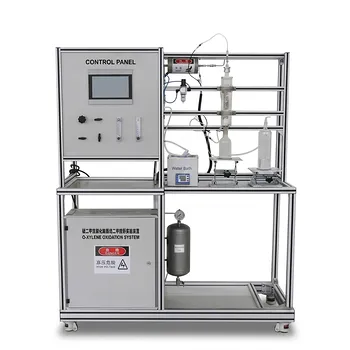
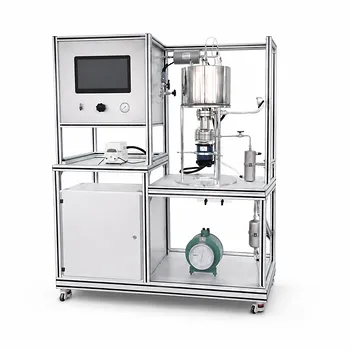
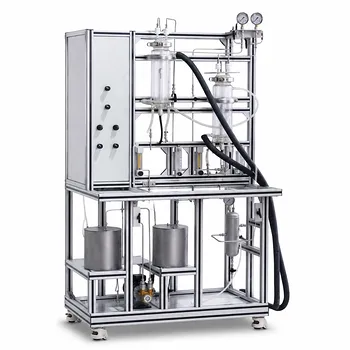
The primary reactor consideration for this pilot plant is managing precise thermal control within a tubular packed-bed reactor, while the dominant safety requirement is the comprehensive containment of a highly toxic mercury-based catalyst. For demonstrating the acetylene-based route to vinyl chloride monomer (VCM), the process uses hydrogen chloride and acetylene gas reacted over a mercuric chloride (HgCl₂) catalyst on an active carbon support at 100°C to 180°C. Your pilot plant design must center on extracting heat from this exothermic reaction to prevent catalyst deactivation by volatilization, while simultaneously ensuring that all equipment from the reactor to the product recovery system prevents any release of mercury into the teaching environment.
Successfully operating an acetylene-to-VCM pilot plant is fundamentally a challenge of precision temperature control to protect a fragile catalyst and rigorous material selection to contain two distinct hazards: the extreme toxicity of the mercuric chloride catalyst and the explosive potential of the acetylene feedstock.
Designing the Catalytic Reactor for Stability and Control
The core of your demonstration unit is a reactor whose design must solve the problem of rapid catalyst failure. Without precise thermal management, the educational value of the unit is lost as the reaction quickly stops or becomes dangerous.
The Tubular Fixed-Bed Design
A tubular, fixed-bed reactor is the standard choice for this heterogeneous catalytic reaction. The acetylene and hydrogen chloride gases flow through tubes packed with the solid catalyst.
This configuration provides a high surface area for the reaction to take place. The fixed bed also lets students study pressure drop and flow distribution as critical parameters in reactor design.
Precision Temperature Control is Mission-Critical
The reaction is highly exothermic, and the mercuric chloride catalyst is extremely sensitive to high temperatures. Allowing the bed to overheat past 180°C causes the active mercuric chloride to volatilize, permanently destroying catalyst activity and creating a toxic mercury vapor hazard.
Hot spots form where heat generation outpaces cooling. Your reactor must therefore integrate a multi-point temperature sensing array within the catalyst bed itself, tied to a rapid-response cooling system—typically a jacketed vessel with circulating thermal oil—to maintain a stable, uniform temperature profile.
Balancing Conversion with Catalyst Lifetime
There is a direct trade-off between achieving a high single-pass conversion of acetylene and extending the life of the catalyst. Pushing for maximum conversion often requires running at the upper end of the temperature range, which accelerates catalyst deactivation.
This pilot plant setup is an ideal platform to teach this critical industrial balance. By varying flow rates and temperatures, students can collect data on catalyst deactivation kinetics and see the economic consequences of process intensification.
Managing the Scale of a Mercury-Based Hazard
Beyond the reactor, every subsequent process unit is part of a safety-critical containment strategy. The standard separation process after the reactor presents a unique set of low-temperature material challenges.
The Complete Containment Strategy
The toxicity of mercury is the overriding safety consideration. A pilot-scale setup must be treated as a closed loop where no mercury or VCM can escape into the laboratory.
This requires robust exhaust scrubbing systems on all vents and a gas detection system for VCM and mercury vapor. The entire system must be sealed, with leak-testing protocols treated as a standard pre-startup procedure.
Material Integrity at Low Temperatures
After the reactor, the product stream is cooled to separate the VCM from unreacted feedstocks. This involves handling a rich VCM stream at cryogenic temperatures, around -16°C.
Material selection must account for this cold-temperature embrittlement risk. Standard carbon steel piping and vessels used for dry VCM must be rated for low-temperature service to prevent brittle fracture.
Understanding the Risks: Materials and Procedural Pitfalls
The intersection of the chemical process and the physical plant creates hazards that demand specific, non-negotiable design choices. Two of the most critical involve the piping system itself and preventing moisture ingress.
The Absolute Prohibition on Copper and Its Alloys
Copper must be eliminated from every component that could contact the process stream. Any trace of copper in piping, valves, gaskets, or instrument fittings will react with acetylene to form copper acetylide.
Copper acetylide is a primary explosive that is shock- and friction-sensitive. Its formation is a catastrophic risk, so material specifications must exclusively call for robust materials like stainless steel, with chemically inert gaskets such as Teflon (PTFE).
Preventing Corrosion from Moisture Contamination
While steel is the correct base material for VCM piping, it is vulnerable to severe corrosion if the system becomes wet. Trace moisture can react with hydrogen chloride to form hydrochloric acid, rapidly attacking the piping from the inside.
A rigorous dry-down procedure using an inert gas like nitrogen is mandatory before introducing acetylene or HCl. The pilot plant's operational protocol must be as critical a learning outcome for students as the reaction chemistry itself.
Making the Right Choice for Your Pilot Plant Goal
Configuring this pilot plant requires prioritizing which educational and operational goals are most important, as there are inherent trade-offs between demonstrating chemistry, ensuring safety, and managing complexity.
- If your primary focus is demonstrating catalytic reaction engineering: Choose the acetylene route with a single tubular reactor, but invest heavily in a multi-zone temperature control and data acquisition system to make the catalyst deactivation problem visible and quantifiable for students.
- If your primary focus is teaching industrial-scale safety and materials science: The acetylene route is your only option for this specific chemistry, so build your curriculum around a "safety case" approach, detailing the rationale behind every material specification, from the Teflon gaskets to the all-steel piping and the mercury scrubbers.
- If your primary focus is comparing vinyl chloride production pathways: Augment this acetylene unit with a second ethylene-based train to let students directly measure the trade-offs between the acetylene route's toxic catalyst management and the ethylene route's high-temperature, high-pressure, and corrosive materials challenges.
Designing this pilot plant is an exercise in creating a safely bounded failure space where students can observe how a single chemical hazard—the mercury catalyst—dictates nearly every aspect of the thermal, mechanical, and procedural design.
Summary Table:
| Process Aspect | Key Challenge / Risk | Engineering Solution |
|---|---|---|
| Reactor Control | Catalyst deactivation & volatilization (>180°C) | Jacketed tubular fixed-bed reactor with thermal oil & multi-point temperature sensors |
| Mercury Hazard | Extreme toxicity of mercuric chloride catalyst | Sealed closed-loop design with VCM/mercury gas detection & exhaust scrubbers |
| Piping Materials | Explosive copper acetylide formation | Complete elimination of copper; use of stainless steel & PTFE gaskets |
| Moisture Ingress | Corrosive hydrochloric acid formation | Nitrogen gas purge and dry-down protocol before start-up |
Bring Industrial-Scale Precision and Safety to Your Lab with LABPARK
Designing pilot plants for hazardous chemical synthesis requires rigorous engineering and absolute safety. LABPARK provides premium Educational and Vocational Unit Operations Pilot Plants in chemical engineering, bioprocess & biotech, and environmental & water treatment.
We help universities, research institutes, and enterprises bridge the gap between theory and industrial practice with systems engineered to the highest safety and control standards.
Ready to upgrade your laboratory with high-performance pilot plants? Contact LABPARK today to discuss your project requirements with our engineering team.
Related Products
- Tubular Reactor Flow Characteristics Determination Educational Unit Operations Pilot Plant
- Residence Time Distribution and Reactor Flow Characteristics Determination Educational Pilot Plant
- Educational Unit Operations Pilot Plant for Intraparticle Diffusion Effective Factor Measurement
- Methane Cracking Educational Unit Operations Pilot Plant
- Methanol Synthesis and Catalyst Performance Evaluation Educational Unit Operations Pilot Plant
People Also Ask
- How do educational unit operations pilot plants address safety and waste management when scaling up?
- How do educational unit operations pilot plants bridge theory and design? Bridge the Engineering Gap
- What are the formulas for single-pass vs overall conversion in pilot plants? Master reactor mass balances
- How Do Pilot Plants Teach Limiting Reactants, Yield, & Selectivity? Real-World ChE Practice
- Why are implicit numerical methods preferred for stiff kinetics? Optimize Reactor Simulation