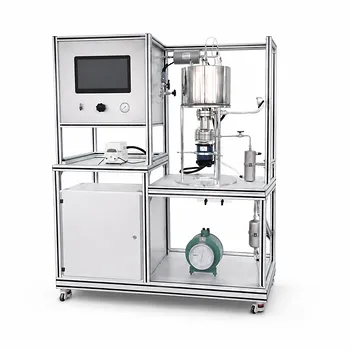
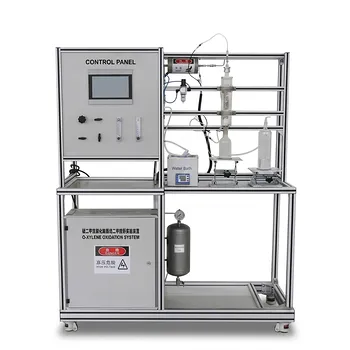
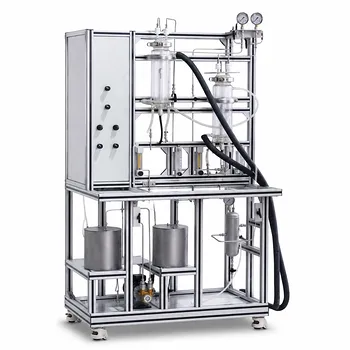
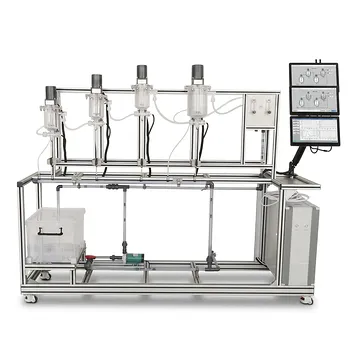
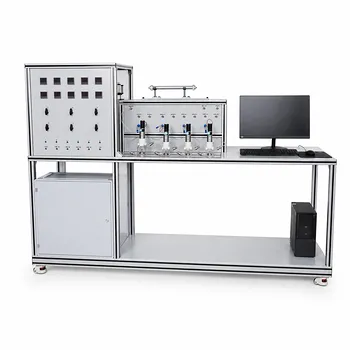
Immobilized homogeneous catalysts bridge the gap between molecular precision and industrial practicality, but their successful evaluation demands a pilot plant strategy that exposes their Achilles’ heel: metal leaching. The two reactor configurations you must demonstrate are the fixed bed and the slurry reactor. The primary operational challenge to study is metal leaching—the gradual detachment and dissolution of the active metal complex from its solid support. Your pilot plant must be equipped to monitor this loss of active species and to test mitigation techniques, most critically a downstream guard bed packed with fresh adsorbent resin that captures leached complexes and can later be recycled as the main catalyst bed.
Pilot plants for immobilized homogeneous catalysts must be designed to continuously track stability and activity. Fixed bed and slurry reactors are the essential configurations, while a guard bed with exchangeable resin is the most powerful tool for demonstrating how to capture leached metal complexes and convert a costly problem into a resource.
Reactor Configurations for Long-Term Evaluation
When you anchor a homogeneous catalyst onto a solid support, you transform a single‑phase system into a heterogeneous one. The reactor choice dictates how you observe stability, deactivation, and mass transfer.
Fixed Bed: The Steady‑State Workhorse
A fixed bed reactor holds the catalyst particles in a stationary packed column. It is ideal for continuous operation and straightforward product/catalyst separation.
Because the liquid streams flow through a static bed, you can mimic industrial scale‑up conditions and monitor activity decline over hundreds of hours. However, you must watch for channeling and pressure drop build‑up, especially if catalyst particles degrade or fines accumulate.
Slurry Reactors: Maximizing Contact and Flexibility
A slurry reactor suspends fine catalyst particles in the liquid phase via mechanical agitation. This configuration delivers excellent mass transfer and temperature control, making it perfect for studying fast reactions and deactivation kinetics.
The penalty is that you need a robust filtration step to separate the catalyst from the product. You must also evaluate catalyst attrition caused by impeller shear—something a pilot plant can directly quantify by measuring particle size distribution over time.
The Primary Challenge: Demonstrating Metal Leaching
Even a perfectly anchored metal complex does not stay put indefinitely. Leaching is the dominant failure mode for immobilized homogeneous catalysts, and your pilot plant must be designed to expose it.
Why Leaching Dismantles Performance
The bond between the metal centre and the support—whether it is a covalent linker or an ionic interaction—can cleave under reaction conditions. Once dissolved in the liquid phase, the precious metal is lost, causing a slow, irreversible drop in conversion and contaminating the product.
Ignoring leaching means you will never understand the true catalyst lifetime, nor will you be able to design an economic process for recovering the metal.
Monitoring Leaching in Real Time
Off‑line sampling can distort results because cooling may shift equilibrium or re‑precipitate metal species. A modern pilot plant should use in‑situ analytical instruments—such as inline UV‑vis or ICP‑OES flow cells—to track dissolved metal concentration continuously.
This real‑time data reveals the exact onset of leaching, which you can then correlate with temperature, space velocity, or reaction cycle. It is the only way to build a reliable kinetic model that includes deactivation.
The Guard Bed Strategy: Turning Waste into Feedstock
The most instructive mitigation concept to demonstrate is a guard bed filled with a fresh adsorbent resin placed immediately downstream of the main reactor. The resin selectively captures the leached homogeneous complexes before they reach the product stream.
Once the main catalyst bed has lost enough activity, the guard bed—now saturated with active complex—can be swapped into the main reactor position, and a new guard bed is loaded. This turns leaching from a liability into a circular catalyst management strategy, and it teaches the principles of process intensification in a tangible way.
Additional Operational Challenges
While leaching is the headline, a thorough pilot‑plant curriculum must also address the physical realities that arise when a once‑homogeneous chemistry becomes heterogeneous.
Bridging the Mass Transfer Gap
A reactor designed for a homogeneous solution may have totally insufficient mixing for a solid‑liquid slurry or a packed bed. Modular pilot plants allow you to adjust impeller designs, baffle configurations, and feed rates to study the interplay of mass transfer, heat transfer, and kinetics.
This hands‑on work is essential for validating design of experiments (DoE) and generating the data that make scale‑up predictable rather than a leap of faith.
Catalyst Deactivation Beyond Leaching
Pilot plants should also reveal other deactivation mechanisms. In a fixed bed, you can monitor progressive pressure drop to detect catalyst spalling or attrition—the detachment of catalyst from the support under high flow or mechanical stress.
In slurry systems, the same phenomenon shows up as a steady increase in submicron fines that pass through the filter. Tracking particle integrity teaches users that catalyst preparation and mechanical stability are as important as the chemistry itself.
In‑situ Analytics for Accurate Kinetic Data
Pilot plants routinely operate at elevated temperatures where slow side reactions and sampling errors distort equilibrium measurements. Using rapid quenching methods or in‑situ probes ensures the collected data represent the true high‑temperature state.
This precision is critical when you later compare the immobilized catalyst’s performance against the original homogeneous benchmark or when you calculate activation energies for scale‑up.
Understanding the Trade‑offs
Every demonstration choice in a pilot plant carries a cost‑versus‑insight trade‑off.
- Fixed bed vs. slurry: A fixed bed mimics industrial continuous processes but risks channeling; a slurry gives better mass transfer and heat management but demands a reliable filtration sequence.
- Guard bed complexity: Installing a guard bed adds pressure drop and extra equipment, yet it turns a deactivation study into a powerful lesson on metal recovery and process economics.
- In‑situ analytics vs. off‑line sampling: In‑situ instruments provide gold‑standard kinetic data but increase capital and maintenance costs; off‑line sampling is simpler but can mask the true dynamic behaviour of leaching.
- Catalyst particle size: Smaller particles reduce internal mass transfer limitations but exacerbate pressure drop in fixed beds and make filtration harder in slurry systems.
A well‑designed pilot plant helps students and researchers see these trade‑offs not as abstract lessons, but as measured outcomes they can directly observe.
Making the Right Choice for Your Pilot Plant Goal
Tailor your reactor configuration and leaching study to the primary objective you want to achieve.
- If your primary focus is fundamental catalyst screening: Choose a slurry reactor with in‑situ analytics to rapidly evaluate activity, selectivity, and the earliest signs of leaching under well‑controlled mass transfer.
- If your primary focus is process scale‑up and longevity: Operate a fixed bed reactor with a guard bed downstream, continuously monitor pressure drop and metal concentration, and demonstrate the swap‑and‑regenerate cycle.
- If your primary focus is equipment‑oriented education: Use a modular pilot plant where students can switch from a fixed bed to a slurry configuration, vary impeller speed, and measure the resulting changes in mass transfer coefficients and leaching rates.
- If your primary focus is economic viability: Quantify the metal inventory across the main bed, guard bed, and product stream over multiple cycles to teach how metal recovery strategies transform the leaching problem into a cost‑saving feature.
Build a pilot plant that confronts leaching head‑on, and you transform a notorious weakness into the defining learning opportunity—one that directly connects molecular‑level catalyst design with industrial‑scale process reality.
Summary Table:
| Reactor Type | Key Advantages | Primary Operational Challenges | Pilot Plant Focus |
|---|---|---|---|
| Fixed Bed | Easy separation, steady-state data, straightforward scale-up | Channeling, pressure drop, catalyst spalling | Long-term stability, guard bed recovery, swapping cycles |
| Slurry Reactor | High mass & heat transfer, flexible kinetics | Catalyst attrition from shear, complex filtration | Particle integrity, filtration efficiency, early leaching signs |
Enhance Your Engineering Programs with LABPARK
To successfully train the next generation of engineers and validate complex kinetics, your lab needs hands-on, industry-grade systems. LABPARK provides state-of-the-art Educational and Vocational Unit Operations Pilot Plants in chemical engineering, bioprocess & biotech, and environmental & water treatment.
Designed specifically for universities, research institutes, and enterprises, our modular pilot plants enable students and researchers to master diverse reactor configurations, monitor catalyst leaching, and test real-world mitigation strategies.
Ready to upgrade your laboratory and research capabilities? Contact LABPARK today to discover our tailored pilot plant solutions!
Related Products
- Fixed Bed Gas Solid Catalytic Reaction Educational Pilot Plant
- Educational Unit Operations Pilot Plant for Intraparticle Diffusion Effective Factor Measurement
- Internal Circulation Gradient Free Catalytic Reaction Educational Pilot Plant
- Methanol Synthesis and Catalyst Performance Evaluation Educational Unit Operations Pilot Plant
- Fluidized Bed Gas Solid Catalytic Reaction Educational Pilot Plant
People Also Ask
- How to determine catalyst pore radius & porosity? Optimize your chemical engineering pilot plant.
- How does identifying the rate-limiting step optimize reaction conditions? Pilot Plant Guide
- How do reactor pilot plants safely study gas-solid reactions? Master kinetics with thermal & flow control.
- How does the Mears criterion evaluate transport resistance? Key Guide to Intrinsic Kinetics
- Fluidized vs. Fixed Bed Reactors: Comparing Heat & Complexity in Pilot Plants