Knowledge Chemical Engineering Education Wet-Bulb Temp Measurement: Why is Air Velocity Critical in Pilot Plants?
Author avatar

Tech Team · LABPARK

Updated 2 months ago

Wet-Bulb Temp Measurement: Why is Air Velocity Critical in Pilot Plants?


It’s a measurement that can fool even careful operators. The most important operational precaution when measuring wet-bulb temperature in a pilot plant is to maintain an air velocity of at least 5 m/s across the wetted sensor. Without this, the reading will not reflect the true thermodynamic wet-bulb temperature—instead, you’ll get a value distorted by radiation and conduction, making downstream calculations of humidity, enthalpy, or drying rates unreliable.

The wet-bulb temperature only becomes a trustworthy psychrometric anchor when convection dominates the energy balance at the wick. A steady airflow above 5 m/s starves other heat-transfer paths of influence, forcing the sensor to settle at the adiabatic saturation temperature dictated solely by evaporative cooling.

Why the Wet‑Bulb Temperature Misbehaves at Low Speeds

The Adiabatic Saturation Balance

A wet-bulb thermometer works by evaporating water from a saturated wick into a moving air stream. The evaporation draws latent heat from the sensor, lowering its temperature until the rate of convective heat gain from the air equals the rate of heat lost to evaporation. When this convective heat‑mass transfer balance is achieved without interference, the indicated temperature is the true wet-bulb temperature.

The Hidden Heat Paths That Creep In

At low air velocities (below roughly 2 m/s), the convective transport becomes weak. Two parasitic effects then seize control of the energy balance:

  • Radiation from warmer surroundings. The sensor “sees” hotter walls, windows, or equipment. This radiant heat input offsets the evaporative cooling, lifting the reading above the true value.
  • Conduction along the sensor stem. Heat travels from the dry mounting body into the wet junction, again pushing the indicated temperature upward.

The slower the airflow, the larger these parasitic contributions become relative to convection. The result is a systematically high and fundamentally wrong wet-bulb reading.

The Critical Role of Air Velocity

Drowning Out Radiation and Conduction

Forcing air past the wick at ≥5 m/s makes convective heat transfer the overwhelmingly dominant mechanism. At this speed, the coefficient for convective heat transfer is so large that the fraction of heat entering via radiation or conduction becomes negligible. The sensor then behaves as if it were in an ideal adiabatic saturator, where the only cooling is the evaporation of water into the air stream.

Why 5 m/s Is the Practical Threshold

Extensive psychrometric work shows that above this threshold the wet-bulb depression stabilizes. Below it, the reading creeps toward the dry-bulb temperature. In pilot-scale drying or air‑conditioning rigs, using a standard sling psychrometer (which achieves ~4–5 m/s) or an aspirated psychrometer (with a small fan) is non‑negotiable for reliable data.

Operational Precautions Beyond Velocity

While the reference highlights air speed as the pivotal factor, a handful of supporting steps turn a decent measurement into a trustworthy one:

  • Use a clean, unclogged wick. Mineral deposits or dirt disrupt saturation and alter the local vapor pressure. Replace the wick regularly.
  • Wet the wick only with distilled water. Ions or dissolved solids change the equilibrium vapor pressure and can leave a fouling residue.
  • Shield the sensor from direct radiation. Even with good airflow, a strong radiant source (a hot dryer wall, sunlight through a window) can still bias the reading. A radiation shield or proper placement eliminates this.
  • Ensure the wick remains fully saturated. A partially dry spot brings the reading closer to the dry-bulb temperature. Check the wick frequently during long runs.

Understanding the Trade‑offs and Pitfalls

The “Too‑Fast” Airflow Myth

A common fear is that very high velocities might super‑cool the wick. In reality, once the adiabatic balance is reached, further increases in velocity do not reduce the wet‑bulb temperature. The risk is actually wick desiccation—the air can strip moisture faster than capillary action resupplies it, especially if the wick is old or the humidity is very low. An aspirated psychrometer with a consistent flow solves this by maintaining a steady but not excessive speed.

Misinterpreting the Value

Remember that the wet‑bulb reading is not an intrinsic property of the air alone. It’s a psychrometric coordinate that depends on the dry‑bulb temperature. Even a perfectly measured wet‑bulb temperature is useless if the dry‑bulb sensor nearby is in a different flow condition or is unshielded. Always pair the two measurements and apply the same shielding and airflow care to the dry‑bulb sensor.

Making the Right Choice for Your Pilot Plant

The path to repeatable psychrometric data lies in matching your setup to your experimental goal.

  • If your primary focus is teaching or routine plant monitoring: Use a motorized aspirated psychrometer that enforces >5 m/s and keep a log of wick changes. This consistently satisfies the velocity requirement without manual effort.
  • If your primary focus is high‑accuracy research data (e.g., enthalpy balances for dryer modelling): Invest in a shielded, aspirated sensor head, verify the air speed with a portable anemometer, and use distilled water with a fresh wick for every critical run.
  • If your primary focus is troubleshooting an existing rig that gives inconsistent humidity values: First check that the wick is clean and fully wet, then measure the air velocity at the sensor plane. Most surprises vanish once the flow exceeds the 5 m/s threshold.

Air velocity is not just a footnote in wet‑bulb measurement—it is the gatekeeper that separates a trustworthy psychrometric coordinate from a thermodynamic ghost. Get the airflow right, and the rest of the psychrometric map falls into place.

Summary Table:

Operational Precaution Target / Requirement Why It Matters (Key Benefit)
Maintain Air Velocity ≥ 5 m/s Dominates heat transfer; eliminates radiation & conduction errors.
Wick Maintenance Clean, regularly replaced Prevents mineral build-up and vapor pressure distortion.
Water Quality Distilled water only Avoids sensor fouling and equilibrium vapor pressure changes.
Sensor Shielding Shielded from direct heat Blocks external radiant sources (dryers, sunlight) from biasing data.
Wick Saturation Fully and continuously wet Prevents the reading from drifting toward the dry-bulb temperature.

Achieve Precise Experimental Data with LABPARK Pilot Plants

Accurate thermodynamic measurements are the foundation of successful chemical engineering research and education. LABPARK provides high-quality Educational and Vocational Unit Operations Pilot Plants in chemical engineering, bioprocess & biotech, and environmental & water treatment for universities, research institutes, and enterprises.

Our expertly engineered pilot plants are designed with precise sensor placement and optimal flow controls to ensure your students and researchers get reliable, repeatable psychrometric data every time.

Ready to upgrade your lab's training and research capabilities? Contact LABPARK today to discuss your custom pilot plant requirements!

Related Products

People Also Ask

Related Products

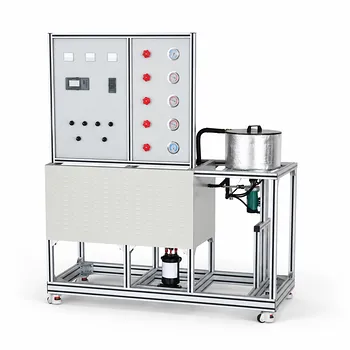
Educational Compression Refrigeration Performance Determination Unit Operations Pilot Plant

Educational Compression Refrigeration Performance Determination Unit Operations Pilot Plant

This educational pilot plant for compression refrigeration performance determination offers dual COP evaluation, regenerative cycle comparison, and calorimeter calibration. Customizable for curriculum integration, it features environmentally conscious design. Supports thermodynamic mapping on pressure-enthalpy diagrams and synchronous monitoring with centralized instrumentation.

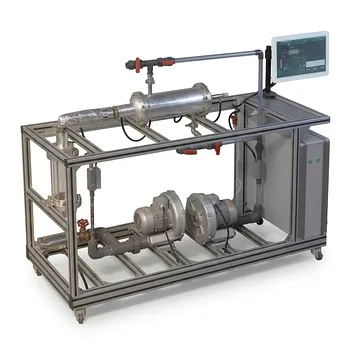
Shell and Tube Heat Exchanger Heat Transfer Coefficient Determination Educational Pilot Plant

Shell and Tube Heat Exchanger Heat Transfer Coefficient Determination Educational Pilot Plant

LABPARK's shell and tube heat exchanger pilot plant enables students to investigate heat transfer coefficients, LMTD, co-current vs counter-current flow, bridging theory and industrial practice. Customizable for chemical, mechanical, environmental engineering curricula. Ideal for unit operations and process engineering labs.

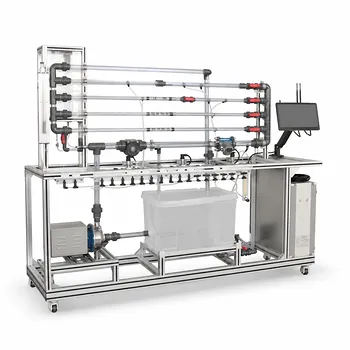
Orifice and Venturi Flowmeter Calibration Educational Pilot Plant for Fluid Mechanics Laboratory

Orifice and Venturi Flowmeter Calibration Educational Pilot Plant for Fluid Mechanics Laboratory

Enhance fluid dynamics education with the Orifice and Venturi Flowmeter Calibration Educational Unit Operations Pilot Plant, featuring transparent orifice and Venturi meters, industrial sensors, touchscreen interface for real-time data analysis and automatic coefficient calculations in engineering student laboratories.

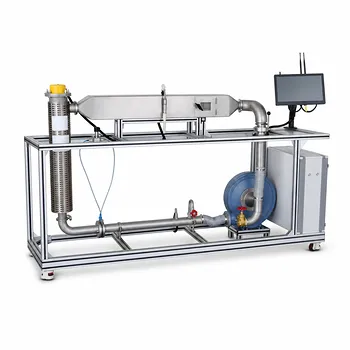
Comprehensive Heat Transfer Coefficient Determination Educational Unit Operations Pilot Plant

Comprehensive Heat Transfer Coefficient Determination Educational Unit Operations Pilot Plant

Advanced industrial-grade educational pilot plant for comprehensive heat transfer coefficient determination. Enables quantitative convective heat transfer analysis, evaluates double-pipe and shell-and-tube exchanger configurations, and includes digital data acquisition. Customizable for engineering curriculum. Ideal for engineering unit operations labs.

Solid Spherical Heat Transfer Coefficient Determination Educational Chemical Engineering Pilot Plant

Solid Spherical Heat Transfer Coefficient Determination Educational Chemical Engineering Pilot Plant

This educational chemical engineering pilot plant enables students to determine convective heat transfer coefficients and observe transient thermal behavior of solid spheres under natural convection, forced convection, fixed beds, and fluidized bed regimes.

Circulating Wind Tunnel Drying and Convective Heat Transfer Coefficient Determination Educational Pilot Plant

Circulating Wind Tunnel Drying and Convective Heat Transfer Coefficient Determination Educational Pilot Plant

This educational pilot plant enables engineering students to study convective drying, air-water vapor systems, and heat transfer by determining drying curves, drying rate curves, and convective heat transfer coefficients under variable conditions.

Rising and Falling Film Evaporation Educational Unit Operations Pilot Plant

Rising and Falling Film Evaporation Educational Unit Operations Pilot Plant

Hands-on educational pilot plant for studying rising and falling film evaporation, flow regimes, and heat transfer. Customizable for university labs with industrial instrumentation and data acquisition. Enables comparative evaluation of evaporation modes and energy efficiency.

Three-Tube Heat Transfer Educational Pilot Plant for Unit Operations Training

Three-Tube Heat Transfer Educational Pilot Plant for Unit Operations Training

Three-tube heat transfer pilot plant for studying convective heat transfer enhancement and condensation. Allows comparison of smooth, corrugated, turbulent tubes, verifying empirical correlations. Ideal for chemical engineering education with safety and closed-loop steam recovery.

Fluid Friction Resistance Determination Educational Unit Operations Pilot Plant

Fluid Friction Resistance Determination Educational Unit Operations Pilot Plant

Engineered bench-scale system for university engineering labs. Provides hands-on fluid mechanics experience: quantitative energy loss analysis, flow regime observation, friction coefficient determination. Features four-point pressure measurement, transparent sections, industrial touchscreen PLC, 3D virtual simulation. Ideal for chemical, mechanical, civil engineering.

Hot Filtration Educational Unit Operations Pilot Plant Laboratory System

Hot Filtration Educational Unit Operations Pilot Plant Laboratory System

This integrated laboratory bench-scale hot filtration pilot plant enables students to study solid-liquid separation under thermal conditions, featuring a stainless steel vessel, removable heating jacket, and multi-layer filter plates for unit operations education, ideal for chemical engineering laboratory curriculum.

Two Phase Flow Pattern Velocity Resistance Measurement Educational Pilot Plant

Two Phase Flow Pattern Velocity Resistance Measurement Educational Pilot Plant

Benchtop educational pilot plant for university labs studying gas-liquid two-phase flow patterns, velocity, and resistance across circular, square, and rectangular conduits. Features 15.6-inch touchscreen, 5G connectivity, differential pressure sensors, safe water-air operation. Supports chemical engineering curricula.

Centrifugal Pump Performance and Orifice Flowmeter Calibration Educational Pilot Plant

Centrifugal Pump Performance and Orifice Flowmeter Calibration Educational Pilot Plant

This versatile educational pilot plant enables engineering students to conduct centrifugal pump performance tests, orifice flowmeter calibration, and fluid mechanics experiments using a transparent flow loop, industrial HMI, and 3D virtual simulation for a comprehensive hands-on learning experience.

Bernoulli Equation Demonstration Unit Operations Pilot Plant

Bernoulli Equation Demonstration Unit Operations Pilot Plant

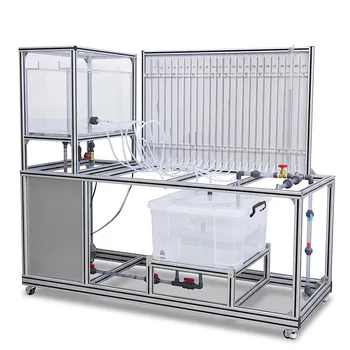
Laboratory pilot plant for Bernoulli's equation demonstration with transparent PVC pipes, 23 piezometer tubes for pressure measurement, and hands-on experiments. Designed for engineering education to study energy conservation, hydraulic grade line, and localized losses in fluid steady-flow systems.

Carbon Dioxide PVT Curve Determination Educational Unit Operations Pilot Plant

Carbon Dioxide PVT Curve Determination Educational Unit Operations Pilot Plant

Enable hands-on learning of thermodynamic principles with this carbon dioxide PVT curve determination pilot plant. Students visualize critical opalescence, phase transitions, and generate P-V isotherms across liquid, gas, and supercritical regions. Robust safety features, adaptable for university engineering labs.

Tubular Reactor Flow Characteristics Determination Educational Unit Operations Pilot Plant

Tubular Reactor Flow Characteristics Determination Educational Unit Operations Pilot Plant

Educational pilot plant for investigating tubular reactor flow characteristics and residence time distribution Features adjustable recycle for plug flow and backmixing studies industrial touchscreen interface and real-time data acquisition Ideal for chemical engineering unit operations laboratory training and education

Cavitation Phenomenon Demonstration and Analysis Educational Unit Operations Pilot Plant

Cavitation Phenomenon Demonstration and Analysis Educational Unit Operations Pilot Plant

Advanced educational pilot plant for demonstrating and analyzing cavitation phenomena in fluid systems. Features a transparent acrylic Venturi test section, high-precision pressure and flow sensors, digital data acquisition, and integrated safety relief valves for engineering curricula.

Two-Dimensional Fluidization Hydrodynamics Educational Pilot Plant for Unit Operations Training

Two-Dimensional Fluidization Hydrodynamics Educational Pilot Plant for Unit Operations Training

Explore gas-solid and liquid-solid fluidization hydrodynamics with our transparent 2D educational pilot plant. Ideal for chemical engineering unit operations labs, it demonstrates fixed to fluidized bed regimes, measures pressure drop, and integrates QR-code digital learning for enhanced student training.

Educational Unit Operations Pilot Plant for Intraparticle Diffusion Effective Factor Measurement

Educational Unit Operations Pilot Plant for Intraparticle Diffusion Effective Factor Measurement

Designed for chemical engineering university labs, this pilot plant allows hands-on determination of catalyst particle intraparticle diffusion effective factors and gas-solid reaction kinetics using a fixed-bed tubular reactor with industrial touchscreen control, bridging theory and practical reactor design.

Binary System Vapor Liquid Equilibrium Data Determination Educational Unit Operations Pilot Plant

Binary System Vapor Liquid Equilibrium Data Determination Educational Unit Operations Pilot Plant

This educational pilot plant determines vapor-liquid equilibrium data for binary systems under atmospheric pressure. Students observe phase behavior, measure T-P-X-Y, and construct phase diagrams for unit operations labs. Features transparent cell, dual circulation. Ideal for chemical engineering curricula.

Dual Mode Heat Transfer Pilot Plant for Unit Operations Training

Dual Mode Heat Transfer Pilot Plant for Unit Operations Training

Engineering-scale dual-mode heat transfer pilot plant for hands-on unit operations training in chemical engineering. Features real and simulated modes, multiple heat exchanger types, comprehensive coefficient determination, and advanced process control with data acquisition for engineering students and researchers.


Leave Your Message