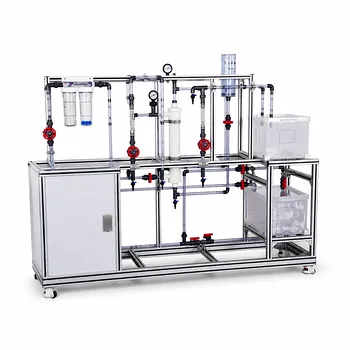
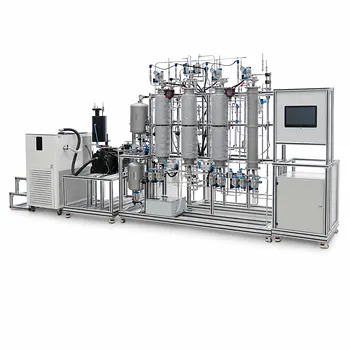
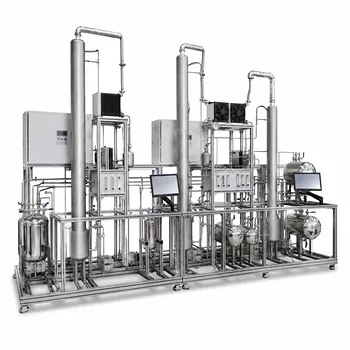
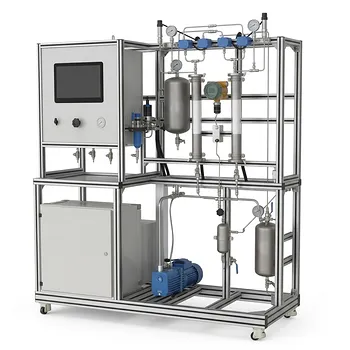
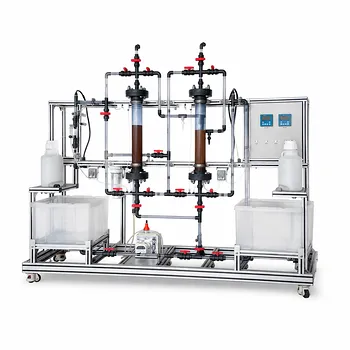
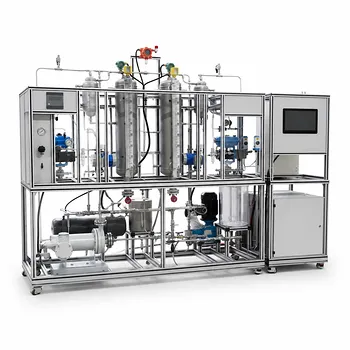
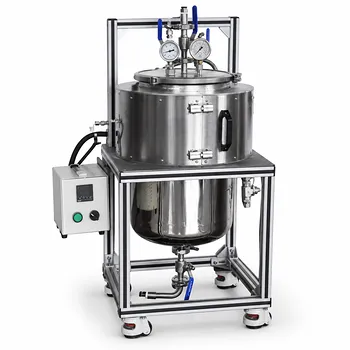
The true control knobs for separation efficiency are not just pressure and temperature—they are the deliberate interplay between pressure ratio, stage cut, and flow distribution.
In a gas purification membrane pilot plant, the key process parameters you must actively control are feed pressure, permeate pressure (and thus the pressure ratio), stage cut, operating temperature, cross-flow velocity, and active membrane area. While the membrane’s intrinsic selectivity provides the potential, only by managing these variables can you direct the outcome toward the desired balance of product recovery, purity, and energy consumption.
True optimization is a trinity: selectivity, pressure ratio, and stage cut. A high‑selectivity membrane cannot compensate for a poorly chosen pressure ratio, and pushing for extreme purity invariably sacrifices recovery and ramps up energy use. Master the interplay, not just the individual setpoints.
Understanding the Core Control Parameters
Pressure Ratio: The Master Variable
The pressure ratio (φ) is the feed pressure divided by the permeate pressure. It forms the thermodynamic boundary that, together with membrane selectivity, dictates the maximum achievable separation.
A membrane with lower selectivity can actually outperform a higher‑selectivity membrane if its pressure ratio is set more favorably. Even the best membrane cannot enrich a component beyond the limit imposed by φ.
Stage Cut: Where Recovery Meets Purity
Stage cut (θ) is the fraction of the feed that becomes permeate. It is the direct lever between product recovery and purity.
A high stage cut yields more permeate product but reduces the average driving force across the membrane, often lowering purity. Conversely, a low stage cut maximizes purity at the expense of recovering less of the target component.
Feed and Permeate Pressures: The Two Sides of the Driving Force
While the ratio matters most, the absolute pressures set the energy bill. Elevated feed pressure boosts flux and can improve separation, but compressor power rises sharply.
Reducing permeate pressure (often with vacuum pumps) also increases the ratio and driving force, but at the cost of vacuum energy. Pilot plants let you manipulate both sides to observe their separate impacts on product purity and recovery.
Temperature: A Dynamic Modulator of Performance
Operating temperature influences both permeability and selectivity. Raising temperature typically increases gas diffusivity, boosting flux, but may decrease selectivity because the solubility difference between gases often narrows.
On the fouling front, higher temperatures enhance solute diffusion away from the membrane surface, helping maintain clean performance—but at the potential expense of separation sharpness.
Flow Distribution and Cross‑Flow Velocity: Guarding Against Inefficiency
Achieving maximum selectivity under operating conditions demands uniform flow distribution across the module. Poor distribution creates dead zones and encourages concentration polarization, effectively lowering the separation factor.
Cross‑flow velocity is the tool that fights polarization. By maintaining turbulence and mixing, it keeps the membrane surface concentration close to the bulk stream, preserving the partial pressure difference that drives separation. You must also limit feed‑side pressure drop; excessive drop reduces the effective pressure ratio along the module length.
Active Membrane Area: The Real‑Time Adaptation Lever
Research pilot plants often allow you to block permeate flow from selected membrane elements while the feed bypasses them. This instantly changes the active membrane area in service.
Doing so lets you study how stage cut, recovery, and capacity respond—without touching pressures or temperature. It’s a powerful technique for demonstrating the modular scalability of membranes and for handling fluctuating feed flows.
The Tug‑of‑War: Balancing Recovery, Purity, and Energy
Purity vs. Recovery
These two goals pull in opposite directions. To raise purity, you must keep the stage cut low and the pressure ratio high, which reduces the volume of product recovered. To raise recovery, you increase the stage cut, but the permeate draws from a lower‑partial‑pressure source, diluting the product.
Performance vs. Energy Costs
Every gain in separation performance requires energy. A higher pressure ratio means bigger compressors or deeper vacuum. A higher cross‑flow velocity needs more pumping power. The pilot plant’s purpose is to quantify these trade‑offs so you can design for the lowest cost per unit of purified gas, not just the highest purity.
Short‑Term Gains vs. Long‑Term Fouling
Aggressively high fluxes and low cross‑flow rates accelerate membrane fouling through concentration polarization and pore blocking. The parameters that give the highest instantaneous separation may also cause the fastest decline in performance, making regular cleaning or anti‑fouling strategies essential.
Common Pitfalls That Derail Optimization
Neglecting Permeate‑Side Pressure Control
Many operators focus only on feed pressure, but permeate pressure is equally critical. A small change in permeate pressure can shift the pressure ratio dramatically, altering both purity and recovery in ways a feed‑pressure adjustment alone cannot mimic.
Underestimating the Impact of Fouling
Even minor fouling reduces effective selectivity and flux. Without intentional fouling‑mitigation steps—such as pretreatment, temperature adjustment, or periodic chemical cleaning—the pilot plant data will reflect a degrading membrane, not a stable process.
Expecting the Membrane Alone to Do the Work
The most common mistake is treating the membrane as a magic filter. A high‑selectivity material in a poorly operated module will deliver mediocre results. Separation efficiency is a system property, not a material property.
Parameter Priorities for Your Specific Goal
- If your primary focus is maximizing product purity: Favor a high pressure ratio with a moderate stage cut, and tightly control temperature to preserve selectivity, even if it raises energy consumption.
- If your primary focus is maximizing recovery (yield): Increase the stage cut while ensuring the permeate pressure is not pulled so low that energy costs explode; consider larger active membrane area or parallel modules.
- If your primary focus is minimizing energy consumption: Operate at the lowest feed pressure that still meets your purity target and avoid deep vacuum; a high‑selectivity membrane will reduce the pressure ratio you need.
- If your primary focus is long‑term stability and fouling resistance: Prioritize high cross‑flow velocity and regular cleaning protocols, and consider a slightly elevated temperature to limit fouling, even if absolute selectivity dips a few percent.
Ultimately, the art of running a membrane pilot plant is recognizing that no control knob moves alone—each adjustment rescues one objective while quietly pulling another off balance.
Summary Table:
| Key Parameter | Primary Role & Control Mechanism | Direct Impact on Separation |
|---|---|---|
| Pressure Ratio (φ) | Ratio of feed pressure to permeate pressure | Dictates the thermodynamic limit of maximum achievable separation. |
| Stage Cut (θ) | Fraction of feed gas that passes to permeate | Controls the direct trade-off between product purity and recovery rate. |
| Temperature | Modulates gas diffusivity and solubility | Alters membrane permeability and selectivity; affects fouling rates. |
| Cross-Flow Velocity | Maintains feed-side turbulence and mixing | Reduces concentration polarization and preserves driving force. |
| Active Membrane Area | Physically blocking/unblocking elements | Adjusts capacity and stage cut to handle fluctuating feed flows. |
Elevate Your Engineering Education & Research with LABPARK
Mastering gas purification requires precise control and reliable equipment. LABPARK provides premium Educational and Vocational Unit Operations Pilot Plants tailored for chemical engineering, bioprocess & biotech, and environmental & water treatment applications.
Whether you are a university upgrading your engineering labs, a research institute testing novel materials, or an enterprise scaling up processes, our pilot plants deliver the accuracy, durability, and modular scalability you need.
Ready to optimize your pilot plant setup? Contact LABPARK today to request a custom consultation!
Related Products
- Multi-Functional Membrane Separation Educational Pilot Plant for Unit Operations Lab
- Photocatalytic Membrane Separation and Degradation Unit Operations Pilot Plant
- Fixed-Bed Chemical Reaction and Gas Dust Tar Removal Unit Operations Pilot Plant
- Bench Scale Carbon Dioxide Capture Educational Unit Operations Pilot Plant
- Multifunctional Membrane Separation Educational Pilot Plant with Ultrafiltration, Nanofiltration, Reverse Osmosis
People Also Ask
- What are the key differences in membrane configurations? Choose the Right Unit Operations Pilot Plant
- How Do Pervaporation, Vapor, and Gas Permeation Differ in Pilot Plants? Key Comparison
- What are the advantages of membrane separation pilot plants? Energy-saving process intensification.
- Pervaporation vs. Vapor Permeation: Handling Suspended Solids in Membrane Pilot Plants
- How do PEI, PVDF, and PSU membranes compare in pilot plants? Find the best fit.