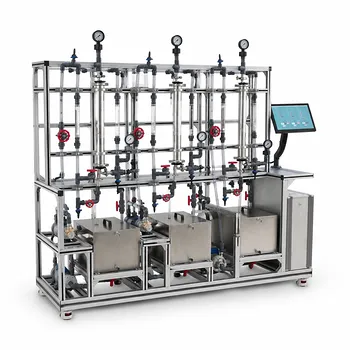
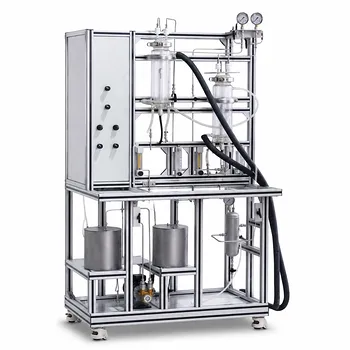
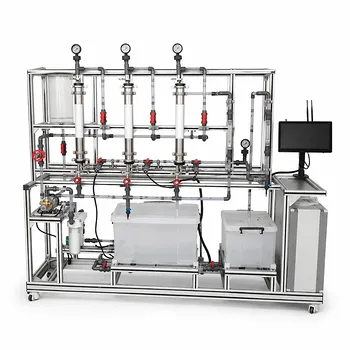
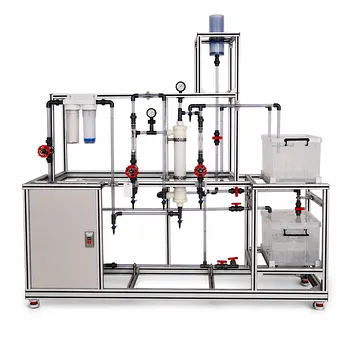
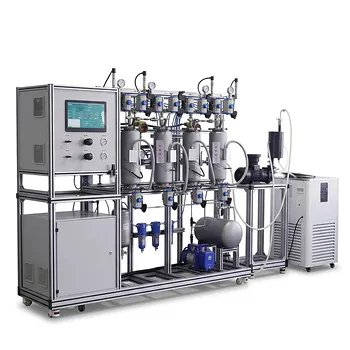
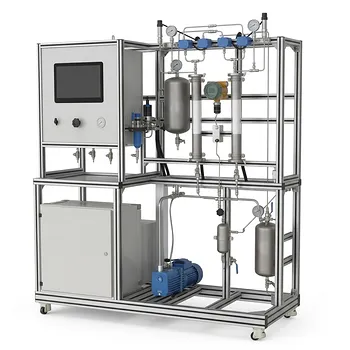
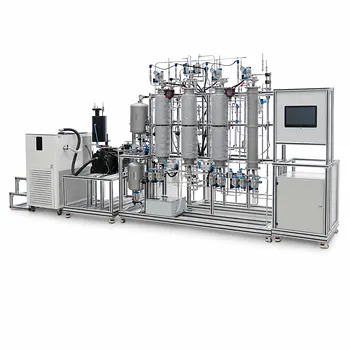
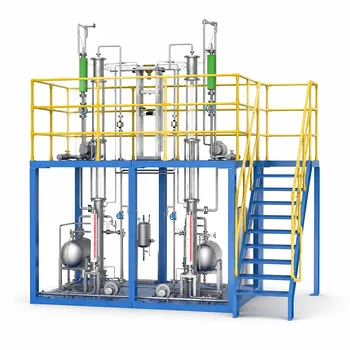
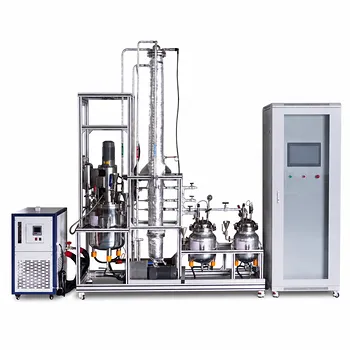
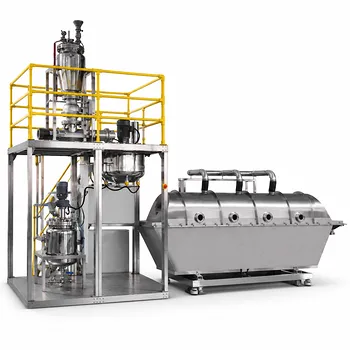
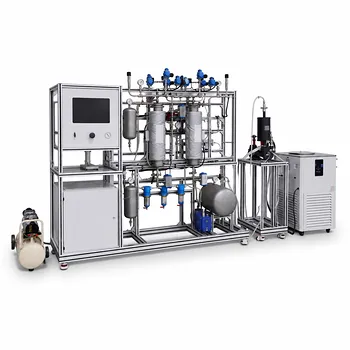
Superficially similar, these three membrane processes are defined by the most decisive variable in pilot-plant operation: the physical state of the feed stream. Pervaporation processes a liquid feed kept at saturation pressure, vapor permeation uses a saturated vapor feed, and gas permeation handles a fully gaseous stream with all components above their critical temperatures. This single difference dictates how the driving force is applied—vacuum on the permeate side for pervaporation and vapor permeation, versus elevated feed pressure (often >100 bar) for gas permeation—and controls the degree of membrane swelling, which is highest with liquid contact and nearly negligible in gas permeation.
The feed phase determines the membrane's swelling behavior, the required pressure equipment, and the safe operating envelope. Misclassifying a feed during pilot testing leads to flawed data, membrane damage, or safety incidents. Always anchor your setup—vacuum or high pressure, liquid delivery or pre-evaporation—to the feed phase you are actually handling.
The Fundamental Variances in Feed, Force, and Swelling
Feed Phase State: Liquid, Saturated Vapor, or Gas
In pervaporation (PV) the feed enters the module as a liquid that is deliberately kept under a few bar of overpressure to prevent premature boiling. The liquid remains at its saturation temperature throughout the feed channel.
Vapor permeation (VP) receives a saturated vapor feed, often directly from the overhead of a distillation column or an upstream evaporator. Here, even a few millibars of pressure loss in the feed line can push the vapor into a superheated state, causing local temperature drops and a loss of driving force.
Gas permeation (GP) works with feeds that are entirely gaseous: all components exist well above their critical temperatures, with partial pressures far below saturation. Compressibility is a central design factor, whereas condensation is never a risk.
Driving Force: Partial Pressure Gradient Across the Membrane
All three processes rely on a gradient in chemical potential, most conveniently expressed as a partial vapor pressure difference. How that gradient is created differs fundamentally. For PV and VP, operators maintain a permeate-side vacuum—typically single‑digit millibars—so that the target component vaporizes, passes through the dense membrane, and is then condensed. An inert sweep gas can be added later in a Combo Mode to sustain the gradient when feed-side concentrations drop.
For GP the strategy is to elevate the feed-side total pressure (often 10–100+ bar), which raises the partial pressure of the permeating species. The gas flux ($J_G$) then follows the simple solution‑diffusion form of Fick’s Law:
$J_G = \frac{P_M}{\delta_m} (p_h - p_l)$
where $P_M = D \cdot S$ is the permeability (diffusivity × solubility) and $\delta_m$ is the membrane thickness. Students can manipulate $p_h$ and mixture composition in a GP pilot plant to verify this relationship directly.
Membrane Swelling: The Density‑Driven Impact on Material Integrity
Swelling is most severe in pervaporation. The high‑density liquid feed plasticizes the membrane polymer, reducing its mechanical strength and altering both solubility and diffusivity—which can either temporarily boost flux or permanently destroy selectivity. Pilot‑plant operators see this as flux creep and a drifting separation factor.
Vapor permeation shows noticeably lower swelling because the feed’s density is two to three orders of magnitude smaller. This makes VP the safer choice when the membrane material is sensitive to solvent‑induced plasticization. In gas permeation, swelling is typically of minor consequence, though it can become relevant at very high feed pressures (e.g., CO₂‑induced plasticization in natural‑gas separations).
Permeate Phase: Condensing or Handling as Gas
In PV and VP, the permeate leaves the membrane as a vapor and is immediately condensed and recovered as a liquid; condensation also helps maintain the vacuum. In GP, the permeate exits as a non‑condensable gas and is handled in the gas phase throughout. This affects your pilot‑plant layout: PV/VP require cold traps and a vacuum pump, while GP needs no condenser but typically employs a back‑pressure regulator.
How These Differences Shape Your Pilot‑Plant Experiments
Selecting the Right Equipment and Pressure Management
A pervaporation rig demands a feed pump, a heater to control the liquid temperature (which exponentially affects vapor pressure), a vacuum pump, and a condenser. For maximum driving force, pilots often demonstrate the Combo Mode: start with a vacuum pump alone, then introduce a small nitrogen sweep when the retentate target concentration becomes low, keeping permeate‑side partial pressure minimal without over‑sizing the vacuum system.
Vapor permeation requires a pre‑evaporator (e.g., a kettle reboiler or a saturated‑vapor inlet). Feed‑side pressure loss must stay within a few millibars; any larger drop superheats the vapor and collapses the driving force. Permeate‑side losses are equally critical: if the vacuum line pressure rises above the design point, the required final concentration can never be reached.
A gas permeation pilot needs a high‑pressure compressor and robust module housing rated for hundreds of bar. The permeate gas can be sent to analysis without any phase change, simplifying downstream sample handling.
When to Choose Vapor Permeation Over Pervaporation
Vapor permeation becomes the clear winner in several scenarios:
- The feed already exists as a saturated vapor, for example directly from a distillation column overhead.
- The raw liquid contains suspended solids (heterogeneous catalysts, insoluble reactants, mother‑liquor fines) that would rapidly foul a liquid‑contacting membrane; pre‑evaporating the feed protects the surface.
- A pervaporation layout would require multiple stages with complex interstage reheating to achieve the same concentration change, whereas VP can handle the duty in fewer stages by cascading feed vapor with inter‑compression.
The trade‑off is energy: VP must continuously supply the heat of vaporization, while PV only compensates for the latent heat consumed inside the module. For a teaching pilot, this makes VP ideal for demonstrating solids‑handling strategies in pharmaceutical and catalyst recovery operations.
Studying Transport Phenomena and Selectivity
All three processes follow the solution‑diffusion mechanism. Separation is not based on pore size but on differences in solubility ($S$) and diffusivity ($D$). This is quantified by the separation factor:
$\alpha_{AB} = \frac{y_A / y_B}{x_A / x_B}$
where $y$ are mole fractions in the permeate and $x$ in the feed. Students vary temperature, feed composition, or pressure and record $\alpha$ to understand how swelling, plasticization, and driving force interact.
In a GP pilot, the linear flux–pressure relationship from Fick’s Law provides a clean system to isolate permeability as a material property. In PV, the exponential dependence of vapor pressure on temperature allows students to explore heat‑integrated operation and its limits.
Understanding the Trade‑offs
Energy Efficiency vs. Operational Robustness
PV avoids the large sensible and latent heat loads of feed evaporation, making it more energy‑efficient for clean liquids. VP and GP are inherently more energy‑intensive, but VP is indispensable when solids tolerance or single‑stage concentration demands override efficiency concerns. GP’s high compression work is the price of separating permanent gases.
Membrane Longevity and Data Drift
Swelling in PV can re‑order the polymer chains, permanently altering both flux and selectivity. Pilot runs must be scoped to capture this drift; frequent solvent resistance testing is essential. VP/GP membranes typically show more stable performance, but high‑pressure GP can cause physical compaction that reduces flux over time, mimicking a decline in effective membrane area.
Scalability and Stage Configurations
Multistage PV is challenging because each stage requires interstage condensation, reheating, and re‑pressurization to keep the feed liquid. VP and GP cascade more naturally: vapor streams can be recompressed between stages, and gas streams can be staged with inter‑coolers or sweep streams. Your pilot‑plant design should mirror the intended large‑scale process to generate meaningful scale‑up data.
Making the Right Choice for Your Research or Teaching Goal
After a brief assessment of your pilot‑plant objectives, select the configuration that aligns:
- If your primary focus is studying membrane swelling and polymer–solvent interactions: Start with pervaporation on a known liquid mixture to observe high‑density swelling effects and plasticization kinetics.
- If your primary focus is processing streams that contain suspended solids (e.g., catalyst recovery or mother liquors): Deploy vapor permeation to prevent surface fouling and extend membrane life.
- If your primary focus is exploring high‑pressure gas separations (CO₂/CH₄, H₂/N₂): Use a gas permeation rig to demonstrate the solution‑diffusion mechanism, stage‑cut control, and pressure‑ratio dependencies.
- If your primary focus is evaluating energy‑efficient driving force strategies: Run pervaporation in Combo Mode and measure the transition point where a sweep gas becomes more cost‑effective than a larger vacuum pump.
Match the configuration to the physical state of the feed, and your pilot plant becomes a controlled window into how real membrane systems behave under industrial conditions.
Summary Table:
| Process | Feed Phase | Driving Force | Membrane Swelling | Permeate Phase |
|---|---|---|---|---|
| Pervaporation (PV) | Liquid | Permeate-side vacuum | High (potential plasticization) | Vapor (condensed to liquid) |
| Vapor Permeation (VP) | Saturated Vapor | Permeate-side vacuum | Low to Moderate | Vapor (condensed to liquid) |
| Gas Permeation (GP) | Gas (above critical temp) | High feed pressure (10-100+ bar) | Negligible | Gas (non-condensable) |
Bring Hands-On Membrane Separation to Your Lab
Are you looking to equip your institution with advanced separation systems? LABPARK provides premium Educational and Vocational Unit Operations Pilot Plants in chemical engineering, bioprocess & biotech, and environmental & water treatment for universities, research institutes, and enterprises.
Our custom-engineered pilot systems help students and researchers safely explore driving forces, mass transfer, and polymer swelling in real-world scenarios.
Contact LABPARK today to find the perfect pilot plant setup for your educational or research goals!
Related Products
- Multi-Functional Membrane Separation Educational Pilot Plant for Unit Operations Lab
- Photocatalytic Membrane Separation and Degradation Unit Operations Pilot Plant
- Multifunctional Membrane Separation Educational Pilot Plant with Ultrafiltration, Nanofiltration, Reverse Osmosis
- Ultrafiltration Membrane Separation Educational Pilot Plant
- Hollow Fiber Ultrafiltration Membrane Separation Educational Pilot Plant
People Also Ask
- What are the key differences in membrane configurations? Choose the Right Unit Operations Pilot Plant
- What are the advantages of membrane separation pilot plants? Energy-saving process intensification.
- Pervaporation vs. Vapor Permeation: Handling Suspended Solids in Membrane Pilot Plants
- How do PEI, PVDF, and PSU membranes compare in pilot plants? Find the best fit.
- What are the trade-offs of polymer vs inorganic membranes in teaching pilot plants? Key laboratory comparison.