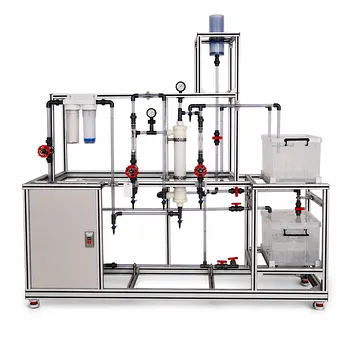
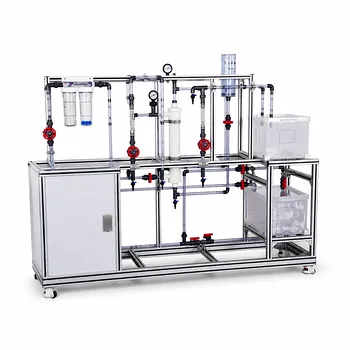
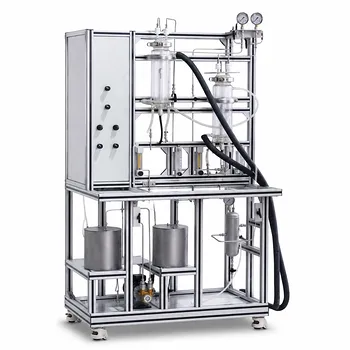
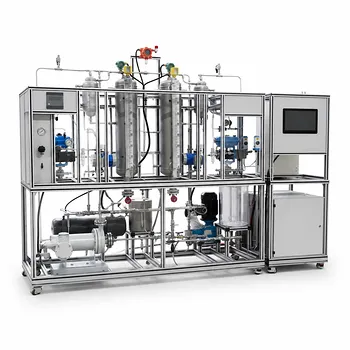
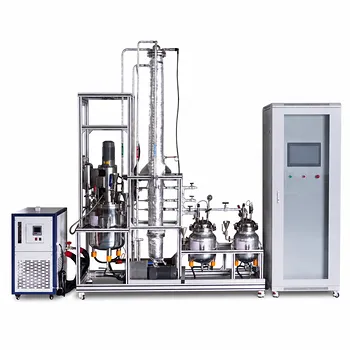
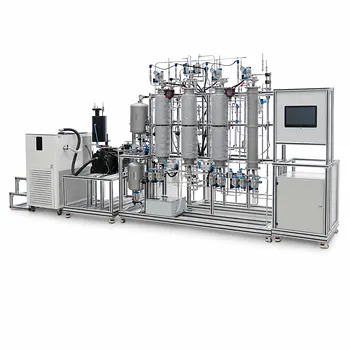
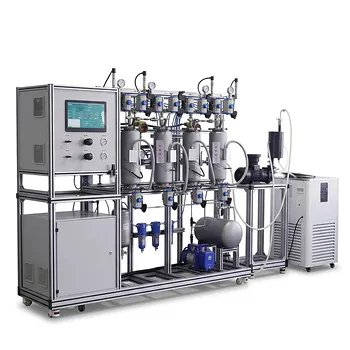
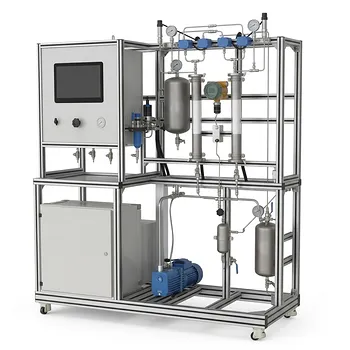
In the teaching laboratory, the membrane you choose doesn’t just separate molecules—it defines the entire educational narrative. Synthetic polymer membranes deliver low-cost, plug-and-play versatility that lets students repeatedly explore fouling, cleaning, and pressure-driven transport under gentle conditions. Inorganic membranes, by contrast, unlock the high-temperature, solvent-resistant frontier of industrial separations but demand a higher capital outlay and more careful handling. The decision to equip a pilot plant with either—or both—is ultimately a decision about which material-characteristic lessons you want students to live through.
The core trade-off is straightforward: polymer membranes maximize hands-on, repeatable experimentation for large groups at minimal cost, while inorganic membranes enable the safe, controlled demonstration of extreme operating environments that reveal how thermal, chemical, and mechanical stability dictate process design. A truly comprehensive teaching unit integrates both to make material limits tangible.
The Physical and Economic Foundations of the Trade-off
Initial Cost and Lab Throughput
Synthetic polymer membranes—polysulfone, PVDF, polyacrylonitrile—are the industry standard precisely because they are cheap to manufacture and easy to replace. In a teaching lab, that means you can stock multiple interchangeable modules. Students can swap membranes between experiments, make mistakes, and repeat runs without blowing the budget.
Inorganic membranes—ceramics, zeolites, sintered metals—carry a significantly higher manufacturing cost. Their complex multilayer coatings and stainless-steel or ceramic supports make each module a capital investment. That financial barrier typically limits the number of units available, forcing the curriculum to rely on smaller group demonstrations rather than bench-scale, hands-on sessions for every student.
The Operating Window: Temperature, Solvents, and pH
Polymer membranes come with a narrow operational comfort zone. Many common natural polymer systems are restricted to temperatures below 45–50 °C, and even high-performance synthetics rarely exceed 90–150 °C. Exposure to harsh organic solvents (DMF, NMP, DMSO) causes swelling and rapid selectivity loss. This forces the teaching laboratory to stay within mild, aqueous, and often neutral-pH feed conditions.
Inorganic membranes shred those limits. Ceramic and metal membranes tolerate continuous operation at 250 °C, with special variants like perovskite hollow fibers designed for oxygen separation at over 500 °C. Their chemical resistance is equally broad—amorphous silica membranes, for instance, handle pH down to 2–3, while some zeolites operate comfortably in aggressive neutral solvents. This thermal and chemical liberty lets instructors design experiments around real industrial feeds: hot process streams, organic synthesis mixtures, and high-temperature gas separations.
Mechanical Robustness and Lifespan Lessons
Polymers teach an unavoidable industrial truth: membranes are consumables. Compaction under pressure, hydrolytic degradation, and irreversible fouling mean students track gradual flux decline, learn to schedule replacement, and understand why maintenance protocols exist. The lifespan lesson is immediate and visceral.
Inorganic membranes offer the opposite experience. Their superior mechanical strength and resistance to compaction deliver stable flux for months or even years. The lesson shifts from “when will it fail” to “why doesn’t it fail”—a perfect gateway to discussing capital-vs.-operating expenditure and the total cost of ownership. The brittleness of ceramics, however, adds a separate handling challenge that must be managed in a student environment.
The Experimental Value: What Each Material Teaches Students
Exposing Fouling and Cleaning-in-Place (CIP) Dynamics
Polymeric membranes are fouling magnifiers. Because they readily adsorb proteins, oils, and colloids, students see pressure drop and flux decline in a single lab session. This makes them ideal for teaching the principles of clean-in-place (CIP): students can experiment with different chemicals, temperatures, and cycle times, then quantify flux recovery. The material’s sensitivity turns an abstract concept into a measurable performance dip.
Inorganic membranes bring the next level. Their chemical robustness permits CIP with aggressive acids, hot caustic, or high-temperature steam—protocols that would destroy a polymer module. Students learn how material choice unlocks or forecloses entire cleaning strategies, and why a dairy plant uses one approach while a solvent dehydration unit uses another.
Visualizing Thermal and Chemical Degradation
Polymer membranes let you safely break things on purpose. Run a polysulfone module at 60 °C with a low-pH feed, and students can measure the irreversible loss of selectivity caused by hydrolysis or swelling. That controlled failure is a memorable lesson in why process engineers impose strict temperature and pH limits.
Inorganic membranes, conversely, allow sustained high-temperature operation where transport mechanisms change. Pair a cold pressure-driven polymer experiment with a hot perovskite hollow-fiber run, and students confront the shift from solution-diffusion to oxygen ionic conductivity. The material becomes the curriculum’s bridge between unit operations and reaction engineering.
Connecting Material Properties to Process Design
Every separation specification—selectivity, flux, cleaning frequency, feed pretreatment—traces back to the membrane material. A pilot plant stocked with both types forces students to make these connections explicitly. They discover that a cheap polymer may require expensive pretreatment, while a costly inorganic membrane might pay for itself by tolerating a raw, unfiltered feed. The material teaches systems thinking, not just membrane science.
Understanding the Trade-offs
The decision tree in a teaching laboratory is not “which is better” but “which compromises are you willing to make for a given learning objective.” The following table of limitations is the real curriculum.
Polymers: Broad Accessibility vs. Narrow Operating Space
- Cost advantage permits large-scale, hands-on training where each student group can run its own module.
- Limited chemical and thermal tolerance means the teaching lab stays clean, aqueous, and mild—much of the industrial reality remains invisible.
- Short lifespan provides a natural lesson in consumable budgeting and preventative maintenance, but can frustrate if replacement stock is not maintained.
Inorganics: Real-World Severity vs. Logistical Complexity
- Extreme stability lets the lab replicate industrial environments: high-temperature gas separations, aggressive solvent feeds, and extreme pH.
- High module cost and brittleness reduce the number of units, often relegating experiments to instructor-led demonstrations rather than independent student inquiry.
- Some inorganics carry their own chemical limits (zeolites sensitively to acids, pH 6–8 windows), so the material’s robustness is not universal—a nuance that itself becomes a teaching point.
Making the Right Choice for Your Curriculum
Your selection should be driven by the material-characteristic narrative you want students to internalize. Use these goalposts to align the investment.
- If your primary focus is core transport principles and hands-on training for large cohorts: Equip the plant with a range of polymeric flat-sheet and hollow-fiber modules. Students gain immediate, tactile feedback on fouling, pressure drop, and cleaning, while the low replacement cost supports repeated, inquiry-based learning.
- If your primary focus is advanced research on high-temperature or solvent-resistant separations: Invest in a small set of ceramic or zeolite modules. The high capital cost is justified by the unique ability to safely run experiments at temperatures and in chemical environments that polymers cannot survive.
- If your goal is to teach the full material-characteristic design space: Build a hybrid pilot plant. Install interchangeable polymeric and inorganic modules on the same skid. Students then run side-by-side comparisons—same feed, different material—directly observing how a single variable (temperature, pH, solvent) dictates separation performance and operational longevity.
A membrane pilot plant is more than a filtration device; it is a stage on which material limits become the starring actors. Choose the molecules you stage, and you choose the depth of the lesson.
Summary Table:
| Feature | Synthetic Polymer Membranes | Inorganic Membranes (Ceramic/Metal) |
|---|---|---|
| Initial Cost | Low (budget-friendly for large groups) | High (requires capital investment) |
| Temperature Limit | Narrow (<45–150 °C) | Wide (up to 250–500 °C+) |
| Chemical Resistance | Low (sensitive to harsh solvents/pH) | High (tolerates acids, bases, organic solvents) |
| Lifespan & Durability | Short (consumable, susceptible to fouling) | Long (mechanically robust, brittle handling) |
| Teaching Value | Great for hands-on cleaning/fouling tests | Best for extreme industrial simulations |
Equip Your Laboratory with Custom Membrane Pilot Plants
Choosing the right membrane technology defines the educational narrative for your students. LABPARK designs and manufactures high-performance Educational and Vocational Unit Operations Pilot Plants in chemical engineering, bioprocess & biotech, and environmental & water treatment. We help universities, research institutes, and enterprises build versatile, hybrid systems equipped with both polymer and inorganic membrane configurations to match your exact curriculum and research goals.
Ready to elevate your practical training? Contact the LABPARK team today to customize your pilot plant solution!
Related Products
- Multifunctional Membrane Separation Educational Pilot Plant with Ultrafiltration, Nanofiltration, Reverse Osmosis
- Ultrafiltration Membrane Separation Educational Pilot Plant
- Multi-Functional Membrane Separation Educational Pilot Plant for Unit Operations Lab
- Hollow Fiber Ultrafiltration Membrane Separation Educational Pilot Plant
- Photocatalytic Membrane Separation and Degradation Unit Operations Pilot Plant
People Also Ask
- How do PEI, PVDF, and PSU membranes compare in pilot plants? Find the best fit.
- Pervaporation vs. Vapor Permeation: Handling Suspended Solids in Membrane Pilot Plants
- How can operators optimize operating conditions and cleaning protocols in membrane separation pilot plants to mitigate fouling?
- What are the advantages of membrane separation in pilot plants? Efficient Organic Vapor Recovery
- Isotropic vs. Anisotropic Membranes: How to Choose the Best Pilot Plant Modules