Knowledge Chemical Engineering Education What are the advantages of membrane separation in pilot plants? Efficient Organic Vapor Recovery
Author avatar

Tech Team · LABPARK

Updated 1 month ago

What are the advantages of membrane separation in pilot plants? Efficient Organic Vapor Recovery


For pilot plants focused on organic vapor recovery, membrane separation units offer a uniquely compelling combination of simplicity, modularity, and cost-effectiveness. Using thin‑film composite membranes with a rubbery permselective layer, these systems selectively permeate organic vapors while rejecting air or other permanent gases. This enables a compact, easy‑to‑operate process that often outperforms traditional methods like adsorption, absorption, or condensation in both capital and operating expense. Typical pilot‑plant applications range from treating off‑gas to meet emission limits to recovering high‑value compounds such as vinyl chloride monomer or propylene from purge streams.

The core insight is that membrane separation in pilot plants turns organic vapor recovery into a low‑energy, continuous, and easily scalable unit operation. Its modular hardware, ambient‑temperature operation, and freedom from thermal phase changes make it ideal for teaching sustainable process design and for testing real‑world retrofits—provided operators actively manage fouling and material compatibility.

The Core Design Advantages of Membrane Systems for Pilot Plants

Simple Modular Installation and Operation

Membrane modules are inherently modular, allowing flexible scaling from bench‑top to small pilot rigs.
They require no complex thermal equipment or moving parts—just a compressor to provide the pressure driving force, a separation stage, and simple collection ports.
This plug‑and‑play nature means a pilot plant can be assembled rapidly, modified easily, and operated by students or researchers with minimal training.

Lower Capital and Operating Costs

Compared to adsorption beds, absorption columns, or cryogenic condensers, membrane systems often carry a lower upfront investment.
Operating expenses are also trimmed because there is no need for a thermal phase change—energy is consumed only for gas compression, not for heating or cooling large mass streams.
In many pilot studies, this translates to a significantly lower specific energy demand per kilogram of recovered solvent, making the unit cost‑effective even for small‑scale demonstrations.

Continuous Operation Without Freezing Issues

When integrated as a replacement for low‑temperature condensers (e.g., those running at −70°C), membranes eliminate ice‑build‑up and defrost downtime.
In streams containing water vapor, conventional cryogenic surfaces freeze, forcing periodic shutdowns. A membrane stage separates organic vapors upstream, allowing the system to run continuously without interruption—an ideal scenario for pilot plants that need to demonstrate steady‑state operation over extended runs.

Energy Efficiency and Gentle Processing

Unlike distillation or high‑temperature condensation, membrane separation operates at ambient or moderate temperatures.
This not only saves energy but also prevents thermal degradation of heat‑sensitive materials—a major advantage if the recovered vapors are monomers, pharmaceutical intermediates, or flavor compounds.
The process can therefore be used to study gentle, low‑carbon separation in a pilot setting, mirroring the sustainability principles demanded in modern industry.

Key Applications in Organic Vapor Recovery Pilot Plants

Off‑Gas Treatment and Emission Compliance

Pilot‑scale membrane units are heavily used to demonstrate how off‑gas streams can be purified before discharge.
By removing volatile organic compounds (VOCs) from reactor vents or tank blanketing lines, the system helps meet stringent environmental emission standards without the need for large carbon‑bed adsorbers or thermal oxidizers.

Valuable Compound Recovery

In petrochemical or polymer pilot plants, membranes recover high‑value monomers like vinyl chloride (VCM) or propylene from purge streams that would otherwise be flared.
The relatively pure permeate can be recycled back into the process, allowing researchers to quantify economic benefits and study closure of material loops—a key feature of circular process design.

Hybrid Configurations for Peak Shaving

A common retrofitting strategy tested in pilot plants is installing a membrane unit upstream of an adsorption bed.
The membrane stage can shave concentration peaks under fluctuating hydrocarbon loads, preventing overload of the fixed‑bed adsorber. This hybrid setup enables the plant to meet modern emission limits while increasing overall treatment capacity at an acceptable additional investment cost.

Understanding the Trade‑offs and Limitations

Membrane Fouling and Flux Decline

Over time, organic vapors and trace particulates can cause fouling, leading to a gradual reduction in permeate flux.
Pilot plants should include pressure‑drop monitoring to teach users how to identify fouling onset and implement cleaning protocols or pre‑filtration—critical lessons for translating the technology to industry.

Limited Chemical Resistance

Polymeric membranes—especially those with PDMS or POMS selective layers—have limited tolerance to extreme pH and some aggressive organic solvents.
Before introducing a feed stream, operators must carefully verify chemical compatibility to avoid swift membrane degradation. This makes material selection an integral part of the pilot‑plant curriculum.

Finite Membrane Lifespan

Even under ideal conditions, membrane materials degrade over time due to plasticization, compaction, or slow chemical attack.
Pilot‑plant protocols must therefore include regular replacement schedules and maintenance logs, giving students hands‑on experience with lifecycle asset management in separation processes.

Making the Right Choice for Your Pilot‑Plant Goal

Selecting a membrane unit for organic vapor recovery should align with your educational or research objectives. Consider the following guide:

  • If your primary focus is demonstrating low‑energy, continuous vapor recovery: Choose a membrane system for its ability to run at ambient temperature without thermal phase changes or freezing downtime.
  • If your primary focus is handling heat‑sensitive organic vapors: Membranes preserve product integrity much better than distillation or hot‑gas condensation.
  • If your primary focus is retrofitting an existing adsorption or condensation train: Use a membrane stage for peak shaving or pre‑separation to boost capacity and meet tighter emission targets.
  • If your primary focus is teaching operational challenges: Membrane pilot plants naturally introduce fouling, material compatibility, and replacement issues—key learning points for future engineers.

Ultimately, membrane separation in a pilot plant delivers a teachable, compact, and economically sound platform for mastering organic vapor recovery—provided you design the system to manage its physical limitations from day one.

Summary Table:

Aspect Key Features Key Benefits
Design Advantages Modular setup, low specific energy, ambient temp Easy scaling, lower CAPEX/OPEX, no thermal degradation
Key Applications Off-gas VOC removal, monomer recovery, peak shaving Environmental compliance, material recycling, increased capacity
Key Limitations Membrane fouling, limited chemical resistance Requires pre-filtration & compatibility checks

Bring Advanced Separation Technology to Your Lab

Are you looking to equip your students or researchers with hands-on experience in modern separation processes? LABPARK provides state-of-the-art Educational and Vocational Unit Operations Pilot Plants in chemical engineering, bioprocess & biotech, and environmental & water treatment. Designed for universities, research institutes, and enterprises, our pilot systems deliver reliable, industrial-grade learning platforms for technologies like organic vapor recovery.

Contact LABPARK today to explore our customizable pilot plant solutions!

Related Products

People Also Ask

Related Products

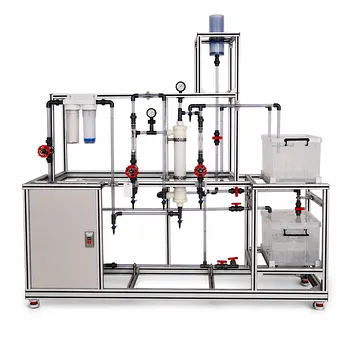
Multifunctional Membrane Separation Educational Pilot Plant with Ultrafiltration, Nanofiltration, Reverse Osmosis

Multifunctional Membrane Separation Educational Pilot Plant with Ultrafiltration, Nanofiltration, Reverse Osmosis

An integrated laboratory bench-scale membrane separation system for higher education engineering labs combining Ultrafiltration, Nanofiltration, and Reverse Osmosis processes. Features industrial PLC control with touch-screen HMI, transparent piping, and academic assessment software. Ideal for chemical and environmental engineering curricula.

Ultrafiltration Membrane Separation Educational Pilot Plant

Ultrafiltration Membrane Separation Educational Pilot Plant

This ultrafiltration membrane separation educational pilot plant enables undergraduate students to process PVA solutions, study hollow fiber membrane dynamics, and perform quantitative analysis with spectrophotometry for hands-on learning of unit operations and industrial maintenance and membrane cleaning protocols.

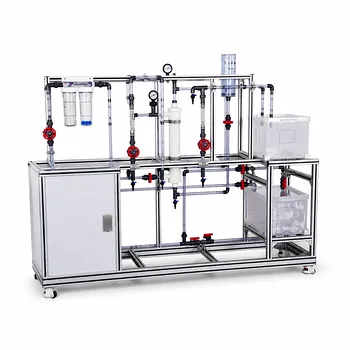
Multi-Functional Membrane Separation Educational Pilot Plant for Unit Operations Lab

Multi-Functional Membrane Separation Educational Pilot Plant for Unit Operations Lab

The Multi-functional Membrane Separation Educational Unit Operations Pilot Plant is an integrated bench-scale laboratory system designed for teaching undergraduate engineering education. It features Ultrafiltration, Nanofiltration, and Reverse Osmosis modules in a compact, mobile unit for practical hands-on learning.

Hollow Fiber Ultrafiltration Membrane Separation Educational Pilot Plant

Hollow Fiber Ultrafiltration Membrane Separation Educational Pilot Plant

Explore our hollow fiber ultrafiltration membrane separation educational pilot plant for hands-on learning of industrial ultrafiltration processes, flux analysis, fouling mitigation, and process control. Compact, customizable, and built for engineering labs.

Photocatalytic Membrane Separation and Degradation Unit Operations Pilot Plant

Photocatalytic Membrane Separation and Degradation Unit Operations Pilot Plant

Bench-scale pilot plant integrating photocatalytic degradation with membrane separation for engineering education. Study advanced oxidation, microfiltration, and hybrid processes using industrial sensors. Features safety light-blocking curtain, low-noise compressor, and durable stainless-steel construction.

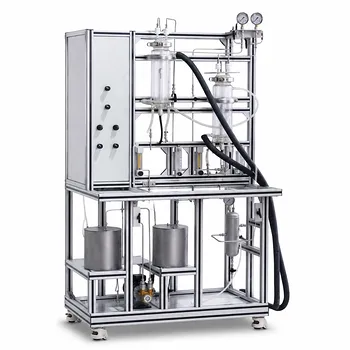
Multi Functional Membrane Crystallization Educational Unit Operations Pilot Plant

Multi Functional Membrane Crystallization Educational Unit Operations Pilot Plant

Integrated bench-scale membrane crystallization pilot plant for engineering education. Provides hands-on training in advanced separation technologies, combining membrane distillation crystallization and process intensification. Features variable scaling vessels, industrial-grade flow control, and interactive digital data acquisition. Customizable for university labs.

Alkaline Membrane Water Electrolysis Educational Pilot Plant Unit Operations Training System

Alkaline Membrane Water Electrolysis Educational Pilot Plant Unit Operations Training System

Hands-on educational pilot plant for alkaline membrane water electrolysis hydrogen production, integrating unit operations training with industrial PLC control, real-time data logging, customizable design, durable 316L stainless steel construction, explosion-proof safety, and modern 5G connectivity for university laboratories.

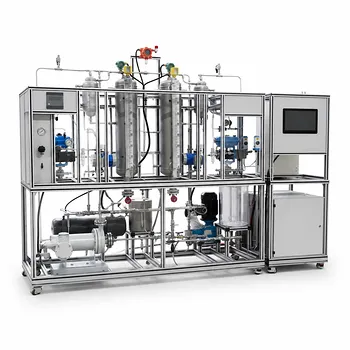
Bench Scale Dual Column Gas Separation and Capture Educational Pilot Plant

Bench Scale Dual Column Gas Separation and Capture Educational Pilot Plant

This dual-column educational pilot plant provides hands-on teaching of gas adsorption, separation, and capture processes. It features stainless steel columns, regeneration up to 400°C, and a 15.6-inch touchscreen PLC for TSA and PSA studies in chemical engineering curricula, process simulation.

Carbon Material Thermal Pretreatment Multiphase Separation Educational Pilot Plant

Carbon Material Thermal Pretreatment Multiphase Separation Educational Pilot Plant

Educational pilot plant for carbon material thermal pretreatment and multiphase separation. Features jacketed agitated reactor, separation column, and modern controls for hands-on unit operations training in heat transfer, fluid flow, and process safety with industrial-grade materials and wireless data acquisition.

Gas-Solid Heterogeneous Separation Demonstration Educational Unit Operations Pilot Plant

Gas-Solid Heterogeneous Separation Demonstration Educational Unit Operations Pilot Plant

Comprehensive visual transparent gas-solid separation pilot plant for chemical engineering labs. Demonstrates gravity settling inertial settling cyclone and bag filter technologies. Enables real-time analysis of fluid-particle mechanics pressure drop and collection efficiency. Ideal for undergraduate unit operations courses.

Educational Pressure Swing Adsorption Ethylene Capture Unit Operations Pilot Plant

Educational Pressure Swing Adsorption Ethylene Capture Unit Operations Pilot Plant

Advanced educational pilot plant for pressure swing adsorption ethylene capture provides comprehensive hands-on training in industrial gas separation processes, featuring an eight-column PSA system, real-time data acquisition, and fully customizable design for chemical engineering unit operations laboratories and research.

Multi-Component Gas Pressure Swing Adsorption Pilot Plant for Unit Operations Education

Multi-Component Gas Pressure Swing Adsorption Pilot Plant for Unit Operations Education

Multi-component gas pressure swing adsorption pilot plant designed for unit operations education. Features four-tower configuration, IoT touchscreen control, dual regeneration, and real-time breakthrough curve analysis for engineering training with safety interlocks and mobile frame simulates industrial PSA processes.

Bio-fermentation Ethanol Production Practical Training Unit Operations Pilot Plant

Bio-fermentation Ethanol Production Practical Training Unit Operations Pilot Plant

Bio-fermentation ethanol production pilot plant for hands-on training in unit operations: fermentation, solid-liquid filtration, membrane separation, and distillation. Bridges theory with industrial practice using industrial-grade components, customizable for university labs. Hybrid automated and manual control for comprehensive learning.

Pressure Swing Adsorption Educational Unit Operations Pilot Plant

Pressure Swing Adsorption Educational Unit Operations Pilot Plant

Integrated bench-scale pressure swing adsorption pilot plant for hands-on teaching of gas-solid separation, mass transfer, and process optimization using nitrogen-oxygen model, featuring dual-column design, industrial touchscreen control, digital assessment suite, and customizable hardware and software configurations for educational laboratories.

Constant Pressure Filtration Educational Unit Operations Pilot Plant

Constant Pressure Filtration Educational Unit Operations Pilot Plant

Hands-on educational pilot plant for constant pressure filtration. Classic plate and frame filter press allows students to study kinetics, determine specific cake resistance, perform cake washing and evaluate washing rates. Ideal for chemical engineering curriculum. Mobile, customizable, safety-compliant design.

Natural Product Extraction Unit Operations Training Pilot Plant

Natural Product Extraction Unit Operations Training Pilot Plant

Integrated natural product extraction pilot plant for chemical engineering training bridges theory and industrial practice with modular extraction and evaporation/concentration units, hybrid touchscreen and manual control, realistic process simulation, and self-contained softened water and vacuum utilities.

Absorption and Desorption Educational Unit Operations Pilot Plant

Absorption and Desorption Educational Unit Operations Pilot Plant

Dual packed column absorption and desorption pilot plant for chemical engineering education, offering real-time mass transfer coefficient measurement, durable mobile frame, industrial touch-screen interface, and customizable design for varied laboratory curricula, enabling hands-on study of gas absorption and stripping.

Supercritical High-Gravity Flash Evaporation Educational Unit Operations Pilot Plant

Supercritical High-Gravity Flash Evaporation Educational Unit Operations Pilot Plant

Bench-scale integrated teaching system for advanced separation and mass transfer, combining supercritical high-gravity flash evaporation with heating, chemical reaction, and material collection, featuring modular design, Stainless Steel 316L construction, transparent visualization, touchscreen control, and safety systems for chemical engineering education.

Dual-Mode Rectification Pilot Plant for Practical Training Unit Operations

Dual-Mode Rectification Pilot Plant for Practical Training Unit Operations

Industrial-scale dual-mode rectification pilot plant for chemical engineering practical training. Features real-material and simulated-material operation modes, sieve-plate column with sight glasses for visual observation of hydrodynamics, and customizable SCADA control for safe, hands-on learning of unit operations and mass transfer.

Multi-Functional Special Distillation Educational Pilot Plant

Multi-Functional Special Distillation Educational Pilot Plant

Versatile multi-functional special distillation pilot plant for chemical engineering education. Supports continuous, vacuum, azeotropic, reactive, extractive distillation. Transparent glass columns enable real-time visual observation of hydrodynamics and separation processes.


Leave Your Message