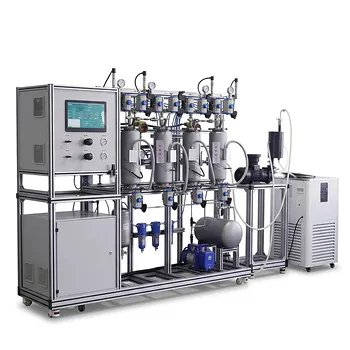
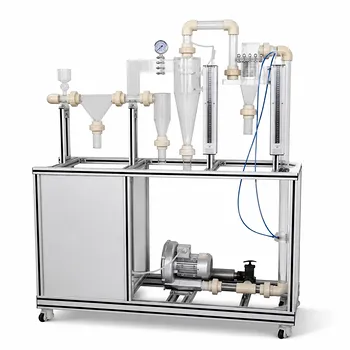
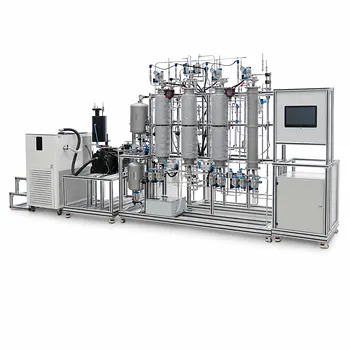
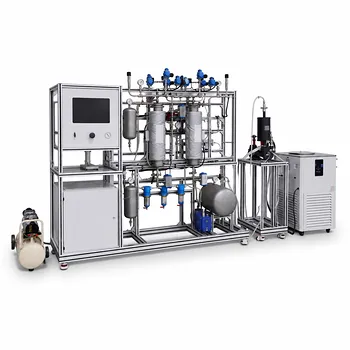
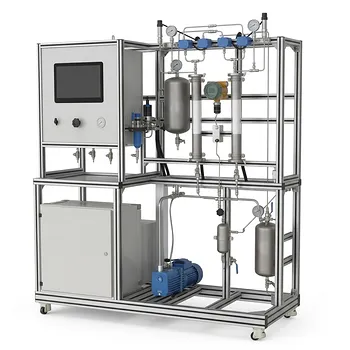
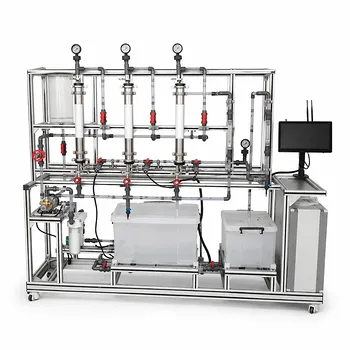
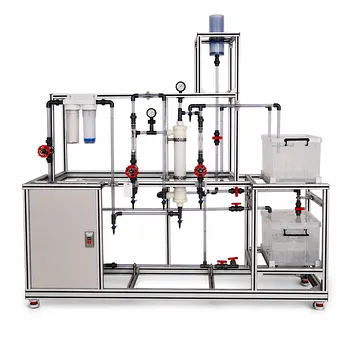
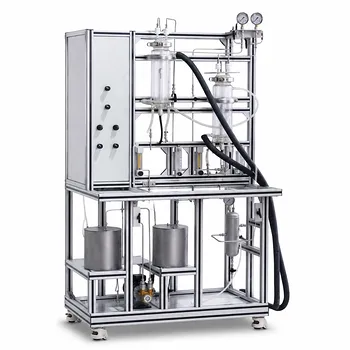
The critical path from a laboratory membrane to a viable industrial process is not a single step, but a rigorous, multi-disciplinary evaluation spanning material science, module engineering, and system integration. When using a chemical engineering unit operations pilot plant to study gas-separation membrane systems, you must evaluate the entire hierarchy of design, from the fundamental material properties to the final process economics. This includes assessing intrinsic permeability and selectivity, optimizing module geometry and flow configuration, verifying chemical and mechanical stability under real conditions, characterizing performance by manipulating key operating parameters, and finally, integrating the module into a full process flowsheet to validate cost-performance against alternatives.
A pilot plant isn't just a larger test cell; it's a process simulator. The core insight is that you must design experiments to isolate and understand the trade-offs between the membrane's intrinsic performance and the module's hydrodynamic reality. The goal is not just to see if a membrane works, but to generate the scale-up data needed to design a commercial system, where parameters like pressure ratio and fouling often dominate economics more than pure permeability.
Deconstructing the Membrane System: A Hierarchical Approach to Evaluation
Evaluating a gas-separation membrane system requires a structured, tiered approach. You cannot simply test a final module and understand it. A pilot plant study must systematically probe every level of the design hierarchy to generate a reliable, scalable process model.
The Material Foundation: Selectivity and Permeability
The journey begins with the membrane material itself. Your pilot plant evaluation must confirm that the chosen material's theoretical potential translates into real-world performance.
- Intrinsic Selectivity: This is the membrane's ability to separate two gases, ideally at infinite pressure ratio. A pilot plant allows you to measure this by operating at very high pressure ratios, quantifying the separation efficiency based on molecular size, adsorption, or solubility differences.
- Effective Permeability: Permeability, or flux, is highly dependent on membrane thickness. Pilot plant testing reveals the effective permeability, which accounts for the real, non-uniform thickness of a manufactured membrane and the impact of physical compaction under high feed pressures.
However, a perfect material is useless in a poorly designed module. Your evaluation must next focus on how the material is formed and housed.
Engineering the Module: Form, Flow, and Geometry
The leap from a small film to a high-density, efficient module is where many processes fail. Your pilot plant study is the proving ground for this critical step.
- Membrane Form Factor: You must evaluate the chosen form, typically either hollow-fiber or flat-sheet (spiral-wound). For example, hollow-fiber modules are ideal for high-pressure hydrogen recovery, while spiral-wound envelopes are highly suitable for recovering organic vapors with selectivities over nitrogen often exceeding 10.
- Module Geometry and Flow Configuration: The goal is to maximize membrane area density while minimizing pressure loss. The pilot plant allows you to study the impact of flow patterns—comparing cocurrent, countercurrent, or cross-flow configurations—on the driving force and ultimate separation efficiency.
- Flow Distribution and Channeling: Achieving maximum selectivity requires understanding flow distribution. A pilot system with a mechanism to adjust active membrane area lets you observe how feed flow is distributed and whether channeling is creating dead zones or bypassing, which directly impacts product purity and recovery.
Ensuring Robustness: Materials of Construction and Fouling
A chemically incompatible or mechanically unstable module is a process safety and economic liability. This evaluation is non-negotiable.
- Chemical Compatibility: You must verify the compatibility of all components, especially the sealing and tubesheet materials, with the process gas stream. A failed seal in a high-pressure mixed-gas environment is catastrophic.
- Progressive Membrane Fouling: Pilot plants are essential for investigating operational degradation. You must evaluate how the membrane’s lifetime and selectivity decline over time due to fouling from contaminants, plasticization by hydrocarbons, or physical aging. This real-time data is critical for predicting replacement costs and designing pretreatment systems.
Mastering the Process: From Operating Parameters to Scale-Up
Once the module’s physical integrity is confirmed, the pilot plant’s primary function becomes clear: to map the entire operating envelope and generate a scalable process model.
The Critical Knobs: Pressure, Temperature, and Flow Rate
A well-designed educational or research pilot plant provides precise control over the four primary operating parameters. Your systematic manipulation of these "knobs" reveals the core trade-offs of the process.
- The Pressure Ratio: This is the single most powerful variable. Defined as feed pressure divided by permeate pressure, it dictates the degree of separation possible. You must manipulate the permeate-side pressure directly to observe its profound, non-linear impact on product purity and recovery.
- Feed Pressure and Compaction: By adjusting feed pressures to mimic high-pressure industrial conditions, you can observe how the membrane's structure physically compacts, reducing flux over time, and separate this effect from surface fouling.
- Operating Temperature: Temperature influences both gas sorption and diffusion rates in the polymer. Your evaluation must characterize how it shifts the trade-off between permeability and selectivity for your specific gas pair.
The Scale-Up Reality: Why One Module is Never Enough
A critical mental model to validate in a pilot plant is the unique scalability of membranes. Your process design evaluation hinges on this concept.
- The Absence of Economy of Scale: Membranes exhibit a scale-up factor of approximately one. Unlike a compressor, a single module cannot be made exponentially cheaper per unit of capacity by making it twice as big.
- The Modular Scale-Up Strategy: This reality forces a numbering-up approach. Your pilot plant study must, therefore, evaluate how multiple modules are best arranged in series and parallel configurations to achieve commercial capacity. This directly informs your process flowsheet design, including staging with interstage compression to optimize recovery and energy use.
Understanding the Trade-offs: The Central Dilemma of Membrane Systems
A pilot plant evaluation is, at its core, a study in trade-offs. Your ability to quantify these will determine the commercial viability of the process.
- Recovery vs. Purity: This is the classic membrane trade-off. High product purity typically requires a high pressure ratio and low recovery. Increasing feed flow to boost production or routing more permeate to recover a higher percentage of the target gas will reduce purity. The pilot plant data directly maps this curve.
- Capital (Membrane Area) vs. Operating Cost (Energy): More membrane area reduces the pressure ratio needed, saving on compression energy. The pilot plant allows you to find the sweet spot where the lifecycle cost of replacing a larger membrane inventory is balanced against the ongoing electricity costs for vacuum pumps or compressors.
- Productivity vs. Longevity: You can always push a membrane harder with higher feed pressures to get more flux. However, this accelerates physical compaction and fouling. Your evaluation must define the maximum sustainable operating point that delivers acceptable flux without sacrificing the membrane's lifetime.
How to Apply This to Your Pilot Plant Project
The specific path you take through this evaluation depends entirely on your primary goal. The pilot plant is a tool, and you must configure its use to answer a specific question.
After defining the core question, you can structure your experimental plan.
- If your primary focus is on fundamental education: Manipulate the core operating parameters (pressure, temperature, flow) systematically to map their individual effects on selectivity and permeability for a well-characterized system like nitrogen/air separation.
- If your primary focus is on new material screening: Design a rapid test protocol that first establishes a baseline with a known gas pair before exposing a small module to the target industrial mixture to quickly assess selectivity loss due to boundary layer effects and chemical interactions.
- If your primary focus is on industrial process scale-up: Operate the pilot plant for extended periods with a real or simulated feed to generate a time-series data set on fouling and compaction, then use that data to validate a process model that predicts the optimal configuration of modules in series and parallel for a target capacity.
- If your primary focus is on energy optimization: Use the pilot plant to generate a complete performance map at various pressure ratios and stage cuts, explicitly calculating the energy consumption per unit of product recovered to find the true economic optimum between membrane area and horsepower.
The membrane pilot plant is the bridge between a 1 cm² film in a lab and a multi-million-dollar industrial system. Mastering its evaluation steps is the only way to ensure that bridge leads to a viable, profitable destination.
Summary Table:
| Evaluation Level | Key Parameters & Variables | Target Outcome / Purpose |
|---|---|---|
| Material Foundation | Intrinsic selectivity, effective permeability | Validate raw separation potential & compaction effects |
| Module Engineering | Geometry (hollow-fiber vs. spiral-wound), flow configuration | Maximize active membrane area & avoid bypassing |
| System Robustness | Tubesheet/seal compatibility, progressive fouling | Predict membrane lifespan & establish pretreatment needs |
| Process Optimization | Pressure ratio, operating temperature, feed flow | Map trade-offs between recovery, purity, and energy |
| Scale-Up Integration | Series & parallel configurations, stage staging | Define optimal flowsheet for commercial-scale operation |
Scale Up Your Separation Research with LABPARK
Transitioning from laboratory membrane testing to industrial-scale application requires robust, reliable process data. LABPARK provides state-of-the-art Educational and Vocational Unit Operations Pilot Plants in chemical engineering, bioprocess & biotech, and environmental & water treatment, specifically designed for universities, research institutes, and progressive enterprises.
Our custom-engineered pilot systems enable you to precisely manipulate operating parameters, study flow dynamics, and gather accurate scale-up data to optimize your process development.
Let us help you build the perfect bridge between theory and industrial reality. Contact LABPARK today to discuss your research and training needs!
Related Products
- Multi-Component Gas Pressure Swing Adsorption Pilot Plant for Unit Operations Education
- Multi-Functional Membrane Separation Educational Pilot Plant for Unit Operations Lab
- Gas-Solid Heterogeneous Separation Demonstration Educational Unit Operations Pilot Plant
- Educational Pressure Swing Adsorption Ethylene Capture Unit Operations Pilot Plant
- Bench Scale Dual Column Gas Separation and Capture Educational Pilot Plant
People Also Ask
- How does Pressure Swing Adsorption (PSA) technology operate? Optimize gas separation with pilot plants.
- How is the direction and driving force of mass transfer determined in a gas absorption unit operations pilot plant?
- How do two-film & penetration theories apply to gas absorption pilot plant teaching? Key pedagogical insights.
- How does partial pressure behavior influence gas absorption pilot plants? Master Mass Transfer
- What are the limitations of Henry's Law in gas absorption pilot plants? Avoid critical lab errors.