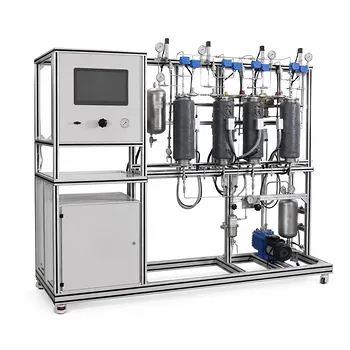
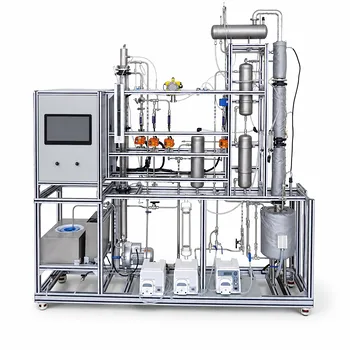
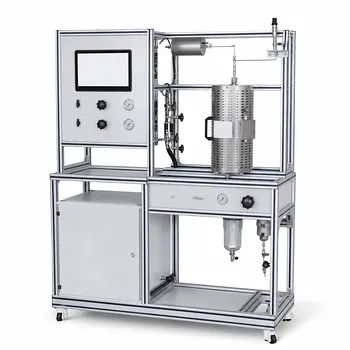
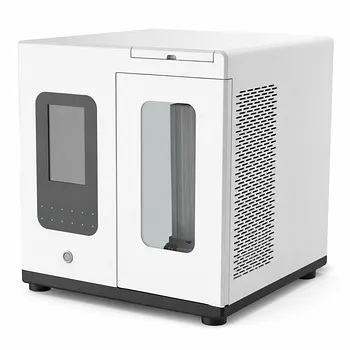
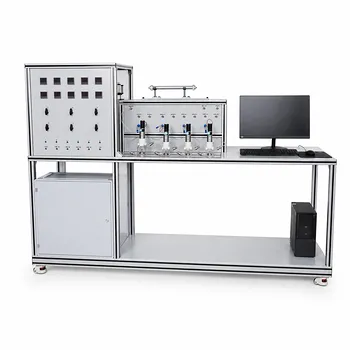
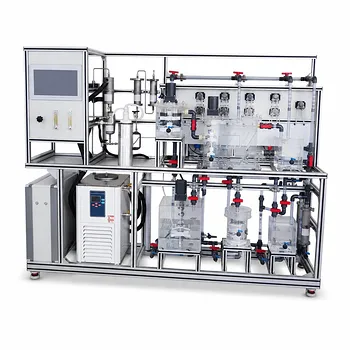
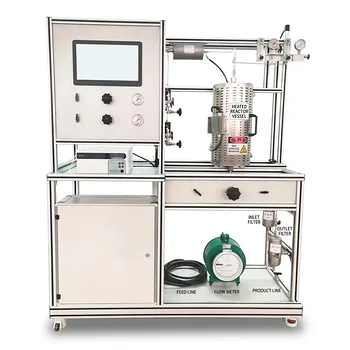
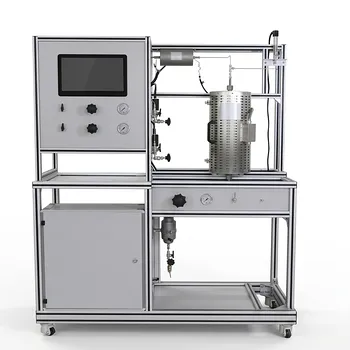
The fundamental thermodynamic difference between high-, medium-, and low-Btu coal-derived gases lies in their chemical composition and resulting energy density. High-Btu gas, composed almost entirely of methane, delivers a heat of combustion of roughly 950 Btu per standard cubic foot. Medium-Btu gas—a mixture of carbon monoxide and hydrogen—contains about 300 Btu/scf, while low-Btu gas is diluted with nitrogen and sits at only ~150 Btu/scf. These diverging heating values are the direct outcome of the specific gasification reactions and process conditions that dictate the synthesis gas’s final molecular makeup.
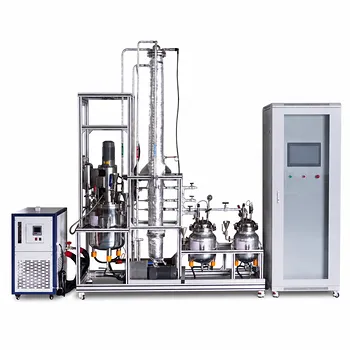
While the Btu number is the most obvious metric, the deeper thermodynamic distinction is about the chemical pathway that creates each fuel. High-Btu gas represents a highly reduced, energy‑dense state reached through exothermic methanation, whereas the lower‑Btu products are trapped at earlier, more oxidized stages—and pilot plants make these abstract phase transitions tangible.
Understanding the Thermodynamic Divide Beyond the Btu Number
The heating value is a convenient label, but it only scratches the surface. The real story is how the carbon and hydrogen atoms are rearranged, and how much chemical energy is retained or lost at each stage.
The Low‑Btu Route: Air‑Blown Gasification and Nitrogen Dilution
Low‑Btu gas is produced when coal is gasified with air instead of pure oxygen. The resulting producer gas contains CO + H₂, but it is heavily diluted by nitrogen from the air.
This dilution does more than just lower the Btu score—it drastically reduces the adiabatic flame temperature and limits the gas’s utility to on‑site, near‑atmospheric combustion. From a thermodynamic point of view, the system exchanges energy density for simplicity, avoiding the cost of an air separation unit.
The Medium‑Btu Threshold: Oxygen‑Blown Syngas
Switching to a purified oxygen stream eliminates the nitrogen ballast. The product is synthesis gas, or syngas—primarily CO and H₂—with a heating value around 300 Btu/scf.
Here, the gas exits the gasifier in a state that still carries significant sensible heat and chemical exergy, but it is not yet fully “upgraded.” Thermodynamically, this is the intermediate plateau where the water‑gas shift reaction (CO + H₂O ⇌ CO₂ + H₂) can be driven to adjust the H₂/CO ratio, setting the stage for downstream synthesis.
The High‑Btu Destination: Catalytic Methanation
To reach pipeline‑quality gas, syngas must undergo methanation—the catalytic reaction that combines CO and H₂ into CH₄. The primary reaction, $2\text{C} + 2\text{H}_2\text{O} \rightarrow \text{CH}_4 + \text{CO}_2$, is a simplified representation of the net conversion.
Methanation is highly exothermic. The chemical energy that was spread across CO and H₂ bonds is compressed into the stronger C–H bonds of methane, liberating heat and concentrating the heating value to near 950 Btu/scf. A pilot plant operating a fixed‑bed methanation reactor lets students measure this heat release and directly connect it to the jump in energy density.
How Chemical Engineering Pilot Plants Turn Theory into Tangible Insight
Pilot‑scale gasification and synthesis units are not just miniature factories. They are living thermodynamic laboratories that expose students to the same mass and energy balances, reaction kinetics, and process constraints that define industrial reality.
Making State Functions and Path Functions Visible
A coal gasifier is a black box of chemical transformations, but the surrounding unit operations—heat exchangers, scrubbers, expansion turbines—illustrate a critical concept: while the total energy change (ΔU) depends only on initial and final states, work and heat are path‑dependent.
By configuring a pilot plant’s cooler and expansion stages in single‑step versus multi‑step arrangements, students observe that identical inlet and outlet gas conditions can yield measurably different work outputs. For example, a gas undergoing isothermal expansion might deliver -10 J of work in one abrupt drop, but -16 J when decompressed in stages. This hammers home the lesson that process optimization is about choosing the right path, a concept that applies directly to the design of syngas quench systems and letdown valves in a gasification plant.
Real‑Time Energy Balances on a Reactor Scale
A jacketed, calorimetric gasification reactor lets students perform a closed energy balance while methanation or oxidation reactions are underway. By tracking cooling water temperature rise, gas flow rates, and composition, they can compute the enthalpy change (ΔH) in real time.
This transforms Hess’s Law from an abstract equation into a measured physical quantity. The pilot plant data reveals exactly where energy enters, is stored, and escapes, making efficiency calculations like cold gas efficiency or steam‑to‑carbon ratio tangible and testable.
Witnessing the Trade‑off Between Heat Recovery and Fouling
Hot syngas exiting a gasifier carries tars and oils that will condense the moment the gas is cooled. Educational pilot units replicate this challenge with a venturi quench and countercurrent vertical heat exchangers.
Students see that a rapid quench prevents tar from baking onto tube walls, but also reduces the amount of high‑grade heat that can be recovered as steam. Running the unit under different temperature profiles allows them to quantify the compromise between cleaner heat exchanger surfaces and lower steam output—a direct window into the economic and safety decisions made in full‑scale plants.
Understanding the Trade‑offs and Limitations
Pilot plants are powerful learning tools, but they also expose the inherent inefficiencies and compromises that govern real processes.
- Equilibrium vs. reality: Even a well‑designed pilot gasifier operates far from chemical equilibrium. Students learn that reaction rates, mass transfer, and heat loss impose practical limits that thermodynamics alone does not predict.
- Catalyst sensitivity: The Haber‑Bosch process, a cousin to methanation, taught the industry that catalysts can be poisoned by sulfur or deactivated by sintering. Pilot methanation runs inevitably reveal that actual methane yields are lower than theoretical, cementing the importance of gas cleaning upstream.
- Scale‑up dangers: A fixed bed that behaves perfectly in a 2‑inch diameter reactor can develop severe channeling and temperature runaway in a larger vessel. The pilot plant demonstrates that dimensionless numbers like Reynolds and Damköhler govern the transition from bench to plant floor.
Applying These Insights to Your Educational or Research Program
The best learning outcome is achieved when the pilot plant’s configuration matches the specific concept you want to illuminate.
- If your primary focus is thermodynamic fundamentals: Select a unit that allows multi‑stage expansion and heat integration experiments. This will vividly illustrate path‑dependence and why “reversible” processes set the upper limit for work.
- If your primary focus is chemical reaction engineering: Use a high‑pressure catalytic methanation or Haber‑Bosch reactor to explore activity, selectivity, and pressure drop in real catalyst beds, linking kinetics directly to the resulting gas heating value.
- If your primary focus is plant safety and operability: Operate the gas cooling and scrubbing stages under fouling conditions. The hands‑on battle with tar condensation teaches more about process resilience than any textbook diagram.
The heat of combustion tells you what the gas is worth, but the pilot plant tells you the full story—how every joule was captured, converted, and, inevitably, lost along the way.
Summary Table:
| Gas Type | Heating Value (Btu/scf) | Primary Components | Production Pathway | Thermodynamic Feature |
|---|---|---|---|---|
| High-Btu | ~950 | CH₄ (Methane) | Catalytic Methanation | Highly exothermic; high energy density |
| Medium-Btu | ~300 | CO + H₂ (Syngas) | Oxygen-Blown Gasification | Retains sensible heat and exergy |
| Low-Btu | ~150 | CO + H₂ + N₂ | Air-Blown Gasification | Nitrogen diluted; lower flame temperature |
Bring Thermodynamic Principles to Life in Your Lab
Teaching complex chemical engineering processes requires hands-on experience that textbooks alone cannot provide. LABPARK offers high-quality Educational and Vocational Unit Operations Pilot Plants in chemical engineering, bioprocess & biotech, and environmental & water treatment.
Specially designed for universities, research institutes, and enterprises, our systems help students transition from abstract theory to industrial reality.
Ready to elevate your engineering department's curriculum? Contact LABPARK today to discover our custom pilot plant solutions!
Related Products
- Bench Scale Carbon Dioxide Capture Educational Unit Operations Pilot Plant
- Fixed-Bed Chemical Reaction and Gas Dust Tar Removal Unit Operations Pilot Plant
- Carbon Dioxide Absorption and Desorption Educational Pilot Plant for Carbon Capture Studies
- Dual-Mode Gas Absorption and Desorption Unit Operations Training Pilot Plant
- Carbon Dioxide Hydrogenation Methanol Synthesis Educational Unit Operations Pilot Plant
People Also Ask
- What unit operations are critical for CCUS training pilot plants? Build hands-on engineering expertise.
- What are the differences between post- and pre-combustion carbon capture training pilot plants?
- How can pilot plants show tail gas vs flue gas CO2 capture differences? Key educational insights.
- How do temperature variations affect CO2 transport models in pilot plants? Model vs Reality
- How does operating pressure influence the transition between absorption and desorption in a CO2 pilot plant?