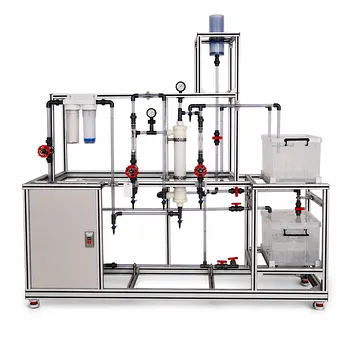
The upstream degasser's primary function is to create a quiet, non-turbulent environment for gravity settling. It achieves this by flashing off dissolved gases entrained in the incoming crude stream and reducing the fluid's pressure to atmospheric levels. This step is critical because it prevents disruptive gas bubbles from rising through and mixing the downstream dehydration tanks, where the delicate process of water-oil separation occurs.
The upstream degasser fundamentally enables laminar, gravity-driven flow by removing the energetic, turbulent phase of dissolved gas. In an educational pilot plant, this configuration allows students to physically witness the critical process transition from a chaotic, three-phase (gas-oil-water) separation to a calm, highly effective two-phase (oil-water) gravity settling operation.
The Degasser's Core Function: Protecting the Settling Zone
The upstream degasser isn't merely a preliminary step; it is the essential guardian of the entire downstream process. Its mechanical function directly dictates the quality of separation in the tanks that follow.
Flashing Off Dissolved Gases to Prevent Turbulence
Crude oil arriving from a wellhead or a pressurized source contains dissolved gases, much like a sealed bottle of soda. When pressure is suddenly reduced to atmospheric levels inside the degasser vessel, these gases violently break out of solution.
If this "flashing" were to happen in a downstream dehydration or wash tank, the rapid bubble formation would create intense mixing and turbulence. This chaotic environment would instantly re-entrain water droplets into the oil and shatter any developing oil-water interface, making effective gravity settling impossible.
Reducing Pressure to Enable Gravity Flow
The degasser acts as a pressure break, lowering the incoming stream's high pressure to atmospheric. This is a deliberate design choice to eliminate the need for downstream pumps.
Pumps are high-shear devices that vigorously emulsify oil and water, creating tiny, stable water droplets that can take days or weeks to settle by gravity. By establishing an open-to-atmosphere, low-pressure system at the very beginning, the process entirely avoids this source of mechanical emulsification.
Designing by the Principle of Gravity Flow
The true innovation of this configuration lies in its complete reliance on physics rather than machinery to move fluid. The design philosophy is to gently guide the process, not forcefully push it.
Eliminating Emulsification Through Low-Shear Design
The configuration between the degasser and the final dehydration tank is designed to use only gravity as the motive force. Fluid moves from the degasser to the water knock-out drum and then to the dehydration tank solely due to a designed hydrostatic head difference.
This gravity-driven transfer is inherently low-shear. Without pumps or high-pressure drops across valves, the fluid moves slowly and peacefully, preserving any nascent water droplet coalescence. The equipment functions as a unit where the primary separation mechanism is time and density difference, undisturbed by mechanical energy.
Sequencing the Separation Stages
The pilot plant models a logical sequence of unit operations. The degasser handles the gross removal of the gas phase. Only then does the now-degassed liquid, flowing under a quiet gravity head, enter the next vessel designed specifically for liquid-liquid separation.
This staged approach teaches a fundamental process engineering principle: address the most disruptive phase first. By removing the gas, you change a complex three-phase separation problem into a more manageable, stable two-phase problem.
Educational Pilot Plants: A Model for Process Understanding
For students and engineers, a pilot plant replicating this setup is a powerful pedagogical tool. It transforms abstract separation theory into a tangible, observable lesson in fluid dynamics and process design.
Modeling the Three-to-Two Phase Transition
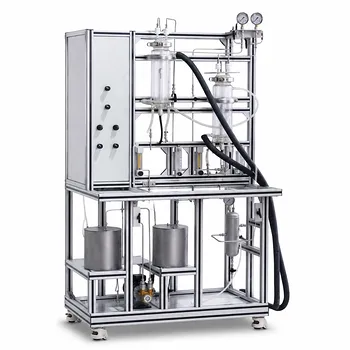
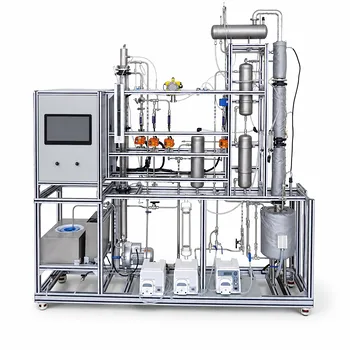
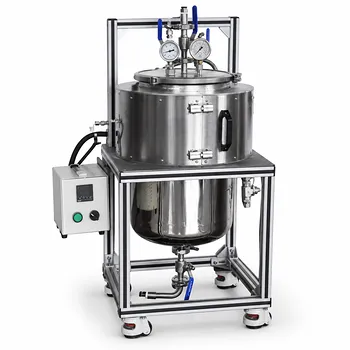
An educational unit operations plant allows students to trace the process stream and witness the phase transition firsthand. At the degasser, they can observe gas being vented off. In the downstream glass-walled tanks, they can then clearly see the calm oil-water interface developing, with quiet settling and coalescence.
This makes the critical concept of "low-shear gravity flow" concrete. The lesson is that effective separation isn't just about chemicals or internals; it's about masterfully managing the fluid's energy to create the conditions for nature—density difference—to do the work.
Demonstrating Real-World Process Design Logic
These plants teach students to think like process designers. The placement of the degasser upstream is not arbitrary; it’s a deliberate strategy to protect the separation integrity of the dehydration tank.
By operating the pilot plant, students learn to avoid the common pitfall of using pumps for transfer between separator vessels. They see that a design choice made at the front end of a process—to flash gas and break pressure to atmosphere—has profound and beneficial consequences for simple, reliable, and efficient liquid-liquid separation downstream.
Understanding the Trade-offs
While this gravity-flow configuration is elegant, it is crucial to understand its inherent limitations and design constraints.
- Elevation Requirement: A gravity-flow system requires a significant vertical drop to generate the necessary motive force. This demands multi-level structures and careful site planning, which can be impractical or expensive at full industrial scale for certain flat terrains.
- Capacity and Rate Limitations: Atmospheric degassers and gravity settlers are best suited for handling low to moderate flow rates. High-throughput systems would require vessels so large that they become structurally and economically prohibitive, making pressurized, more compact separation a necessity.
- Sensitivity to Feed Changes: The system's performance is highly dependent on a relatively stable feed composition and viscosity. A change to a heavier, more viscous crude oil can dramatically slow settling rates, rendering the fixed-residence-time gravity tanks less effective without a change in process temperature or a chemical aid.
Making the Right Choice for Your Goal
The upstream degasser in a gravity-settling process is a lesson in elegant design. How you apply this knowledge depends on your primary objective.
- If your primary focus is education and fundamental understanding: This pilot plant configuration is the ideal teaching tool to visually demonstrate the physics of phase separation, the dangers of shear-induced emulsions, and the philosophy of low-energy process design.
- If your primary focus is designing a field-scale separation facility: Use this principle as a golden standard to benchmark against. While pure gravity flow may not always be feasible, the goal remains the same: minimize pressure drops and avoid pumps after the degasser to protect the separation process from turbulence.
The degasser’s true function is less about what it removes and more about what it preserves: a tranquil environment where water and oil can finally part ways.
Summary Table:
| Stage / Feature | Operational Mechanism | Key Benefit in Separation |
|---|---|---|
| Gas Flashing | Lowers fluid pressure to atmospheric levels | Prevents turbulent gas bubbles from disrupting settling tanks |
| Gravity-Driven Flow | Relies on hydrostatic head difference (no pumps) | Eliminates pump-induced shear and emulsion of oil & water |
| Phase Simplification | Isolates gas removal from liquid separation | Converts complex 3-phase flow into stable 2-phase settling |
| Educational Utility | Visual, multi-level glass-walled design | Allows students to observe laminar settling and phase boundaries |
Bring Real-World Process Engineering to Your Lab
Bridge the gap between process theory and hands-on practice. LABPARK provides premium Educational and Vocational Unit Operations Pilot Plants in chemical engineering, bioprocess & biotech, and environmental & water treatment.
Specially designed for universities, research institutes, and enterprises, our pilot plants enable students and researchers to visually trace phase transitions, analyze gravity flow, and master industrial separation techniques.
Ready to elevate your training and research capabilities? Contact LABPARK today to discuss your laboratory requirements!
Related Products
- Photocatalytic Membrane Separation and Degradation Unit Operations Pilot Plant
- Constant Pressure Filtration Educational Unit Operations Pilot Plant
- Fixed-Bed Chemical Reaction and Gas Dust Tar Removal Unit Operations Pilot Plant
- Multi-Functional Membrane Separation Educational Pilot Plant for Unit Operations Lab
- Rising and Falling Film Evaporation Educational Unit Operations Pilot Plant
People Also Ask
- What are the key differences in membrane configurations? Choose the Right Unit Operations Pilot Plant
- How Do Pervaporation, Vapor, and Gas Permeation Differ in Pilot Plants? Key Comparison
- What are the structural & performance trade-offs of flat-sheet, spiral-wound, & hollow-fiber membrane modules?
- Pervaporation vs. Vapor Permeation: Handling Suspended Solids in Membrane Pilot Plants
- How do PEI, PVDF, and PSU membranes compare in pilot plants? Find the best fit.