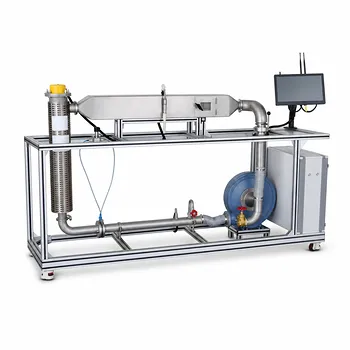
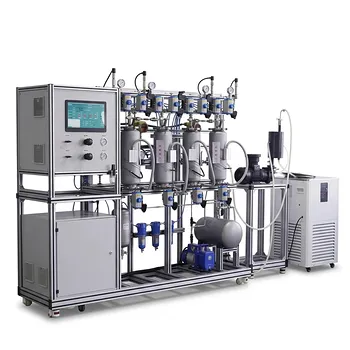
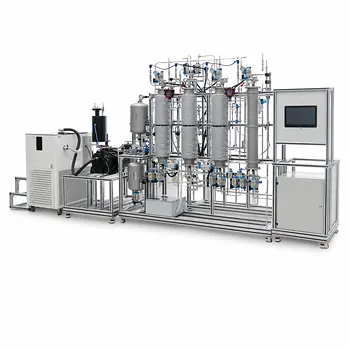
Energy efficiency is not just an industrial buzzword—it’s a core principle that can be made tangible in the lab. Incorporating a waste gas recycling loop in a unit operations drying pilot plant allows students to study energy conservation and process optimization with immediate, measurable results. By mixing warm exhaust air with fresh intake air before the preheater, the system visibly reduces the external heat required for drying. Using the plant’s instrumentation, students can experimentally determine the optimal recycle ratio, map mixing state points on humidity charts, and calculate concrete improvements in thermal efficiency.
The waste gas recycling loop transforms a conventional dryer from an isolated unit operation into a rich learning system for energy integration, psychrometric analysis, and sustainable process design. Its true value lies in teaching students to think in terms of closed-loop systems rather than linear flows.
Unpacking the Educational Value of a Closed-Loop Dryer
Turning Warm Exhaust into a Didactic Resource
The pilot plant physically re‑routes a portion of the humid, warm exhaust back to the inlet. This simple act immediately demonstrates a practical energy‑saving strategy used across industry. Instead of losing sensible heat to the environment, the recycled gas preheats the incoming fresh air.
The energy reduction is not abstract. Students measure heater power with and without recycle, seeing firsthand how much external energy the loop saves. This direct observation cements the concept of heat integration far more effectively than a textbook problem ever could.
Mastering Psychrometrics with Real Data
Every drying process sits firmly in the world of humidity, dew points, and enthalpy. The recycle loop provides a dynamic, real‑time case study for psychrometric chart analysis.
As recycle ratio changes, the mixing point of exhaust and fresh air shifts. Students plot inlet, mixing, and outlet states, trace heating and drying paths, and visualize how air properties evolve inside the loop. The chart is no longer a static diagram—it becomes a live tool for diagnosing and optimizing the process.
Finding the Sweet Spot: experimental Determination of Optimal Recycle Ratio
The plant’s instrumentation—temperature, humidity, flow, and energy sensors—turns the dryer into a test bed. Students systematically vary the recycle ratio and collect performance data.
They then calculate key metrics such as thermal efficiency and specific energy consumption. Plotting these against the recycle ratio reveals an optimum that balances energy savings against the rising humidity of the incoming air. This hands‑on optimization exercise mirrors real industrial decision‑making, where data, not guesswork, guides process design.
From Drying to System Thinking: Broader Engineering Lessons
The Conceptual Bridge to Reactor Recycle Loops
While chemical reactor loops teach students to distinguish single‑pass conversion from overall conversion, the drying gas recycle offers an intuitive energy analogue. The single‑pass heat consumption drops dramatically because the recycled air already carries sensible heat, much like unreacted feed returning to a reactor reduces the fresh feed rate.
Seeing this parallel helps students internalize recycle philosophy across disciplines. The drying plant provides a gentle, visually accessible introduction to closed‑loop thinking before they tackle the mass‑balance complexities of a synthesis loop.
Tackling Simulation Tear Streams and Convergence
If the pilot plant is paired with simulation software, students face a challenge familiar to anyone modeling recycle systems: where to break the loop and how to initialize the tear stream. Providing a reasonable estimate for the recycle flow rate prevents divergence, teaching an essential skill in steady‑state process simulation.
The physical plant validates the model. Students can iterate between measured values and simulation guesses, learning why convergence matters and how to achieve it efficiently. This bridges the gap between theoretical modeling and real operational stability.
Embedding Sustainability and Waste Minimization
Recycling exhaust gas directly reduces the volume of air discharged to the environment. In an era where the treatment of exhaust, wastewater, and residues is a non‑negotiable competency, this loop introduces waste minimization at the source.
Students see that sustainability isn’t just about end‑of‑pipe cleanup; it starts with process design that reuses energy and reduces emissions. The lesson aligns directly with environmental safety training and green engineering principles, all within the safe confines of a pilot plant.
Practical Skills for Future Engineers
Data‑Driven Process Optimization
Working with the recycle loop forces students to move beyond qualitative observations. They collect streams of sensor data, calculate energy balances, and turn raw numbers into actionable process insights. This data fluency is exactly what modern employers expect.
Understanding Process Control Dynamics
Closing the loop introduces feedback—disturbances in the exhaust humidity affect the inlet and cascade through the dryer. Students observe how a change in recycle damper position influences the entire system’s stability. It’s an early, concrete lesson in process control and dynamics that a once‑through dryer cannot offer.
Safety and Environmental Awareness
Operating a recycle loop also raises practical questions: What happens if humidity builds too high and condensation occurs? Could contaminants accumulate? Students learn to identify these risks and set operational boundaries, reinforcing the safety‑first mindset required in any plant environment.
The Hidden Trade‑offs of Gas Recycling in Drying
Higher humidity can punish drying rate. As the recycle ratio climbs, the mixed inlet air carries more moisture. Beyond a certain threshold, the drying rate falls sharply, and the overall cycle time may increase, negating some energy savings.
Fan energy and pressure drop matter. Routing gas through a recycle duct adds resistance. The fan must work harder, consuming electricity. In some configurations, this parasitic load can erode the net efficiency gain if not carefully accounted for.
Contaminants can accumulate. Closed‑loop operation may concentrate fine particles, volatiles, or odorous compounds. Periodic bleeding or filtration becomes necessary, adding complexity that students must recognize and manage.
The optimum is never universal. The best recycle ratio depends on ambient air conditions, product moisture sensitivity, and throughput requirements. Teaching students to find the optimum for each scenario instills a respect for context‑specific engineering.
Making the Right Choice for Your Educational Goal
After evaluating the educational and practical dimensions, align the investment with your specific objectives.
- If your primary focus is teaching energy conservation fundamentals: The waste gas recycle loop is an unmatched tool for demonstrating heat integration, psychrometrics, and thermal efficiency in a single, tangible setup.
- If your primary focus is preparing students for industrial process design: The loop introduces closed‑loop thinking, trade‑off analysis, and data‑driven optimization—skills directly transferable to reactor‑separator‑recycle systems and beyond.
- If your primary focus is integrating sustainability into the curriculum: The plant turns waste reduction into a hands‑on exercise, making environmental principles concrete rather than abstract.
- If your primary focus is building simulation‑to‑reality competence: Pairing the physical loop with a process simulator teaches tear‑stream convergence and model validation, bridging theory and practice powerfully.
The waste gas recycling loop elevates a simple drying experiment into a compelling lesson in system integration, energy stewardship, and real‑world decision‑making. It gives students not just a result, but the ability to think like an engineer.
Summary Table:
| Key Educational Value | Practical Learning Benefit |
|---|---|
| Heat Integration | Measure real power savings by recycling warm exhaust air |
| Psychrometrics | Plot real-time humidity and enthalpy changes on charts |
| Process Optimization | Find the optimal recycle ratio to balance energy vs. drying rate |
| Systems Thinking | Understand feedback loop control and process simulation concepts |
Elevate Your Lab Training with LABPARK
To prepare the next generation of engineers for sustainable industrial practices, hands-on training is essential. LABPARK provides advanced Educational and Vocational Unit Operations Pilot Plants in chemical engineering, bioprocess & biotech, and environmental & water treatment for universities, research institutes, and enterprises worldwide.
Our pilot plants—equipped with realistic features like waste gas recycling loops—help your students master energy conservation, process optimization, and system dynamics.
Contact LABPARK today to discuss your lab requirements!
Related Products
- Residence Time Distribution and Reactor Flow Characteristics Determination Educational Pilot Plant
- Multi-Functional Drying Educational Unit Operations Pilot Plant
- Fixed-Bed Chemical Reaction and Gas Dust Tar Removal Unit Operations Pilot Plant
- Solid Waste Pyrolysis and Refining Educational Pilot Plant for Unit Operations
- Circulating Wind Tunnel Drying and Convective Heat Transfer Coefficient Determination Educational Pilot Plant
People Also Ask
- Why is temperature regulation via a cooling jacket a critical feature in CSTR pilot plants used for laboratory training?
- What is the significance of CSTR chaotic behavior? Master Reactor Safety
- How does CSTR cooling jacket design influence stability? Control reactor oscillations.
- How does steady-state multiplicity affect the operation and safety of exothermic reactions within a CSTR pilot plant? - Guide
- What parameters to monitor transitioning from Batch to CSTR? Master Pilot Plant Setup