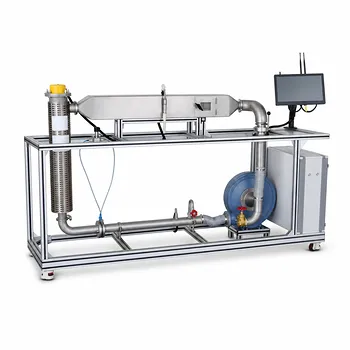
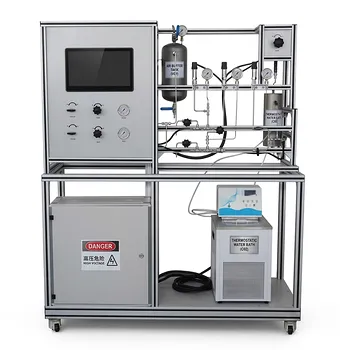
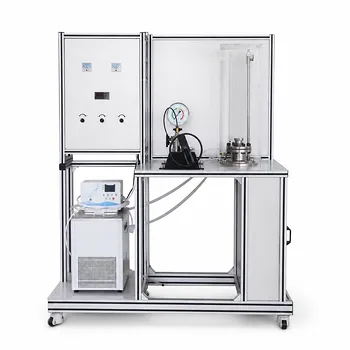
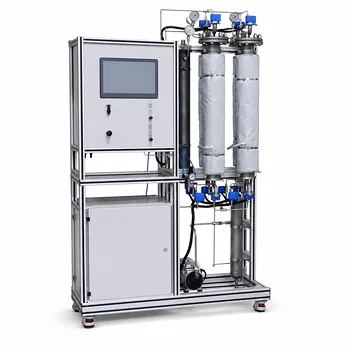
The choice between an air cooler and a water-cooled heat exchanger in a chemical engineering unit operations training system hinges on three core factors: available utility infrastructure, process temperature requirements, and the specific educational objectives of the training system. A water-cooled shell-and-tube unit is typically the more compact and operationally economical choice when a reliable source of cooling water exists. However, an air-cooled finfan cooler becomes essential in arid regions, when cooling water is prohibitively expensive, or when the process fluid’s target outlet temperature remains above 65°C.
For most educational pilot plants, water-cooled exchangers offer a compact, cost-effective solution—provided a dependable water supply is available. Air coolers become imperative where water is scarce or for high-temperature processes, and they deliver unique pedagogical value by teaching air-side heat transfer and fan-power calculations.
Utility Infrastructure and Availability of Cooling Water
The Dependence on a Reliable Water Source
Water-cooled heat exchangers demand a consistent and sufficient supply of cooling water. In a laboratory or classroom setting, this utility may simply not be available—or come at a prohibitive cost. If the training facility lacks accessible cooling water loops or is located in an arid geographic region, water-based cooling becomes a non-starter.
When Air Cooling Becomes the Only Practical Answer
In such utility-constrained environments, air-cooled finfan coolers are the go-to solution. They eliminate the need for water, making the system entirely self-contained on the air side. This independence not only simplifies the installation but also avoids the complexities and costs of water treatment, recirculation, and wastewater disposal.
Process Temperature Requirements and Economic Boundaries
The Temperature Thresholds That Guide the Decision
The target outlet temperature of the process fluid is the single most decisive technical parameter. Industry guidelines crystallize into three clear bands:
- Above 65°C: Air coolers are generally the most cost-effective and practical option. The large temperature driving force overcomes the inherently low air-side heat transfer coefficient.
- Between 50°C and 65°C: A detailed economic analysis is required, balancing energy consumption, equipment cost, and utility expenses.
- Below 50°C: Water-cooled systems are typically preferred because the superior thermal properties of water deliver efficient cooling in this range.
Why High Outlet Temperatures Favor Air Cooling
When the process does not need to reach low final temperatures, the penalty of air’s low heat transfer coefficient diminishes. There is no need to invest in a water system to achieve a modest temperature reduction. Additionally, for hot process streams, using ambient air avoids the thermal shock and potential fouling that can occur when introducing cold cooling water directly.
Footprint, Installation Space, and Equipment Cost
The Space Penalty of Air Coolers
Air has a notoriously low heat transfer coefficient, meaning an air cooler requires a significantly larger heat transfer area to reject the same thermal duty as a water-cooled unit. This translates into a larger physical footprint and a higher initial equipment cost due to the extended finned surfaces and fan assemblies.
Water-Cooled Compactness as a Lab Advantage
For a training pilot plant where bench or floor space is limited, water-cooled shell-and-tube exchangers are far more compact. They pack a high heat transfer area into a relatively small volume, making them easier to integrate into crowded laboratory layouts.
Operating Costs and Energy Consumption
The Hidden OpEx of Air-Cooled Systems
Although air coolers eliminate water and water-treatment costs, they are more expensive to operate in terms of electricity. Large fans must continuously draw air across the finned tubes, and the fan power can become a significant operating expense, especially for high-duty systems. In an educational context, this creates a valuable teaching opportunity to calculate fan power requirements and understand air-side pressure drop.
Water Cooler Savings Tied to Resource Stability
Water-cooled exchangers rely on pumps and a steady water source, but their operating cost is typically lower if the facility already has an existing cooling water network. The true economic comparison must factor in the full lifecycle of the water system, including treatment, pumping, and potential permits—items that an air cooler side-steps entirely.
Educational Considerations for a Unit Operations Training System
Teaching the Fundamentals of Heat Transfer
Both exchanger types offer rich pedagogical ground. A water-cooled system may be more straightforward for teaching basic heat balance calculations and temperature cross-effects. An air cooler, however, forces students to grapple with the concept of air-side resistance as the controlling resistance, making it an excellent platform for illustrating overall heat transfer coefficients dominated by one side.
Demonstrating Real-World Engineering Trade-offs
Deploying both an air cooler and a water-cooled exchanger in the same pilot plant creates a powerful comparative learning environment. Students can run experiments under varying ambient conditions to see how relative humidity and dry-bulb temperature shift performance, or they can directly measure the difference in approach temperature between the two systems. This hands-on comparison cements the economic and thermodynamic principles behind utility selection.
Sizing and Cost Estimation Exercises
When designing an air cooler for a training system, the industry practice of basing cost estimates on the outside bare tube surface area (rather than the extended finned area) becomes a teachable moment. Students learn how standard costing methods account for the base tube diameter and apply fin efficiency factors, bridging the gap between textbook correlations and real vendor quotations.
Understanding the Trade-offs and Common Pitfalls
Limitations of Air Coolers in an Educational Setting
- Fan noise: Large air coolers can be loud, potentially disrupting lectures or lab work in small rooms.
- Performance sensitivity: The cooling capacity drifts with ambient temperature and humidity, making it harder to maintain steady-state conditions for reproducible student experiments.
- Poor low-temperature performance: Air coolers struggle to cool a process stream below roughly 15–20°C above the ambient dry-bulb temperature, limiting their application for sub-ambient training exercises.
Limitations of Water-Cooled Exchangers
- Water quality and fouling: Untreated or hard water can lead to scaling and biological growth on the tube side, increased maintenance, and inconsistent heat transfer.
- Utility lock-in: The training rig becomes permanently tied to a water supply; moving the pilot plant to another lab or demonstrating off-grid operation becomes impossible.
- Higher complexity for transient experiments: Water flow and temperature must be controlled precisely, introducing another layer of instrumentation that can distract from the core heat transfer lesson.
When Combining Both Systems Becomes Overwhelming
While a dual-system pilot plant maximizes teaching flexibility, it also multiplies the control logic, instrumentation, and safety interlocks. For a single-term laboratory, instructors may find that students spend more time troubleshooting the utilities than absorbing the heat transfer fundamentals. The design must balance pedagogical ambition with operational simplicity.
Making the Right Choice for Your Training System
The best decision aligns the exchanger type with your facility’s limits, your educational goals, and the process temperatures you intend to demonstrate. Consider these targeted recommendations:
- If your primary focus is maximizing teaching flexibility and comparative analysis: design a pilot plant with both an air-cooled finfan cooler and a water-cooled shell-and-tube exchanger, enabling students to run side-by-side experiments on the same process stream.
- If your lab has limited utility infrastructure (no cooling water): opt for an air-cooled system; it will be self-contained and can still serve as an excellent platform for teaching air-side heat transfer and fan power calculations.
- If you plan to demonstrate high-temperature processes (outlet > 65°C): an air cooler is the economically rational choice and prevents the complications of introducing cooling water to a hot stream.
- If your primary goal is a compact, low-maintenance rig for basic heat balance demonstrations: a water-cooled shell-and-tube exchanger, fed by existing city water or a small chilled-water loop, offers the simplest path to repeatable, clear-cut results.
- If you want to emphasize real-world costing and design methods: include a scaled-down air cooler and have students size it using the outside bare tube area method, directly connecting laboratory work to industrial practice.
The ideal training system turns the fundamental limitation of air—its low heat transfer coefficient—into a hands-on lesson in how real engineers choose and size equipment. By matching the cooling technology to your lab’s infrastructure and your curriculum’s core learning outcomes, you create an environment where students don’t just see the equations but experience the trade-offs that shape industrial decisions every day.
Summary Table:
| Selection Factor | Air-Cooled Heat Exchangers | Water-Cooled Heat Exchangers |
|---|---|---|
| Utility Requirements | None (uses ambient air) | Reliable cooling water loop required |
| Optimal Process Temp. | Best for outlet temperatures > 65°C | Best for outlet temperatures < 50°C |
| Footprint & Space | Large physical footprint | Compact, space-saving design |
| Key Pedagogical Focus | Air-side resistance & fan power calculations | Heat balance & temperature crossover |
| Operational Sensitivity | Highly affected by ambient weather | Stable and reproducible performance |
Equip Your Lab with the Right Thermal Systems
Choosing the right heat exchanger configuration is critical for effective hands-on training. LABPARK provides state-of-the-art Educational and Vocational Unit Operations Pilot Plants in chemical engineering, bioprocess & biotech, and environmental & water treatment for universities, research institutes, and enterprises.
We help you design custom pilot plants that match your physical facility constraints while maximizing pedagogical value for your students.
Ready to optimize your training laboratory? Contact our engineering team today to find the perfect configuration for your curriculum!
Related Products
- Educational Compression Refrigeration Performance Determination Unit Operations Pilot Plant
- Rising and Falling Film Evaporation Educational Unit Operations Pilot Plant
- Circulating Wind Tunnel Drying and Convective Heat Transfer Coefficient Determination Educational Pilot Plant
- Comprehensive Heat Transfer Coefficient Determination Educational Unit Operations Pilot Plant
- Solid Spherical Heat Transfer Coefficient Determination Educational Chemical Engineering Pilot Plant
People Also Ask
- In chemical engineering unit operations training plants, how does partial conversion with recycle improve selectivity?
- How should operators and lab engineers resolve material-balance problems? Apply degree-of-freedom analysis
- What process factors must be evaluated when replacing vapor-compression refrigeration? A pilot-plant checklist
- Why Switch Unit Operations Flow Configurations? Impact on Experimental Measurements
- Why is distinguishing between elastic and plastic deformation critical? Prevent tablet capping.