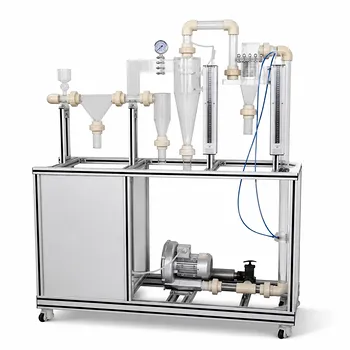
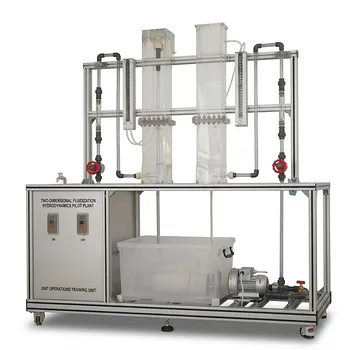
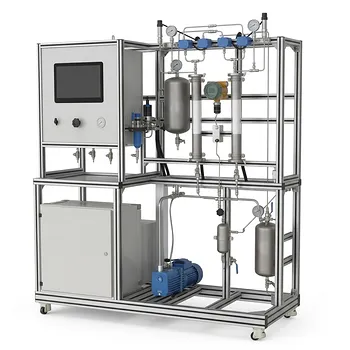
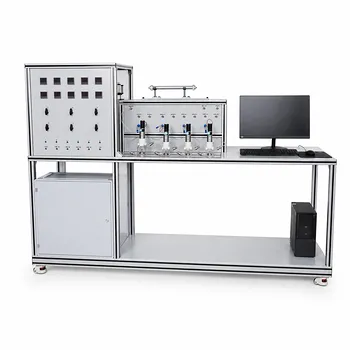
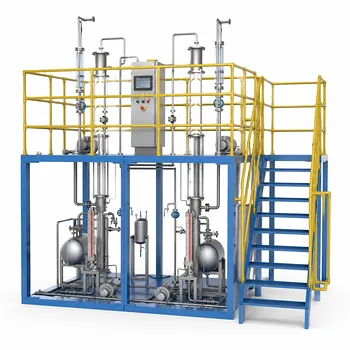
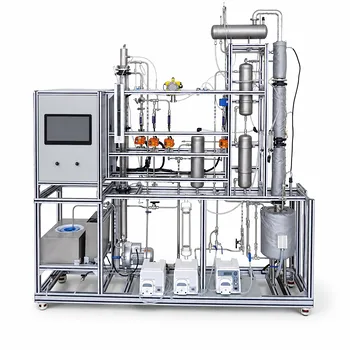
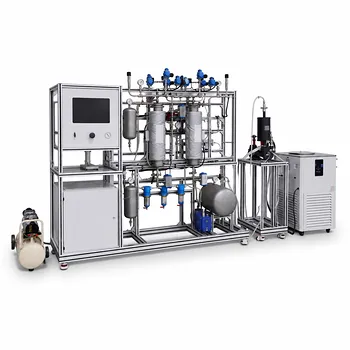
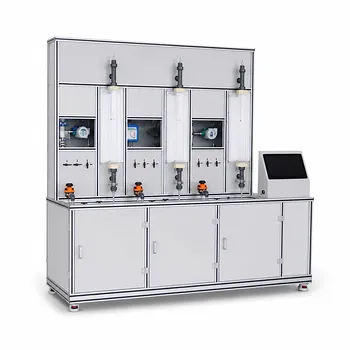
A precisely instrumented gas-solid reactor pilot plant—typically a packed or fluidized bed unit with multi-zone temperature control, high-accuracy gas flow regulation, and real-time compositional analysis ports—is the defining design that allows students to deconstruct the complex reduction of iron oxides. By manipulating these integrated features, a student can replicate the counter-current chemical environment of a blast furnace, measure reaction rates under controlled conditions, and systematically identify whether gas-film mass transfer, ash-layer diffusion, or intrinsic surface kinetics governs the process.
The true value of these pilot plants lies not in miniaturizing a blast furnace, but in turning a multi-physics industrial phenomenon into a set of isolable, measurable laboratory variables. The combination of precise thermal zoning, flexible gas delivery, and instantaneous sampling transforms abstract reaction engineering theory into a clear, diagnostic toolkit for understanding gas-solid kinetics and mass transfer.
The Heart of Gas-Solid Kinetics: Replicating the Blast Furnace Environment
The industrial blast furnace hides its kinetic secrets inside a moving-bed reactor with steep temperature and composition gradients. A well-designed pilot plant deconstructs this complexity into three controllable domains that students can manipulate independently.
Multi-Zone Temperature Control: Walking the Thermodynamic Staircase
The reduction of hematite (Fe₂O₃) to metallic iron is not a single reaction—it progresses through discrete oxide phases at characteristic temperature thresholds: Fe₂O₃ → Fe₃O₄ near 450 °C, Fe₃O₄ → FeO around 600 °C, and FeO → Fe above 800 °C.
A pilot plant equipped with independently controlled heating zones lets students set each zone to these target temperatures, physically mapping the thermodynamic staircase.
By holding one zone at a fixed temperature while varying the temperature in another, they can isolate the kinetics of a single reduction step.
This staged control directly mirrors the real thermal gradient inside a blast furnace shaft, but in a form that can be probed and modeled step by step.
Precise Gas Flow Regulation: Engineering the Counter-Current Reagent
In a blast furnace, rising CO-rich gas meets descending iron ore. The pilot plant replicates this with mass flow controllers that deliver precise blends of CO, CO₂, and inert gases at set superficial velocities.
Students can vary the gas flow rate to simulate different regions of the furnace—high velocity near the tuyeres, low velocity higher up—and observe how the gas-solid contact time shifts the reduction extent.
By switching gas composition mid-experiment, they can emulate the changing CO/CO₂ ratio that real ore particles experience, linking gas-phase thermodynamics to solid conversion.
This ability to program the “atmosphere” around the solid bed is what turns a simple heated tube into a kinetic reactor capable of generating rate data that map onto industrial conditions.
Real-Time Analytical Sampling: Reading the Chemical Story as It Unfolds
A pilot plant’s sampling ports, coupled to online gas chromatography or mass spectrometry, give students a continuous readout of outlet gas composition.
Instead of waiting for a final solid analysis, they watch CO disappear and CO₂ appear in real time, calculating instantaneous reaction rates and detecting shifts in mechanism the moment they occur.
Placing multiple sampling points along the reactor height lets them measure the evolution of gas composition with bed depth—a direct analogue to the counter-current profile of a blast furnace.
This instantaneous feedback closes the gap between theoretical rate expressions and observable behavior, making it possible to fit kinetic models directly to experimental data.
Diagnosing the Rate-Controlling Mechanism Through Systematic Variation
Answering “which step is slow?” is the central intellectual task in gas-solid reaction analysis. Pilot plant design features exist precisely to make that diagnosis unambiguous.
Exposing Gas-Film Mass Transfer Control
When the conversion rate increases markedly with gas velocity, the primary resistance sits in the gas boundary layer around each particle.
In a pilot plant, the student simply raises the CO flow rate. If the reaction accelerates linearly or near-linearly, film diffusion is rate-controlling.
This regime dominates in rapid, highly exothermic reductions and is typically observed at high temperatures where the surface kinetics are inherently fast.
The pilot plant’s mass flow controllers make this test a routine sweep—no hardware modification needed, only a setpoint change.
Uncovering Pore Diffusion Control (Ash Layer Resistance)
Once the outer layer of a particle is reduced to a porous iron shell, incoming CO must diffuse through that solid product layer to reach the unreacted core.
In this regime, gas velocity becomes irrelevant, and even large temperature swings produce only modest kinetic changes.
The pilot plant reveals this by holding flow constant and varying temperature: a low apparent activation energy signals that ash diffusion limits the rate.
Students can further confirm the mechanism by running experiments with different particle sizes—the time for complete conversion scales with the square of particle radius under ash diffusion control, a test easily performed by swapping solid feed batches.
Isolating Intrinsic Chemical Kinetics
When the reaction is sluggish and temperature has a dramatic effect, surface kinetics dominate.
The pilot plant’s multi-zone heating allows the student to step temperature precisely while holding gas flow and composition constant.
A rapid rise in rate with temperature—quantified as a high activation energy—indicates that the chemical reaction at the interface is the rate-determining step.
In this regime, students can use the analytical sampling stream to measure concentration changes at different residence times, fit rate laws, and calculate true kinetic constants that are independent of transport effects.
Understanding the Trade-offs and Practical Limitations
A pilot plant is a deliberate simplification of industrial reality, and that simplification comes with blind spots.
- Scale‑down distorts hydrodynamics. The small bed diameter and uniform packing of a laboratory reactor often eliminate the channeling, wall effects, and heterogeneous flow that plague full-scale blast furnaces. Data collected under idealized flow must be viewed as intrinsic kinetic and mass transfer information, not a direct prediction of industrial performance.
- Safety constraints limit gas composition. While real blast furnaces operate with high CO concentrations and elevated temperatures, educational pilot plants often dilute reactive gases with inert streams. This reduces hazards but can mask certain kinetic regimes or alter the driving force for film diffusion.
- Transient thermal behavior differs. The furnace’s burden spends hours moving through a continuum of temperatures. A small, electrically heated pilot plant reaches thermal steady state quickly, sometimes missing slow solid-state transformations that influence industrial reduction profiles.
Making the Right Choice for Your Learning Goal
The specific configuration of a gas-solid pilot plant should match the kinetic question being asked. When selecting or designing such a unit, consider the following:
- If your primary focus is mapping the temperature-dependent phase sequence of reduction: Choose a packed bed reactor with multi-zone heating and at least three independent temperature control loops. Integrate multiple gas sampling ports along the bed height to correlate temperature with gas composition.
- If your primary focus is identifying the rate-controlling mechanism: Prioritize a unit that allows independent variation of gas velocity, temperature, and particle size—typically a rigidly instrumented tubular or fluidized bed reactor with mass flow controllers and pressure drop sensors.
- If your primary focus is teaching reactor design and scale-up methodology: Select a pilot plant with a data acquisition system that computes real-time conversion and calculates dimensionless numbers (like the Thiele modulus or Sherwood number), enabling direct comparison against classic kinetic models for shrinking core or progressive conversion.
- If your primary focus is studying mass transfer limitations: Use a reactor that can operate with a wide range of superficial gas velocities and that can accommodate solid samples of different geometries. Coupling this with fast-response gas analysis lets students build a direct correlation between flow conditions and film diffusion resistance.
The best pilot plant is not the one that most closely mimics a blast furnace in appearance, but the one that makes the fundamental transport and kinetic steps transparent, measurable, and teachable.
Summary Table:
| Rate-Controlling Mechanism | Key Diagnostic Variable | System Observation |
|---|---|---|
| Gas-Film Mass Transfer | Gas Velocity | Conversion rate increases with gas flow velocity |
| Ash Layer Diffusion | Particle Size & Temp | Conversion scales with particle size; low temperature sensitivity |
| Intrinsic Surface Kinetics | Multi-Zone Temperature | High activation energy; rate is highly sensitive to temperature |
Bring Industrial Chemistry to Life in Your Lab
Equip your students and researchers with the tools to master complex reaction engineering. LABPARK provides premium Educational and Vocational Unit Operations Pilot Plants in chemical engineering, bioprocess & biotech, and environmental & water treatment. Tailored for universities, research institutes, and enterprises, our systems deliver the precise thermal control and instrumentation needed to map kinetics and mass transfer.
Ready to upgrade your laboratory? Contact us today to explore our custom solutions!
Related Products
- Fixed Bed Gas Solid Catalytic Reaction Educational Pilot Plant
- Fluidized Bed Gas Solid Catalytic Reaction Educational Pilot Plant
- Micro-Scale Gas-Solid Catalytic Reaction Educational Pilot Plant
- Fixed-Bed Chemical Reaction and Gas Dust Tar Removal Unit Operations Pilot Plant
- Educational Unit Operations Pilot Plant for Intraparticle Diffusion Effective Factor Measurement
People Also Ask
- How do reactor pilot plants safely study gas-solid reactions? Master kinetics with thermal & flow control.
- How does the Mears criterion evaluate transport resistance? Key Guide to Intrinsic Kinetics
- Fluidized vs. Fixed Bed Reactors: Comparing Heat & Complexity in Pilot Plants
- Why is a multibed configuration necessary for exothermic reactions? Optimize your pilot plant trajectory.
- How is the friction factor determined for fixed-bed pilot plants? Select the best pressure drop correlation.