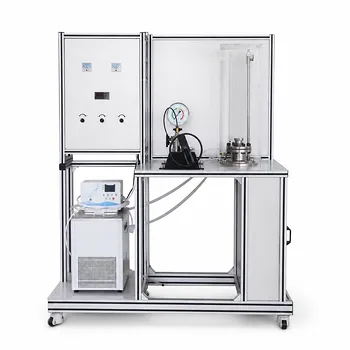
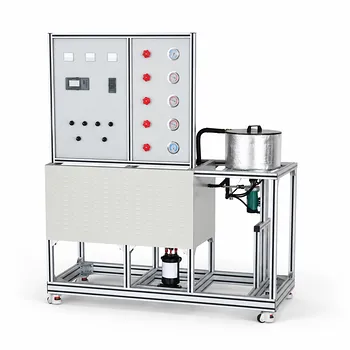
Phase transformations in copper complexes are governed by subtle shifts in coordination geometry and hydrogen‑bonded networks, triggered by vapor exposure or solvent interactions. The color changes provide a direct window into the thermodynamic and kinetic principles driving solid‑state and solvent‑mediated phase transitions. In chemical engineering teaching systems, these transformations are demonstrated through controlled vapor‑exposure chambers and reflux condensers, enabling students to quantify solid‑liquid and gas‑solid operations at both molecular and process scales.
The vivid color shifts observed in copper complexes are not mere curiosities—they are macroscopic reporters of molecular‑level reorganization. By leveraging these transformations in pilot‑plant experiments, chemical engineering education bridges coordination chemistry fundamentals with core unit‑operation principles such as mass transfer, thermodynamics, and kinetics.
The Chemical Principles Behind the Phase Transformation
Coordination Sphere and Hydrogen‑Bonded Network Rearrangement
The color of a copper complex is determined by its ligand field and the geometry of its coordination sphere.
When water vapor interacts with a solid copper complex, it can insert itself into the crystal lattice, disrupting existing hydrogen bonds and altering bond angles around the copper center.
This reconfiguration changes the energy gap between d‑orbitals, shifting the absorbed wavelength and producing a visible color change—for example, from green/yellow to orange upon steam exposure.
Thermodynamic Driving Forces for Phase Transformation
Every phase transformation is driven by a reduction in Gibbs free energy.
The reddish‑brown form of the copper complex is metastable—it exists in a local energy minimum but is not the most stable configuration under ambient conditions.
Refluxing in ethanol provides sustained thermal energy, allowing the system to overcome an activation barrier and settle into the thermodynamically stable black crystal phase.
Kinetic Control and Metastability
Even when a phase is thermodynamically favored, it may not form immediately because of kinetic hindrance.
The metastable reddish‑brown crystals persist indefinitely at room temperature because the molecular rearrangement required for the black phase is too slow without external energy input.
Refluxing supplies the necessary energy to accelerate bond breaking and reforming, effectively converting kinetic control into thermodynamic control—a central concept in chemical reaction engineering.
Demonstrating Solid‑Liquid Operations: The Refluxing Transformation
Metastable Reddish‑Brown to Stable Black Crystals
The classic teaching experiment involves a reddish‑brown copper complex that, after 3 hours of refluxing in ethanol, converts entirely to a black crystalline product.
This solid‑liquid suspension operation exemplifies solvent‑mediated phase transformation, where the ethanol acts as both a heat transfer medium and a solvent that facilitates molecular motion at the crystal surface.
The Reflux Condenser as a Teaching Tool
A standard reflux condenser setup in a pilot plant enables students to maintain constant temperature while recycling evaporated solvent.
They can measure the rate of color change using in‑line spectrophotometry or intermittent sampling, correlating it with fluid temperature, stirring rate, and solvent composition.
This directly teaches heat and mass transfer, as the rate‑limiting step may be the dissolution of the metastable phase or the nucleation of the stable one.
Demonstrating Gas‑Solid Operations: Vapor‑Induced Phase Change
Steam Exposure and Color Shift
When a green/yellow copper complex is exposed to water vapor (steam), the solid undergoes a phase transformation to an orange product without dissolving.
The water molecules diffuse into the crystal lattice, forming new hydrogen bonds and rearranging the coordination sphere.
This gas‑solid reaction demonstrates solid‑state diffusion and adsorption—fundamental mass‑transfer operations in processes like drying, catalysis, and gas storage.
Vapor Exposure Chambers and Real‑Time Monitoring
Teaching‑scale pilot plants can include humidity‑controlled chambers with optical windows.
Students can track the transformation kinetics by monitoring the reflectance or color change over time, correlating it with vapor pressure and temperature.
Such experiments make abstract concepts like Fickian diffusion in solids tangible, showing how macroscopic properties (color) reflect microscopic transport phenomena.
Integrating Analytical Techniques for Deeper Insight
Spectrophotometric Tracking of Phase Transitions
Both the refluxing and vapor‑exposure experiments lend themselves to quantitative analysis using UV‑vis spectrophotometry.
In the solid‑liquid operation, a small sample can be dissolved and measured; in the gas‑solid operation, a fiber‑optic probe can directly read the solid’s reflectance.
This reinforces the link between coordination chemistry (ligand‑field changes) and process analytical technology, a skill vital for modern chemical engineers.
Relating to Broader Mass‑Transfer Concepts
The same coordination chemistry principles underlie other educational modules, such as the oxidation of colorless [Cu(NH₃)₂]⁺ to blue [Cu(NH₃)₄]²⁺ by gas‑phase oxygen.
While that reaction is primarily gas‑liquid mass transfer, it shares the theme of using color as an indicator of composition, allowing students to compare solid‑liquid, gas‑solid, and gas‑liquid operations in a unified framework.
Understanding the Trade‑offs and Pitfalls
Interpreting Color Changes Correctly
A color change alone does not always prove a complete phase transformation—spectroscopic validation (e.g., powder XRD or IR) is needed to confirm the final structure.
Students must learn to differentiate between surface color shifts due to hydration and bulk phase transformations.
Kinetic Reproducibility
The metastable phase is highly sensitive to particle size, temperature history, and trace impurities.
Inconsistencies in the reddish‑brown starting material can lead to variable induction times before the black phase appears, making it a teachable moment about nucleation and reproducibility in process engineering.
Scale‑Up Limitations
While the pilot‑plant demonstration is robust, scaling the refluxing transformation to a larger reactor may alter heat‑transfer rates and solvent‑to‑solid ratios, potentially changing the mechanism.
This illustrates the critical difference between lab‑scale thermodynamics and industrial‑scale kinetics, preparing students for real‑world challenges.
Making the Right Choice for Your Curriculum
If your primary focus is thermodynamics: Use the refluxing transformation to illustrate Gibbs free energy, metastable states, and activation energy, with color as a direct readout of phase composition.
If your primary focus is mass transfer: Deploy the vapor‑exposure chamber to explore gas‑solid diffusion, adsorption isotherms, and the effect of humidity on solid‑state transport.
If your primary focus is process analytics: Combine either experiment with in‑line spectrophotometry or fiber‑optic probes to teach real‑time monitoring and the relationship between molecular coordination changes and macroscopic property shifts.
Every color shift in these copper complexes is an invitation to teach core chemical engineering principles in a hands‑on, visually compelling way that students will remember long after the experiment ends.
Summary Table:
| Operation Type | Process Method | Color Shift | Core Engineering Principles |
|---|---|---|---|
| Solid-Liquid | Ethanol refluxing | Reddish-brown to black | Solvent-mediated phase change, heat & mass transfer, thermodynamic control |
| Gas-Solid | Water vapor exposure | Green/yellow to orange | Solid-state diffusion, adsorption kinetics, Fickian diffusion in solids |
Bring Chemical Engineering Unit Operations to Life in Your Lab
Bridge molecular theory and practical process engineering with premium educational hardware. LABPARK designs and provides high-performance Educational and Vocational Unit Operations Pilot Plants in chemical engineering, bioprocess & biotech, and environmental & water treatment for universities, research institutes, and enterprises.
Whether you need to demonstrate complex thermodynamics, mass transfer, or real-time process analytics, our pilot plants offer the scalability and precision your students need.
Contact LABPARK today to upgrade your curriculum and lab capabilities!
Related Products
- Carbon Dioxide PVT Curve Determination Educational Unit Operations Pilot Plant
- Dual-Mode Rectification Pilot Plant for Practical Training Unit Operations
- Multi Pump Fluid Transport Process Piping Unit Operations Training Pilot Plant
- Carbon Material Thermal Pretreatment Multiphase Separation Educational Pilot Plant
- Multi-Reactor Educational Pilot Plant for Reaction Engineering Unit Operations
People Also Ask
- How do temperature variations affect CO2 transport models in pilot plants? Model vs Reality
- What unit operations are critical for CCUS training pilot plants? Build hands-on engineering expertise.
- What key thermodynamic properties & engineering challenges affect scCO2 reactions in pilot plants?
- How are titration curves used in pilot plants? Guide to process control & endpoint accuracy
- What are the applications and limitations of the Virial EOS? Enhance Your Pilot Plant Lab