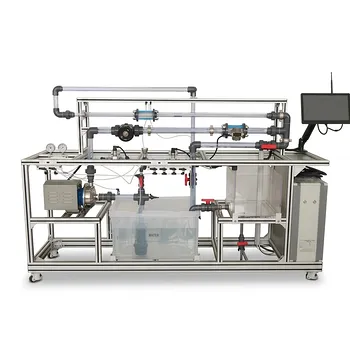
The Virial equation of state (EOS) excels in the educational pilot plant as a pedagogical bridge, connecting the abstract world of intermolecular forces to tangible, measurable gas-phase behavior. It is most practically applied to model non-ideal gas behavior in low-to-medium pressure operations, such as gas compression experiments or single-phase vapor flow studies. However, its fundamental limitation is an absolute inability to model the liquid phase, rendering it useless for any unit operation involving condensation, vapor-liquid equilibrium, or high-pressure conditions near the critical point.
The Virial equation is a powerful teaching tool for making thermodynamics visible, but its strict applicability to only the vapor phase makes it a specialized instrument, not a universal one. Its practical value in a pilot plant is inversely proportional to the pressure and complexity of the phase behavior; the moment liquid droplets form, its utility drops to zero.
The Pedagogical Power of the Virial Equation
The true practical application of the Virial EOS in a pilot plant is not about achieving the most accurate simulation, but about building an engineer's fundamental intuition. It transforms statistical mechanics from theory into a calculable reality.
Making Molecular Interactions Measurable
In a gas-phase pilot plant, the ideal gas law is just a starting point. The Virial equation's power series format ($Z = 1 + B/V + C/V^2 + ...$) allows students to directly quantify deviation from ideality.
- The second virial coefficient (B) is the star of the show for educational applications. It represents the net effect of interactions between just two molecules.
- Students can back-calculate this parameter from simple pilot-plant measurements of pressure, volume, and temperature (PVT data) for pure gases or simple mixtures like carbon dioxide and nitrogen.
- This process turns an abstract concept like the Lennard-Jones potential into a concrete, experimentally derived number. A student sees a non-zero
Bvalue and knows molecules are attracting or repelling each other.
Validating Theory with Physical Data
The Virial equation provides a direct loop between theoretical prediction and physical reality, which is the heart of engineering education.
- A pilot plant equipped with a gas compression system or a high-precision pressure vessel becomes a validation laboratory.
- Students use experimental PVT data to calculate the compressibility factor
Z. They can then fit this data using the Virial equation truncated after the second or third term. - This exercise doesn't just teach thermodynamics; it teaches model validation. Students learn that a model is a fit to reality, not reality itself, by seeing where the equation works perfectly and where it begins to fail.
The Hard Limits of Virial: Where the Model Breaks
The Virial equation’s limitations are not gradual; they are hard, defining the operational boundary of its applicability in any pilot plant.
The High-Pressure Ceiling
The Virial equation is fundamentally a density expansion series. Its accuracy is confined to the vapor phase, far from the critical point.
- At moderate to high pressures, the gas density increases, making interactions between three, four, or more molecules significant. The mathematical contributions of the third (C), fourth (D), and higher virial coefficients are no longer negligible.
- Truncating the series after the second or third term, as is common practice, introduces unquantifiable errors because the neglected higher-order interactions become dominant.
- In a pilot plant setting, this means the Virial equation is unsuitable for studying high-pressure reactors, supercritical fluid extraction, or deep gas injection processes. Using it there produces dangerously misleading results.
The Unbreakable Liquid Phase Barrier
This is the Virial equation's single most critical failure point for unit operations education.
- The power series formulation of the Virial equation is derived based on the theoretical assumption of a gas phase. It does not converge for a liquid.
- Any process involving a phase change is off-limits. This includes core chemical engineering operations like distillation, vapor-liquid equilibrium (VLE) studies in a flash drum, and condensation in heat exchangers.
- You cannot use a single Virial EOS to model a two-phase system self-consistently. If liquid forms in a pilot plant’s separator, the Virial model for that unit operation instantly becomes invalid. For these scenarios, a cubic equation of state (like Peng-Robinson or Soave-Redlich-Kwong) that applies to both vapor and liquid phases is mandatory.
Understanding the Trade-offs: Virial vs. Cubic Equations
Choosing an equation of state is an exercise in managing compromises. The Virial EOS's trade-off is a profound pedagogical clarity in exchange for a narrow operational envelope.
The Trade-off is Between Theory and Scope
The Virial equation's strength is its direct, parameterized link to molecular physics. A cubic equation's strength is its broad, empirical utility.
- Virial's Gain: Each term has a clear physical meaning linked to molecular clusters, providing a rigorous theoretical foundation that supports teaching statistical mechanics principles.
- Virial's Loss: This theoretical purity comes at the cost of universality. It cannot describe dense fluids.
- Cubic Equation's Gain: Models like Peng-Robinson can describe both gas and liquid phases, enabling a single, self-consistent calculation for an entire distillation column from reboiler to condenser.
- Cubic Equation's Loss: Their parameters are more empirical, heavily reliant on critical properties and an acentric factor. The link to fundamental intermolecular forces is obscured, making them less intuitive for first-principles teaching.
Common Pitfalls in Pilot Plant Experiments
A frequent mistake is choosing a model based on familiarity rather than the physics of the system.
- Pitfall 1: Using Virial for a System with Possible Condensation. If you're studying gas compression, the high-pressure stage post-cooler might cause condensation. The single-phase Virial model will predict physically impossible supercritical-like behavior without warning of the liquid dropout, leading to massive errors in flow rate and compressor work calculations.
- Pitfall 2: Ignoring Mixture Complexity. For gas mixtures, calculating the cross-second virial coefficient ($B_{ij}$) requires mixing rules and experimental interaction parameters like $k_{ij}$. Using pure-component data alone without properly validating the mixing rule against pilot-plant data renders the multicomponent Virial model just as empirical as a cubic model, but without the cubic model's phase-change capability.
Making the Right Choice for Your Educational Goal
The decision to use the Virial equation in your pilot plant should be driven purely by your pedagogical objective and the physical constraints of your experiment.
- If your primary focus is teaching the connection between molecular physics and bulk properties: Use the Virial equation in a gas-phase PVT experiment. Limit conditions to low pressure where the truncated series is demonstrably accurate. The goal is that "aha" moment when a student calculates the second virial coefficient.
- If your primary focus is designing or operating a unit operation involving phase change: Do not use the Virial equation. You must use a cubic EOS like Peng-Robinson or Soave-Redlich-Kwong. This applies to distillation, absorption with volatile solvents, or any study of vapor-liquid equilibrium. The need for phase continuity overrides the Virial model's theoretical elegance.
- If your primary focus is on high-accuracy gas-phase work at moderate pressures: Use the Virial equation judiciously, potentially with third coefficient terms, but cross-validate your results. Use a cubic equation as a benchmark to quantify the error introduced by truncating the Virial series. This teaches a powerful lesson on model boundaries.
The Virial equation of state is a precision instrument, not a blunt tool; its unmatched ability to illuminate molecular origins of non-ideality is yours to harness, provided you respect its absolute confines.
Summary Table:
| Feature | Virial Equation of State (EOS) | Cubic Equation of State (e.g., Peng-Robinson) |
|---|---|---|
| Phase Applicability | Vapor/Gas phase only (low-to-medium pressure) | Both Vapor and Liquid phases |
| Pedagogical Value | High (directly links molecular interactions to PVT data) | Moderate (more empirical parameters) |
| Phase Change & VLE | Unsuitable (cannot model condensation) | Excellent (ideal for distillation, flash drums) |
| Parameter Focus | Second/Third virial coefficients ($B$, $C$) | Critical properties ($T_c$, $P_c$) & acentric factor ($w$) |
Bring Thermodynamics to Life in Your Laboratory
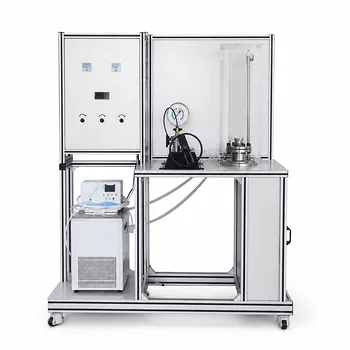
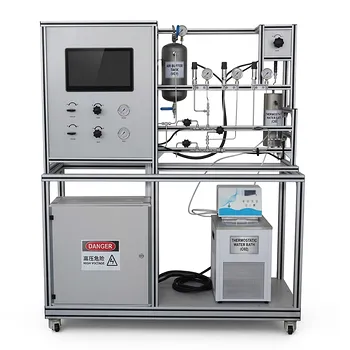
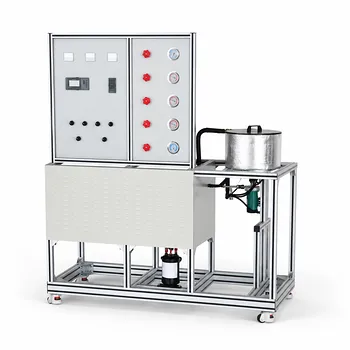
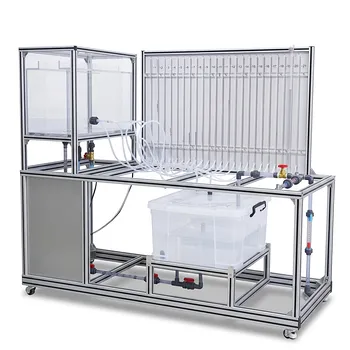
Looking to bridge the gap between abstract thermodynamic equations and hands-on engineering practice? LABPARK provides premium Educational and Vocational Unit Operations Pilot Plants in chemical engineering, bioprocess & biotech, and environmental & water treatment.
Engineered specifically for universities, research institutes, and enterprises, our pilot plants allow students and researchers to safely validate thermodynamic models, study fluid behavior, and master real-world unit operations.
Contact LABPARK today to discuss how our pilot plants can enhance your curriculum and research capabilities!
Related Products
- Carbon Dioxide PVT Curve Determination Educational Unit Operations Pilot Plant
- Binary System Vapor Liquid Equilibrium Data Determination Educational Unit Operations Pilot Plant
- Throttling Effect Determination Educational Unit Operations Pilot Plant
- Ternary Liquid-Liquid Equilibrium Educational Pilot Plant
- Educational Compression Refrigeration Performance Determination Unit Operations Pilot Plant
People Also Ask
- How do temperature variations affect CO2 transport models in pilot plants? Model vs Reality
- What unit operations are critical for CCUS training pilot plants? Build hands-on engineering expertise.
- What precautions prevent sample loss when volatilizing silica with HF? Crucial Steps for Safe Lab Training
- Why is selecting the correct EOS critical in pilot plants? PR vs. SRK compared.
- Why is cold junction compensation critical for thermocouples in pilot plants? Achieve Accurate Process Data