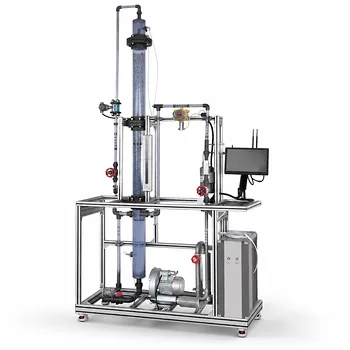
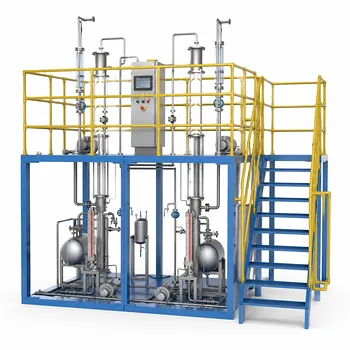
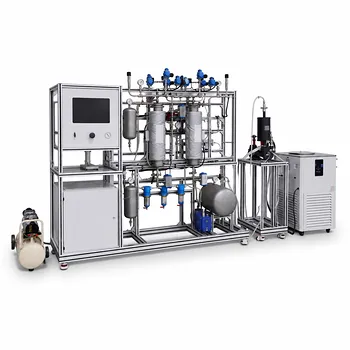
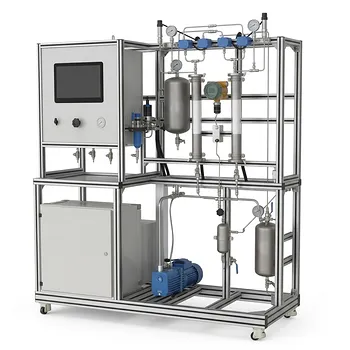
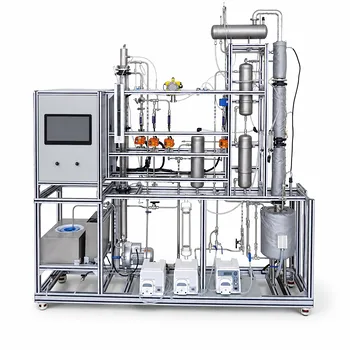
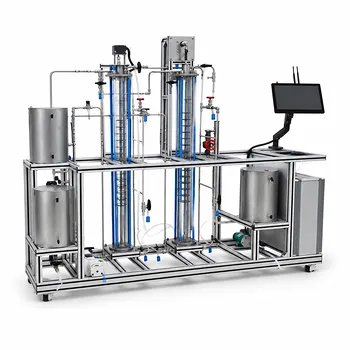
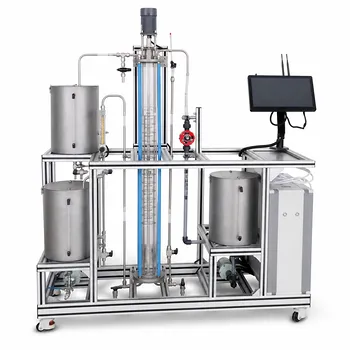
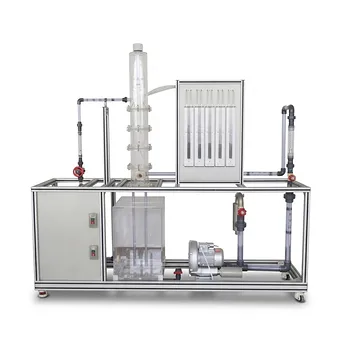
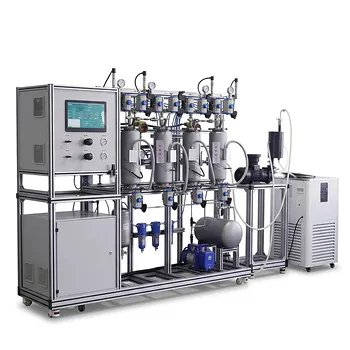
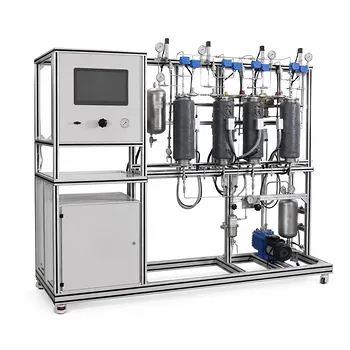
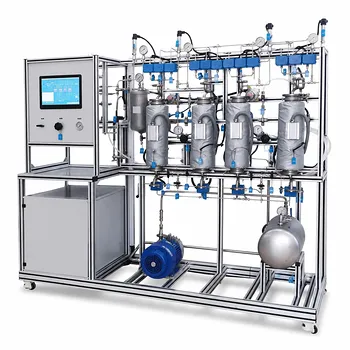
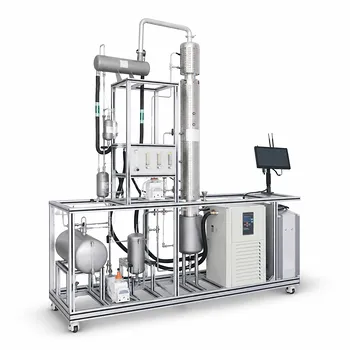
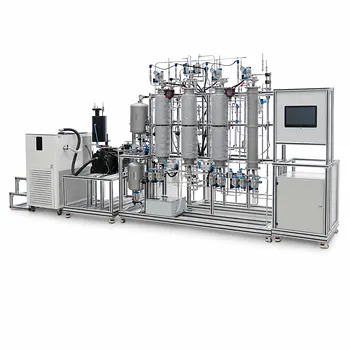
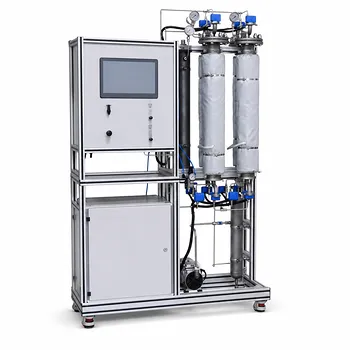
Stripping ammonia from water in a pilot plant is a masterclass in applied thermodynamics. It directly showcases how temperature-dependent gas-liquid equilibrium governs the separation, allowing you to transfer ammonia from the liquid to the gas phase by carefully controlling thermal energy. The exercise also teaches you to calculate mass transfer coefficients and evaluate stripping column efficiency using the fundamental principles of unit operations.
Stripping ammonia from an aqueous solution in an absorption/stripping pilot plant is a vivid demonstration of how shifting gas-liquid equilibrium through temperature manipulation—coupled with optimized gas-to-liquid flow ratios—enables selective solute removal. The core takeaway is that you can maximize ammonia volatilization while minimizing water vaporization only by precisely balancing heat input, column hydraulics, and mass transfer driving forces.
Why the Ammonia–Water System Is an Ideal Teaching Vehicle
The volatilization of ammonia from an aqueous ammonium hydroxide solution condenses several core chemical engineering principles into a single, observable separation process. The system is safe enough for a teaching lab, yet its behavior directly mirrors industrial stripping operations. Because ammonia is a highly soluble gas that also reacts with water, the system allows you to explore both physical equilibrium effects and the influence of weak chemical interactions.
The Overriding Role of Gas–Liquid Equilibrium
The most immediate principle you see is gas–liquid equilibrium, governed by Henry’s law for dilute solutions and modified by temperature. As the primary reference states, gas solubility decreases sharply as solvent temperature increases. With ammonia, the equilibrium partial pressure rises exponentially with temperature, meaning a heated ammonium hydroxide solution becomes thermodynamically inclined to release NH₃ into a gas phase.
Temperature as the Process Lever
In the pilot plant, the feed liquid is heated to shift the equilibrium toward the gas side. This directly demonstrates that separation is not just about contact; it’s about manipulating thermodynamic conditions. You control the driving force for mass transfer by raising the temperature, which increases the equilibrium slope m in the stripping operating line equation.
Mass Transfer Fundamentals in a Packed Stripping Column
Once the equilibrium is shifted, the actual rate of ammonia removal depends on mass transfer kinetics and column hydrodynamics. A packed column provides counter-current gas–liquid contact, and the pilot plant allows you to measure inlet and outlet concentrations to quantify performance.
How Mass Transfer Coefficients Are Calculated
The pilot plant is instrumented to collect liquid-phase ammonia concentrations at both ends of the column. With known gas and liquid flow rates, you can use material balances and the two-film theory to determine an overall liquid-phase mass transfer coefficient (KLa). This teaches students how to translate raw concentration data into a rate-based performance metric that is transferable to larger-scale designs.
The Stripping Factor and Operating Line
Unlike absorption, where the operating line lies above the equilibrium curve, a stripping operation requires the operating line to lie below the equilibrium curve. The stripping factor (L/mG) must be less than the slope of the equilibrium line for effective transfer. In a pilot plant run, you can vary the stripping gas flow rate G or increase temperature (raising m) to lower the stripping factor, directly reducing the number of liquid-phase transfer units (NOL) needed and improving efficiency.
Thermal Energy Management and Selective Volatilization
A central challenge this pilot plant highlights is selectivity. Heating the solution drives off both ammonia and water vapor. The process must be adjusted to supply enough thermal energy to release the desired amount of NH₃ while minimizing energy waste on water vaporization.
Balancing Heat Input and Separation Goals
This teaches energy integration principles and the concept of minimum thermodynamic work. You observe that excessive heating does not linearly improve stripping efficiency; instead, it disproportionately increases water vaporization, lowering the ammonia concentration in the exit gas. The pilot plant forces you to find an optimal temperature window—high enough for sufficient ammonia equilibrium pressure, yet low enough to prevent boiling and excessive water loss.
Understanding the Trade-offs
Every principle you demonstrate comes with a practical limitation. Understanding these trade-offs is what elevates the pilot plant experience from a simple demonstration to a genuine engineering investigation.
Energy Efficiency vs. Stripping Performance
Raising temperature increases m and lowers the stripping factor, which reduces the required column height. But it also increases sensible heat requirements and water evaporation. The pilot plant lets you quantify this trade-off by measuring power input and condensate loss. You learn that industrial stripping often uses a balance between preheater duty and column pressure drop, a lesson directly transferable to real-world solvent regeneration loops.
The Risk of Ammonia Slip
If the gas flow rate is too high or liquid distribution is poor, you can get ammonia slip—unabsorbed ammonia in the treated water outlet. Measuring concentration at the bottom outlet reveals when the stripping factor is not low enough or when liquid holdup is insufficient. This demonstrates column flooding and turndown limitations as well.
The Impact of Column Internals
Packed columns offer lower pressure drop and better turndown than trayed columns, but they can suffer from maldistribution. By running the pilot plant at varying liquid-to-gas ratios, you see the onset of loading and flooding, connecting empirical pressure drop measurements to the fundamental concepts of column hydraulics.
How to Apply These Principles in Your Pilot Plant Runs
When you step into a lab to volatilize ammonia from an aqueous solution, your approach should directly target the core engineering metrics.
- If your primary focus is mass transfer fundamentals: Run the column at several steady-state temperatures, measure KLa from concentration profiles, and correlate it with gas and liquid superficial velocities.
- If your primary focus is energy optimization: Map the relationship between feed preheat temperature and the fraction of ammonia stripped, while monitoring condenser load to quantify water co-vaporization.
- If your primary focus is column design: Vary liquid and gas flows to identify flooding points, and use these data to back-calculate packing factors and bed height requirements for a given stripping factor.
- If your primary focus is process controllability: Introduce step changes in steam or gas flow and observe the dynamic response of outlet ammonia concentration, illustrating the time constants of the packed bed.
By purposely isolating each principle, you turn a simple stripping column into a comprehensive unit operations laboratory that builds intuition for gas–liquid mass transfer, thermodynamics, and process design simultaneously.
Summary Table:
| Core Principle | Mechanism in Pilot Plant | Key Engineering Metric |
|---|---|---|
| Gas-Liquid Equilibrium | Temperature-dependent shifting of ammonia solubility | Equilibrium slope ($m$), Henry's Law |
| Mass Transfer Kinetics | Counter-current gas-liquid contact in packed beds | Mass transfer coefficient ($K_L a$), $N_{OL}$ |
| Energy Management | Balancing feed preheat against water evaporation | Stripping factor ($L/mG$), thermal efficiency |
| Column Hydraulics | Varying gas/liquid flow rates to observe pressure drop | Flooding point, loading limits, packing factor |
Bring Theoretical Chemical Engineering to Life in Your Lab
Are you looking to enhance hands-on learning and research outcomes? LABPARK provides state-of-the-art Educational and Vocational Unit Operations Pilot Plants in chemical engineering, bioprocess & biotech, and environmental & water treatment for universities, research institutes, and enterprises.
Our advanced pilot systems allow students and researchers to master mass transfer, thermodynamic equilibria, and column hydraulics with real-world equipment.
Contact LABPARK today to request a catalog or discuss a custom pilot plant configuration for your lab!
Related Products
- Absorption and Desorption Educational Unit Operations Pilot Plant
- Packed Bed Absorption Educational Unit Operations Pilot Plant
- Multimodal Absorption and Desorption Pilot Plant for Unit Operations Training
- Dual-Mode Gas Absorption and Desorption Unit Operations Training Pilot Plant
- Bench Scale Dual Column Gas Separation and Capture Educational Pilot Plant
People Also Ask
- How to demonstrate physical vs chemical absorption using a pilot plant? A practical lab guide.
- Why are liquid-phase mass transfer rates in pilot plants comparable to gas-phase rates? Key Insights
- Why is interface composition critical in absorption pilot plants? Bridging Theory & Practice
- How do absorption pilot plants assist students in calculating mass transfer coefficients and sizing column parameters?
- How to Calculate HTU & NTU for Pilot Plant Packing Height: A Complete Guide