The ability to calculate absorption rates in a pilot plant hinges on a single, invisible point: the solute concentration at the gas-liquid interface. This interface composition is the critical link between the gas-film and liquid-film resistances, but it’s exactly where direct measurement becomes impossible. In practical engineering education, this dilemma is resolved by shifting focus away from the microscopic interface and toward overall mass transfer coefficients—a pragmatic workhorse that relies solely on easily measurable bulk phase concentrations.
The interface composition is the theoretical key that unlocks the two-film equations, but it’s an engineering mirage in a running pilot plant. Education bridges this gap by teaching how to bypass the need for that invisible data point entirely, using overall coefficients that turn a microscopic impossibility into a macroscopic, measurable reality.
The Interface: The Invisible Linchpin of Absorption
The two-film theory is the classic lens for understanding interphase mass transfer. Its elegant construction, however, creates a very specific dependency.
Why the Interface Composition Matters
Film-coefficient equations, such as ( N_A = k_g (p_{A,G} - p_{A,i}) ) for the gas film, explicitly require solute concentrations directly at the interface (( p_{A,i} ) and ( c_{A,i} )).
These interface values represent the local driving force for mass transfer in each phase. Without them, you cannot decouple the gas-side resistance from the liquid-side resistance.
The Two-Film Theory's Graphical Solution
The theory provides a clever workaround on paper. It assumes equilibrium at the interface, meaning the interface compositions lie on the equilibrium curve.
By knowing the ratio of the film mass transfer coefficients, you can graphically determine the point on the equilibrium curve that satisfies both film equations. This intersection solves the puzzle.
The Pilot Plant Reality: When Theory Meets Physical Limits
The graphical solution crashes into a hard physical wall the moment you transition from textbook to pilot plant.
Why You Can't Just Stick a Probe at the Interface
The gas-liquid interface in an absorption column is not a flat, stationary plane. It's a chaotic, microscopic, and dynamic region of froth, bubbles, and ripples.
Placing a physical sensor that can selectively sample the fluid composition at a point so small and transient is practically impossible. You are forced to rely only on measurements of the bulk gas and liquid streams entering and leaving the column.
The Shifting Nature of Resistances
In a real pilot plant, the film coefficients themselves aren’t static. They change with flow rates, temperature, and column hydrodynamics.
This means the ratio needed for the graphical construction is a moving target, making any off-line determination of the interface composition obsolete before it can even be used.
How Education Bridges the Gap with an Engineering Compromise
Chemical engineering curricula don't abandon the two-film theory. They teach a brilliant shortcut that acknowledges the measurement constraint head-on.
The Power of the Overall Mass Transfer Coefficient
The core educational strategy is the introduction of the overall mass transfer coefficient, such as ( K_G ) or ( K_L ). These coefficients absorb the individual film resistances into a single term.
Instead of using an unmeasurable interface concentration, they are paired with an overall driving force based entirely on bulk phase concentrations—for example, the difference between the bulk gas partial pressure and the equilibrium partial pressure of the bulk liquid.
From Micro-Scale Theory to Macro-Scale Measurement
Students and operators are trained to collect data from standard instruments like inlet and outlet gas sensors or liquid-phase titration samples.
These bulk measurements are then plugged directly into the overall coefficient equation to calculate absorption rates and mass transfer resistance. The complex, invisible interface is effectively rendered unnecessary for practical pilot plant work.
Understanding the Trade-offs of the Overall Coefficient Approach
This engineering compromise is not without its conceptual cost. An overall coefficient is a system-specific, not a fundamental, property.
The primary pitfall is that the overall coefficient is only strictly valid when the equilibrium relationship is linear. When the equilibrium curve is highly curved, the overall driving force loses its rigorous meaning and the coefficient becomes concentration-dependent.
The educational lesson is that you are swapping high-resolution local insight for the ruggedness of a measurable, system-level parameter. It’s a deliberate loss of theoretical elegance in exchange for operational utility.
Making the Right Choice for Your Learning or Design Goal
Your approach must match your objective. The path changes depending on whether you are mastering theory or managing a real process.
- If your primary focus is understanding fundamental transport phenomena: Dive deep into the two-film theory and the graphical construction of interface compositions. This mental model is essential for grasping where each resistance originates.
- If your primary focus is designing, operating, or troubleshooting a pilot plant: Master the use of overall mass transfer coefficients. Your entire workflow will depend on correlating measurable bulk concentrations with column performance.
This shift from the ideal to the achievable is the hallmark of all engineering education—it turns a measurement impossibility into a manageable, teachable discipline.
Summary Table:
| Feature | Two-Film Theory (Micro-Scale) | Overall Coefficient Method (Macro-Scale) |
|---|---|---|
| Data Source | Invisible interface concentration ($p_{A,i}$, $c_{A,i}$) | Measurable bulk phase concentrations |
| Measurement | Practically impossible in real-time | Easily captured via standard sensors/titration |
| Primary Use | Understanding fundamental transport phenomena | Column design, operation, and troubleshooting |
| Limitation | Requires static, known film coefficient ratios | Less rigorous for highly curved equilibrium lines |
Bring Chemical Engineering Theory to Life with LABPARK
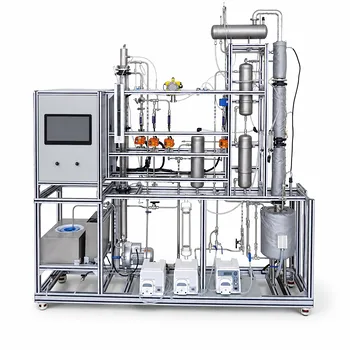
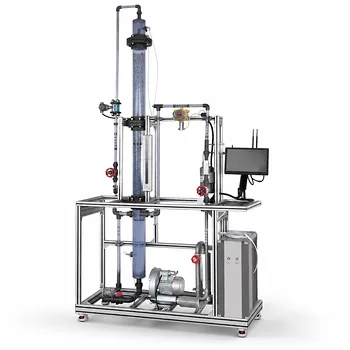
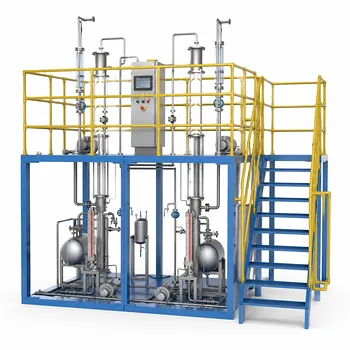
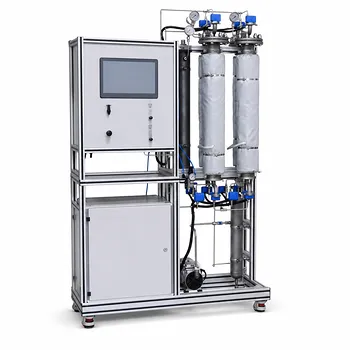
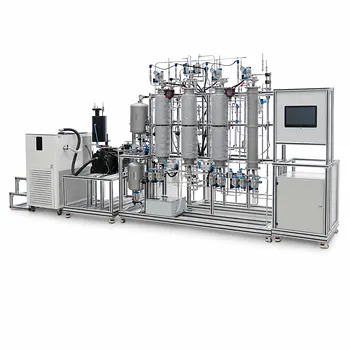
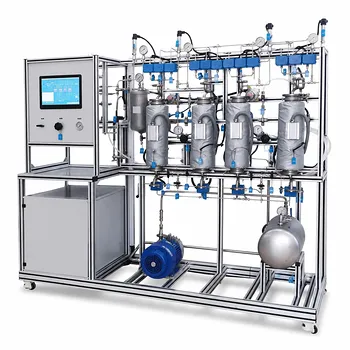
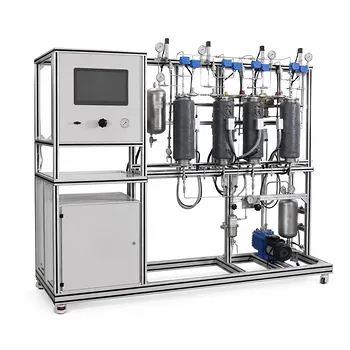
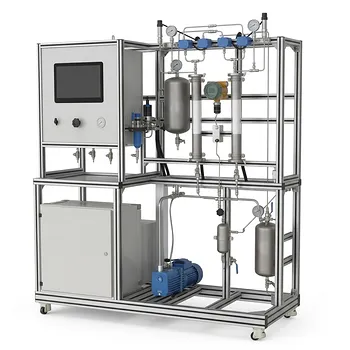
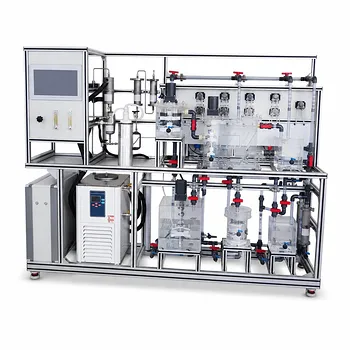
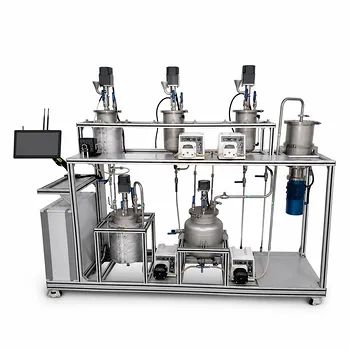
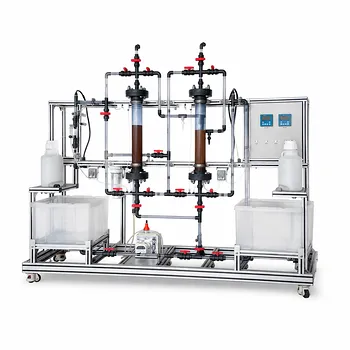
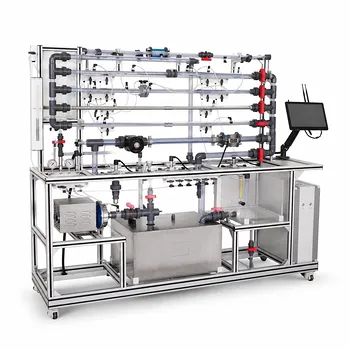
Bridging the gap between complex thermodynamic equations and hands-on operational reality is critical for effective engineering education. LABPARK provides premium Educational and Vocational Unit Operations Pilot Plants across chemical engineering, bioprocess & biotech, and environmental & water treatment sectors.
Tailored for universities, research institutes, and enterprises, our robust pilot plants allow students and researchers to master absorption columns, calculate mass transfer coefficients, and gain practical system-level insights.
Equip your laboratory with industry-grade learning tools—contact LABPARK today to discuss your custom pilot plant requirements!
Related Products
- Carbon Dioxide Absorption and Desorption Educational Pilot Plant for Carbon Capture Studies
- Absorption and Desorption Educational Unit Operations Pilot Plant
- Packed Bed Absorption Educational Unit Operations Pilot Plant
- Dual-Mode Gas Absorption and Desorption Unit Operations Training Pilot Plant
- Multimodal Absorption and Desorption Pilot Plant for Unit Operations Training
People Also Ask
- How does operating pressure influence the transition between absorption and desorption in a CO2 pilot plant?
- How do temperature variations affect CO2 transport models in pilot plants? Model vs Reality
- What unit operations are critical for CCUS training pilot plants? Build hands-on engineering expertise.
- How do electrolytes affect phase equilibrium in absorption pilot plants, and how to calculate it?
- Why is critical surface tension key in column internals? Optimize gas absorption pilot plant efficiency