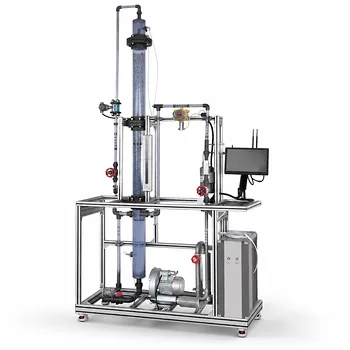
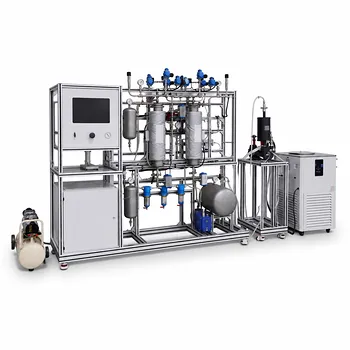
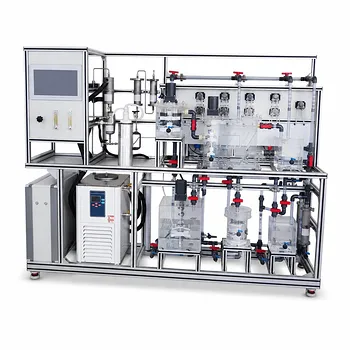
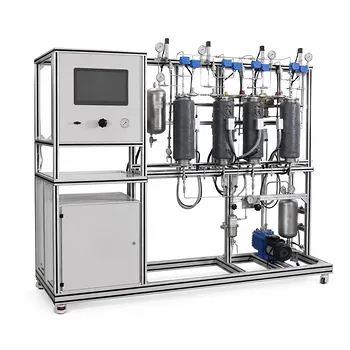
The critical surface tension of your packing material determines whether your pilot plant’s liquid spreads into a thin film or beads up uselessly. In gas absorption, the mass transfer rate is proportional to the wetted surface area ($a_w$) – not the total geometric surface. If the liquid’s surface tension ($\sigma$) is greater than the packing’s critical surface tension ($\sigma_c$), the solvent refuses to wet the solid, drastically shrinking the active interfacial area and gutting separation efficiency. Choosing a packing material with a sufficiently high $\sigma_c$ ensures the liquid forms a continuous film over the packing, maximizing the area where gas and liquid can actually meet.
The number‑one driver of a packed column’s performance is the wetted interfacial area. Critical surface tension is the physical key that unlocks “wettability.” High‑$\sigma_c$ materials like steel, glass, or ceramic practically guarantee film flow; low‑$\sigma_c$ plastics can starve a column of active area long before any other design flaw appears. In a pilot plant – where you must trust that your hardware reflects the underlying mass‑transfer theory – ignoring $\sigma_c$ means you are building a black box that may never reach meaningful steady‑state data.
The Fundamental Link Between Wettability and Mass Transfer
The surface‑level answer is about wettability, but the deeper need in a pilot plant is repeatable, interpretable mass‑transfer data and pedagogical clarity. This section breaks down the physics that makes $\sigma_c$ inescapable.
Critical Surface Tension: The Defining Parameter
A solid’s critical surface tension ($\sigma_c$) is the highest liquid surface tension that will still spontaneously spread into a film on that solid. If $\sigma_\text{liquid} > \sigma_c$, the liquid forms discrete rivulets or droplets. If $\sigma_\text{liquid} < \sigma_c$, the liquid wets the surface completely.
In gas absorption, the solvent typically has a surface tension in the range of 20–70 mN/m. A packing’s $\sigma_c$ tells you immediately whether your chosen liquid will spread. For example, water ($\sigma \approx 73$ mN/m) will wet glass ($\sigma_c \approx 73$) or steel ($\sigma_c \approx 71–75$), but it beads up catastrophically on polyethylene ($\sigma_c \approx 30$) or PTFE ($\sigma_c \approx 40$).
Why Higher Wettability Equals Higher Efficiency
In a packed column, the effective interfacial area ($a_w$) is what appears in the mass‑transfer rate equation: [ \text{Rate} \propto a_w \cdot (\text{concentration driving force}) ] The total geometric area of the packing is meaningless if large portions stay dry. Wettability controls which fraction of that geometry is actually covered by a flowing liquid film.
When the liquid fully wets the packing, gas contacts the film everywhere, and the column performs close to its theoretical maximum. When wettability is poor, the liquid channels through only a few paths, and the volumetric mass‑transfer coefficient ($K_G a$) collapses. In a pilot plant, that collapse can be mistaken for a fundamental process limitation when it is nothing more than a poor material match.
Comparing the Materials That Matter Most in Pilot Plants
The primary reference and supporting data give clear benchmarks for $\sigma_c$ (in $10^{-3}$ N/m):
- Glass: 73
- Stainless steel: 71–75
- Ceramic: ~61
- PTFE (Teflon): 40
- Polyethylene: 30–33
- Paraffin: ~20
These aren’t academic trivia. In a side‑by‑side demonstration – often exactly what an educational pilot plant is designed to show – glass or steel packings can deliver mass‑transfer coefficients several times higher than an identical column filled with polyethylene rings.
The Consequences in a Live Pilot Plant
When a plant is built for training or research, students and engineers run experiments to measure absorption efficiency, pressure drop, and height of a transfer unit (HTU). If the packing wets poorly, the measured active area becomes an uncontrolled variable. Calculated mass‑transfer coefficients lose all physical meaning.
Worse, the resulting data can mislead a designer into over‑sizing downstream equipment or selecting the wrong absorbent. In contrast, when you choose a high‑$\sigma_c$ material, the liquid film is stable and close to the ideal model. This allows the pilot plant to faithfully illustrate principles like the absorption factor, drift corrections, or the effect of flow rates – because the wetting behavior itself is no longer the bottleneck.
Understanding the Trade-offs
No property comes without consequences. High‑$\sigma_c$ materials are not the universal, cost‑free answer for every pilot plant.
Cost, Weight, and Fragility
Glass packing offers perfect wettability for aqueous systems and the massive benefit of visual observation, but it is fragile and expensive to replace. Stainless steel is robust and has an excellent $\sigma_c$, yet it is heavy and can be attacked by acidic gases or chlorides. Ceramic strikes a middle ground but adds weight and can be brittle.
Plastic packings like polypropylene or polyethylene are cheap, lightweight, and chemically inert. Their low $\sigma_c$ makes them poor candidates for water‑based absorption columns unless the solvent is a low‑surface‑tension organic liquid. However, many pilot plants purposely include both high‑ and low‑$\sigma_c$ packings so students can measure the stark difference in performance and link it directly to surface energy theory.
Surface Treatment as a Bridge?
Some plastics can be chemically or plasma‑treated to raise their effective surface energy temporarily. In a short‑term pilot‑plant campaign, a treated plastic packing might perform on par with steel. But these treatments are rarely stable over hundreds of hours or cleaning cycles. For a plant that must deliver consistent teaching or research data, relying on a treated surface is a gamble that can undermine the entire dataset.
The Teaching vs. Industry Tension
An industrial unit might accept the penalty of low‑wettability packing if it saves capital and the column is massively over‑designed. A pilot plant, however, is a truth machine. Its job is to strip away unknowns and reveal the intrinsic kinetics and thermodynamics. By selecting a material with a $\sigma_c$ well above your solvent’s surface tension, you retire one of the most stubborn unknowns and let students and researchers focus on the chemistry and fluid mechanics that truly drive the process.
Making the Right Choice for Your Pilot Plant Goal
The “best” packing material isn’t an absolute. It depends on what you need the pilot plant to demonstrate. Use the recommendations below to guide your selection.
- If your primary focus is teaching mass‑transfer fundamentals: Use glass or stainless‑steel packings. Their high $\sigma_c$ guarantees full wetting for aqueous solutions, giving students clean, repeatable data that directly matches theoretical HTU‑NTU calculations.
- If your primary focus is exploring solvent‑packing compatibility: Benchmark a high‑$\sigma_c$ baseline (glass) against candidate plastic packings. This lets you isolate the wettability effect and decide whether a cheap plastic is viable for your specific solvent system.
- If your primary focus is demonstrating the influence of surface energy: Build the plant to accept interchangeable packing sections. Run identical experiments with glass, ceramic, PTFE, and polyethylene. The dramatic drop in $K_G a$ from 73 mN/m to 30 mN/m will make the concept of critical surface tension unforgettable for students.
- If your primary focus is minimizing cost while keeping data valid: Use ceramic or high‑quality stainless‑steel random packings. Ceramic offers a solid $\sigma_c \approx 61$, is cheaper than glass, and avoids the corrosion pitfalls of plain steel – just double‑check the liquid’s surface tension against 61 mN/m.
By placing critical surface tension at the center of your packing selection, you transform the pilot column from a finicky black box into a reliable instrument – one that teaches the right lessons, validates the right models, and never leaves you guessing why the mass transfer is so poor.
Summary Table:
| Material | Critical Surface Tension ($\sigma_c$, mN/m) | Water Wettability ($\sigma \approx 73$ mN/m) | Ideal Pilot Plant Application |
|---|---|---|---|
| Glass | 73 | Excellent (Spontaneous film) | Visual observation of film flow & fundamental mass transfer teaching |
| Stainless Steel | 71–75 | Excellent (Spontaneous film) | Robust, high-efficiency research and durable pilot operations |
| Ceramic | ~61 | Good | Cost-effective academic validation; excellent corrosion resistance |
| PTFE (Teflon) | 40 | Poor (Beads up) | Organic solvent systems or demonstrating poor wetting behavior |
| Polyethylene | 30–33 | Very Poor (Beads up) | Low-cost comparative studies & low-surface-tension solvent testing |
Elevate Your Chemical Engineering Lab with LABPARK
Are you looking to build a reliable, high-performance pilot plant that delivers accurate, repeatable experimental data?
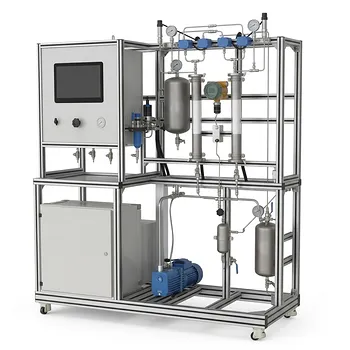
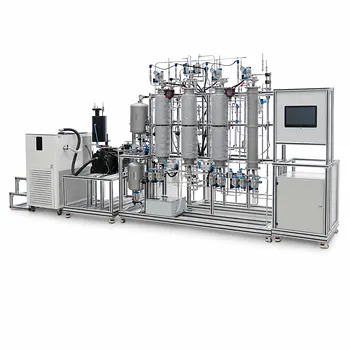
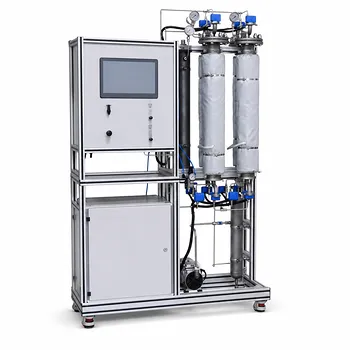
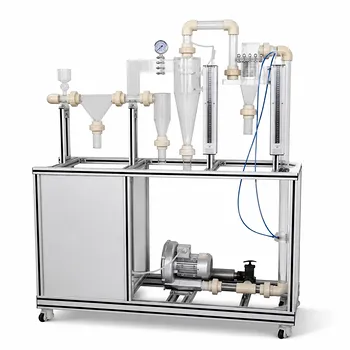
LABPARK provides state-of-the-art Educational and Vocational Unit Operations Pilot Plants in chemical engineering, bioprocess & biotech, and environmental & water treatment for universities, research institutes, and enterprises. Our systems are engineered to help students and researchers clearly observe and analyze key mass transfer phenomena—like the critical surface tension of column packings.
Let our engineering experts design the perfect pilot plant setup for your curriculum or research goals. Contact LABPARK today to discuss your custom project requirements!
Related Products
- Dual-Mode Gas Absorption and Desorption Unit Operations Training Pilot Plant
- Carbon Dioxide Absorption and Desorption Educational Pilot Plant for Carbon Capture Studies
- Carbon Dioxide Adsorption and Capture Educational Unit Operations Pilot Plant
- Multi-Component Gas Pressure Swing Adsorption Pilot Plant for Unit Operations Education
- Absorption and Desorption Educational Unit Operations Pilot Plant
People Also Ask
- How do two-film & penetration theories apply to gas absorption pilot plant teaching? Key pedagogical insights.
- How is the direction and driving force of mass transfer determined in a gas absorption unit operations pilot plant?
- How does partial pressure behavior influence gas absorption pilot plants? Master Mass Transfer
- Why does increasing flow fail to enhance absorption in fast chemical reactions? Pilot Plant Insights
- How to model chemical absorption as physical absorption? The pilot plant simplification criterion.