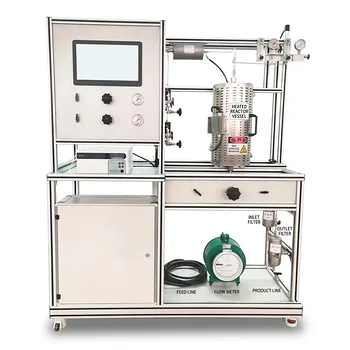
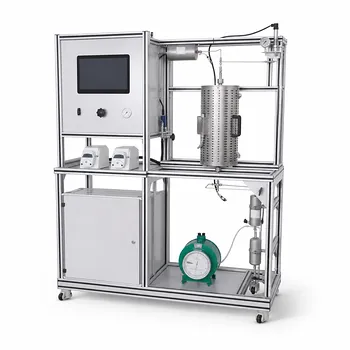
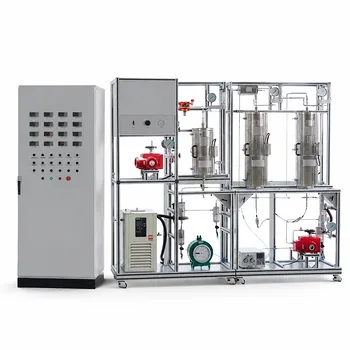
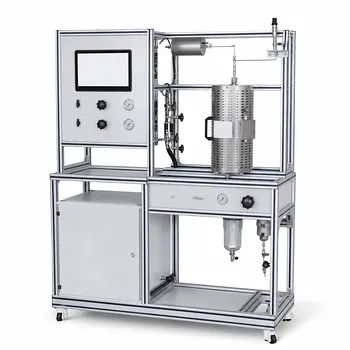
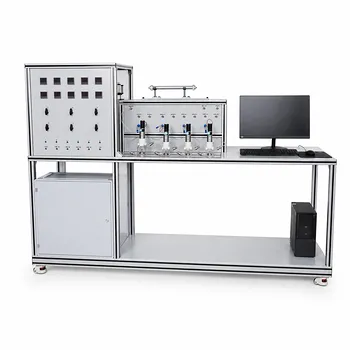
Photochemical reactor optimization begins with a precise inventory of physical, optical, and kinetic data.
To model or optimize a photochemical reactor in a pilot plant, you must baseline four categories of parameters: the radiation source’s characteristics, the reactor’s physical and optical properties, the reaction’s kinetics and spectral absorption features, and any reflector specifications. This data set forms the foundation for rigorous mass, energy, and radiation balances—the heart of photochemical unit operations education and research.
The core challenge of photochemical reactor modeling isn’t the availability of data, but understanding why these particular parameters must be collected together. Without simultaneous capture of radiation emission, medium attenuation, and kinetic initiation, you cannot solve the coupled integro-differential equations that govern the Local Volumetric Rate of Energy Absorption (LVREA)—the true performance driver. Pilot plant training that neglects this coupling teaches incomplete engineering.
The Four Pillars of a Photochemical Reactor Model
The primary reference groups the essential inputs into four interdependent categories. Each must be measured or specified to an accuracy that matches the complexity of the modeling goal—especially in a teaching lab where foundational understanding is paramount.
Radiation Source Data: Not Just a Lamp Specification
You need more than the lamp’s nameplate wattage. Collect power consumption along with the full spectral distribution of its output. The geometry (arc length, tube diameter) and its nominal operating conditions—such as cooling requirements or aging behavior—directly influence how light enters the reaction zone. A mismatch between the lamp’s emission spectrum and the reactant’s absorption window can render even an otherwise well-designed reactor useless.
Reactor Physical Characteristics: Geometry, Materials, and Safety Boundaries
The reactor’s internal geometry—typically annular or tubular—determines the radiation path length and flow distribution. Crucially, document the light transmission characteristics of the wall material (quartz, Pyrex, etc.) and its own spectral cutoff. In pilot-scale educational setups, the reactor also must be classified as a pressure vessel; wall thickness, head type, and nozzle orientation are not just mechanical details but safety-critical parameters that influence permissible operating temperature and pressure ranges.
Reaction Kinetics and Optical Properties: The Where and Why of Light Absorption
Photochemical kinetics differ from thermal kinetics. You must map the microkinetic pathway—the light-activated initiation step, followed by dark propagation and termination. This requires the absorption spectrum of every species present (reactants, products, and any inert solvents or gases) and the primary quantum yield of the initiation step. Without these, you cannot calculate how much absorbed light actually drives chemistry versus being wasted as heat.
Reflector Characteristics: Shaping the Light Field
If the reactor employs an external or internal reflector, its geometry, reflectivity, and spectral reflectance must be characterized. An elliptical or parabolic reflector doesn’t just increase intensity—it redistributes the radiation field’s angular and spatial profile, altering the LVREA maps and potentially introducing hot spots that degrade selectivity.
Why These Parameters Are Non-Negotiable for Pilot Plant Training
Collecting a checklist is trivial; understanding the interdependence of these parameters is the real educational outcome. The supplementary references reveal why each category is essential when modeling teaches more than plug‑and‑play operation.
The Coupled Balance Problem That Defines Photochemical Reactors
A photochemical reactor never obeys a simple rate law. The initiation rate depends on the Local Volumetric Rate of Energy Absorption (LVREA), which itself depends on the local light intensity. That intensity is attenuated by the species concentrations along the light path. As the reaction proceeds, concentrations change, modifying the radiation field and, in turn, the reaction rate. The mass and radiation balances are an integro-differential system that must be solved simultaneously. Without baseline radiation source, reactor geometry, and absorption spectra, this coupling cannot be formulated, making any pilot plant “optimization” a guess.
Boundary Conditions That Depend on Reactor Wall Materials
For a laminar‑flow tubular photoreactor, the mass balance boundary condition at the wall is not always a simple no‑flux statement. If heterogeneous wall termination dominates (e.g., radical recombination on quartz), the boundary condition becomes a flux balance between radial diffusion and surface reaction rates. This directly ties the reactor’s material choice—already specified in the physical characteristics category—to the kinetic model. Students who learn to adjust these boundary conditions gain insight into how surface‑specific data transforms reactor performance predictions.
The LVREA as the Connecting Thread
All collected parameters feed into the computation of the LVREA field. The lamp’s spectral power, the reactor window’s transmission cutoff, the absorption coefficients of the medium, and reflector geometry collectively define the radiation intensity at every point. The LVREA then becomes the source term in the mass balance for the initiation step. Pilot plant training that isolates any of these inputs from the others fails to demonstrate how a photochemical process truly behaves under scale‑up.
Understanding the Trade-offs and Common Pitfalls
Trust is built on honesty about limitations. Every parameter collection effort involves compromises, and ignoring them leads to skewed models.
The Inherent Complexity of Spectroradiometric Measurements
Obtaining the lamp’s absolute spectral power output or the reactor wall’s wavelength‑dependent transmittance requires specialized equipment (spectroradiometers, integrating spheres) not always present in a teaching pilot plant. A common pitfall is to substitute nominal manufacturer data without verifying actual ageing drift, or to assume a reflector’s specular reflectivity without considering its angular dependence. These simplifications introduce systematic errors into the LVREA calculation that can exceed the uncertainty of kinetic rate constants.
When Detailed Kinetics Overwhelm Training Objectives
A full microkinetic pathway with quantum yields may be inaccessible for proprietary reactions or multi‑component mixtures. In an educational setting, there is a trade‑off: introducing students to the coupled‑balance framework with simplified kinetics (e.g., a single‑step effective initiation) still teaches the core concept, whereas demanding exhaustive kinetic data can delay meaningful experimentation. The risk is that students confuse a simplified training model with a safe scale‑up model.
Neglecting Safety‑Critical Mechanical Parameters
The supplementary references emphasize pressure vessel classification for multiphase and non‑isothermal reactors. Even if photochemical reactions operate at low pressure, the solvent’s vapor pressure at elevated temperature or an exothermic run‑away can turn a thin‑walled glass reactor into a hazard. Baseline parameter collection must therefore extend to the reactor’s mechanical limits, or the model becomes academically elegant but operationally unsafe.
Making the Right Choice for Your Pilot Plant Goals
How you weight these baseline parameters depends on whether your primary objective is education, research, or process development.
- If your primary focus is foundational pilot plant training: Prioritize the complete set of parameters that demonstrate the radiation‑mass balance coupling. Emphasize measurement of lamp spectra, reactor transmittance, and a well‑characterized model reaction (e.g., a known actinometer) so students can compute and experimentally validate LVREA maps.
- If your primary focus is advanced research into new photochemistry: Invest heavily in the reaction kinetics and optical properties pillar—microkinetic pathway, species‑specific absorption spectra, and primary quantum yield—while maintaining rigorous radiation source and reactor geometry data to avoid publishing results that are device‑specific artifacts.
- If your primary focus is scale‑up readiness or industrial training: Do not treat the reflector and reactor‑wall spectral data as optional. At larger scales, non‑uniform light fields and heterogeneous wall effects determine yield and selectivity; collecting this data early prevents costly redesigns.
Data that grounds the coupled radiation‑mass balance transforms a pilot‑scale photochemical reactor from a black‑box demonstration into a rigorous engineering tool.
Summary Table:
| Parameter Category | Key Data to Collect | Engineering Importance |
|---|---|---|
| Radiation Source | Spectral distribution, power consumption, lamp geometry | Defines energy input and spectral alignment with reactants. |
| Reactor Geometry | Internal layout, wall material transmittance, pressure limits | Determines light path length, flow profile, and operation safety. |
| Reaction Kinetics | Absorption spectra, microkinetic pathways, quantum yield | Crucial for solving the LVREA and predicting reaction rates. |
| Reflector Properties | Geometry, reflectivity, spectral reflectance | Shapes the spatial distribution of the light field. |
Elevate Your Chemical Engineering Lab with LABPARK
Ready to bring rigorous, hands-on photochemical and unit operations training to your institution? LABPARK designs and manufactures premium Educational and Vocational Unit Operations Pilot Plants in chemical engineering, bioprocess & biotech, and environmental & water treatment.
We help universities, research institutes, and enterprises bridge the gap between academic theory and industrial application with safe, scalable, and highly precise equipment.
Contact LABPARK today to discuss your laboratory requirements and request a customized quote!
Related Products
- Photocatalytic Membrane Separation and Degradation Unit Operations Pilot Plant
- O-Xylene Oxidation to Phthalic Anhydride Educational Unit Operations Pilot Plant
- Multi Functional Catalytic Reaction and Reactor Evaluation Educational Unit Operations Pilot Plant
- Residence Time Distribution and Reactor Flow Characteristics Determination Educational Pilot Plant
- Tubular Reactor Flow Characteristics Determination Educational Unit Operations Pilot Plant
People Also Ask
- What are the key differences in membrane configurations? Choose the Right Unit Operations Pilot Plant
- How Do Pervaporation, Vapor, and Gas Permeation Differ in Pilot Plants? Key Comparison
- What are the structural & performance trade-offs of flat-sheet, spiral-wound, & hollow-fiber membrane modules?
- Pervaporation vs. Vapor Permeation: Handling Suspended Solids in Membrane Pilot Plants
- How do PEI, PVDF, and PSU membranes compare in pilot plants? Find the best fit.