Knowledge Chemical Engineering Education Resin vs. Sulfuric Acid in Educational Reactors: Operational Pros & Cons
Author avatar

Tech Team · LABPARK

Updated 1 month ago

Resin vs. Sulfuric Acid in Educational Reactors: Operational Pros & Cons


Your choice of catalyst defines the entire operational profile of a pilot plant—from safety protocols to the quality of student learning. In educational reactor settings, strong acid cation-exchange resins offer overwhelming practical advantages over liquid sulfuric acid: they eliminate equipment corrosion, dramatically simplify product separation, prevent dangerous side reactions, and allow catalyst reuse. The critical trade-off is that resins operate with lower catalytic activity and must stay within strict temperature limits to avoid irreversible degradation.

For an educational pilot plant, where operator safety, equipment longevity, and pedagogical clarity are paramount, the operational benefits of solid ion-exchange resins decisively outweigh the raw kinetic power of sulfuric acid. The resin catalyst transforms a complex, hazardous process into a clean, reproducible unit operation that is ideal for teaching.

Operational Advantages of Resin Catalysts in Educational Pilot Plants

Near-Total Elimination of Corrosion Hazards

Liquid sulfuric acid is aggressively corrosive, especially at elevated temperatures. In a teaching lab, this forces you to use expensive, resistant materials like glass-lined steel or specialized alloys—driving up plant cost and maintenance.

Resin catalysts are non-corrosive solids. They can be used safely in standard stainless-steel or even glass reactors, drastically reducing capital expenditure and eliminating the risk of a catastrophic acid leak. This is the single biggest operational advantage for a shared educational facility.

Drastic Simplification of Post-Reaction Workup

With homogeneous sulfuric acid, you face a tedious, messy neutralization step. You must quench the acid with a base, generating a sulfate salt waste stream that requires separation and disposal. This adds steps, time, and chemical inventory.

With a heterogeneous resin, catalyst separation is a simple physical step. Running the reactor in a fixed-bed configuration or just filtering the slurry removes 100% of the catalyst. The product mixture remains clean, allowing students to proceed directly to distillation or analysis without an intermediate neutralization.

Superior Selectivity and Cleaner Product Profiles

Concentrated sulfuric acid is a powerful catalyst, but it has poor chemical manners. It promotes unwanted side reactions like carbonization, dehydration, sulfonation, and etherification. In a pilot plant, these byproducts confound mass balances and make product purification a nightmare.

Ion-exchange resins are far more selective. They catalyze the desired reaction—often esterification or hydrolysis—without attacking other functional groups. This produces a cleaner reaction mixture, making it easier for students to calculate meaningful conversion and yield data.

Reusability and Sustainable Lab Practices

Sulfuric acid is consumed or lost in the neutralization step. Every run requires fresh acid, generating a continuous stream of hazardous corrosion and toxic waste.

Resin catalysts can be recovered by filtration, washed, and reused across dozens of lab sessions. This lowers chemical costs per experiment, reduces the environmental footprint, and provides a hands-on lesson in green chemistry and catalytic principles.

Understanding the Persistent Disadvantages of Resins

Lower Catalytic Activity and Slower Kinetics

Concentrated sulfuric acid delivers an immediate, high-concentration proton pool, resulting in extremely fast reaction rates. This is its one undeniable advantage.

Resins, by contrast, rely on accessible acid sites on a solid matrix. Their effective proton concentration is lower, and mass transfer limitations can slow the overall rate. For an experiment meant to finish in a three-hour lab period, you must verify that the resin can deliver sufficient conversion in the available time.

Strict Thermal Limitations

The polystyrene-divinylbenzene backbone of a typical strong acid resin begins to degrade irreversibly above 120–150 °C. The sulfonic acid groups can leach off, permanently destroying the catalyst’s activity.

Sulfuric acid has no such organic backbone and can operate at far higher temperatures. If your target reaction requires vigorous reflux at temperatures exceeding the resin’s stability limit, a solid catalyst simply cannot be used. This thermal ceiling is the most rigid boundary when scoping a resin-catalyzed process.

Potential for Fouling and Swelling

In a fixed bed, fine particulates or viscous reactants can plug the resin bed and cause pressure drop issues. Additionally, resins swell in certain solvents, which can change bed volume and flow characteristics. These operational quirks teach valuable troubleshooting skills but add a layer of complexity not present with a homogenous acid catalyst.

Making the Right Choice for Your Educational Goal

The catalyst you choose should serve your primary teaching objectives. A single-minded pursuit of conversion rate will lead to a different answer than a focus on safe, holistic process education.

  • If your primary focus is teaching complete unit operations and green engineering: Use a strong acid cation-exchange resin. You will demonstrate catalysis, continuous fixed-bed processing, and catalyst recovery, all within a safe, low-corrosion environment that mirrors modern industrial practice.
  • If your primary focus is strictly on chemical kinetics and achieving maximum conversion in a single session: Sulfuric acid may appear attractive for its raw speed, but only if your institution can manage the substantial corrosion, waste disposal, and safety infrastructure it demands.
  • If your primary focus is process safety and minimizing upfront plant cost: The resin catalyst is the only responsible choice. The savings on materials of construction, elimination of neutralization vessels, and intrinsically safer operation make it the clear winner for an educational setting.

The operational profile of a solid resin catalyst transforms an aggressive chemical process into a manageable, transparent teaching tool, empowering students to focus on fundamental reaction engineering rather than hazardous material survival.

Summary Table:

Feature Strong Acid Cation-Exchange Resin Liquid Sulfuric Acid
Corrosion Hazard Non-corrosive (uses standard stainless steel/glass) Highly corrosive (requires expensive specialty alloys)
Separation Process Simple physical filtration (easy workup) Complex neutralization step (generates salt waste)
Selectivity High (cleaner product profile, fewer side reactions) Lower (prone to carbonization and byproducts)
Reusability Reusable across multiple lab sessions Consumed and lost during neutralization
Reaction Kinetics Slower (diffusion-limited) Rapid (immediate high proton concentration)
Temperature Limit Strict ceiling (120–150 °C) High thermal stability

Upgrade Your Chemical Engineering Lab with LABPARK

Designing a safe, effective, and modern learning environment requires the right equipment. LABPARK provides high-quality Educational and Vocational Unit Operations Pilot Plants in chemical engineering, bioprocess & biotech, and environmental & water treatment.

Our pilot plants are engineered to help universities, research institutes, and enterprises safely demonstrate advanced chemical reactions, catalyst behaviors, and unit operations.

Ready to enhance your curriculum with industry-grade pilot plants? Contact LABPARK today to find the perfect solution for your facility!

Related Products

People Also Ask

Related Products

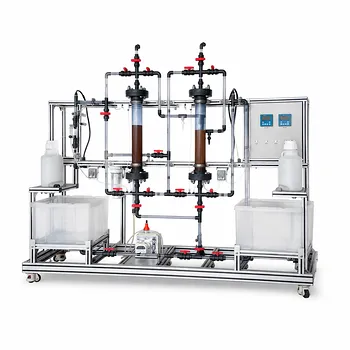
Ion Exchange Water Purification Educational Pilot Plant for Engineering Unit Operations

Ion Exchange Water Purification Educational Pilot Plant for Engineering Unit Operations

This bench-scale ion exchange pilot plant trains engineering students in water purification. Dual transparent columns simulate industrial softening and demineralization. Students observe fluid dynamics, perform resin regeneration, and analyze breakthrough curves. The corrosion-resistant frame ensures durability in unit operations experiments.

Alkaline Membrane Water Electrolysis Educational Pilot Plant Unit Operations Training System

Alkaline Membrane Water Electrolysis Educational Pilot Plant Unit Operations Training System

Hands-on educational pilot plant for alkaline membrane water electrolysis hydrogen production, integrating unit operations training with industrial PLC control, real-time data logging, customizable design, durable 316L stainless steel construction, explosion-proof safety, and modern 5G connectivity for university laboratories.

Constant Pressure Filtration Educational Unit Operations Pilot Plant

Constant Pressure Filtration Educational Unit Operations Pilot Plant

Hands-on educational pilot plant for constant pressure filtration. Classic plate and frame filter press allows students to study kinetics, determine specific cake resistance, perform cake washing and evaluate washing rates. Ideal for chemical engineering curriculum. Mobile, customizable, safety-compliant design.

Electrolyte Distillation Purification and Formulation Educational Pilot Plant

Electrolyte Distillation Purification and Formulation Educational Pilot Plant

Integrated bench-to-pilot scale educational pilot plant for electrolyte distillation, purification, and formulation with borosilicate glass construction, PLC automation, touchscreen HMI, and advanced industrial safety features for hands-on chemical process training, ideal for chemical engineering and materials science curricula.

Educational Rotary Disc Liquid-Liquid Extraction Pilot Plant

Educational Rotary Disc Liquid-Liquid Extraction Pilot Plant

A transparent rotary disc column for educational liquid-liquid extraction experiments. This pilot plant enables students to study mass transfer, droplet dynamics, and flooding behavior, bridging theory and practice in chemical engineering unit operations education. Features variable-speed agitation and PLC control.

Potassium Salt Thermal Dissolution and Crystallization Separation Educational Unit Operations Pilot Plant

Potassium Salt Thermal Dissolution and Crystallization Separation Educational Unit Operations Pilot Plant

This educational pilot plant allows chemical engineering students to perform potassium salt thermal dissolution and cooling crystallization experiments, integrating solubility studies, supersaturation control, and solid-liquid separation in a safe, compact, and customizable laboratory system for hands-on unit operations learning.

Multi-Stage Stirred Tanks in Series Residence Time Distribution and Mixing Performance Determination Educational Pilot Plant

Multi-Stage Stirred Tanks in Series Residence Time Distribution and Mixing Performance Determination Educational Pilot Plant

Explore residence time distribution and mixing performance in series stirred tanks with this educational pilot plant. Real-time conductivity sensors, interactive 3D simulation, and industrial-grade PC for chemical engineering lab training. Customizable to curricula.

Carbon Dioxide PVT Curve Determination Educational Unit Operations Pilot Plant

Carbon Dioxide PVT Curve Determination Educational Unit Operations Pilot Plant

Enable hands-on learning of thermodynamic principles with this carbon dioxide PVT curve determination pilot plant. Students visualize critical opalescence, phase transitions, and generate P-V isotherms across liquid, gas, and supercritical regions. Robust safety features, adaptable for university engineering labs.

Educational Compression Refrigeration Performance Determination Unit Operations Pilot Plant

Educational Compression Refrigeration Performance Determination Unit Operations Pilot Plant

This educational pilot plant for compression refrigeration performance determination offers dual COP evaluation, regenerative cycle comparison, and calorimeter calibration. Customizable for curriculum integration, it features environmentally conscious design. Supports thermodynamic mapping on pressure-enthalpy diagrams and synchronous monitoring with centralized instrumentation.

Multi Functional Catalytic Reaction and Reactor Evaluation Educational Unit Operations Pilot Plant

Multi Functional Catalytic Reaction and Reactor Evaluation Educational Unit Operations Pilot Plant

Bench-scale educational pilot plant for catalytic reaction and reactor evaluation, integrating fixed bed, fluidized bed, and stirred tank reactors. Students compare reactor designs, evaluate catalysts, and study reaction kinetics and hydrodynamics. Perfect for unit operations labs in chemical engineering curricula.

Photocatalytic Membrane Separation and Degradation Unit Operations Pilot Plant

Photocatalytic Membrane Separation and Degradation Unit Operations Pilot Plant

Bench-scale pilot plant integrating photocatalytic degradation with membrane separation for engineering education. Study advanced oxidation, microfiltration, and hybrid processes using industrial sensors. Features safety light-blocking curtain, low-noise compressor, and durable stainless-steel construction.

Carbon Dioxide Absorption and Desorption Educational Pilot Plant for Carbon Capture Studies

Carbon Dioxide Absorption and Desorption Educational Pilot Plant for Carbon Capture Studies

Explore carbon dioxide absorption and desorption with this educational pilot plant. Transparent columns visualize mass transfer; electric heating simulates industrial solvent regeneration; touchscreen interface enables data monitoring. Ideal for chemical engineering, bridging theory and practice.

Low Concentration Carbon Dioxide Capture Pressure Swing Adsorption Educational Pilot Plant

Low Concentration Carbon Dioxide Capture Pressure Swing Adsorption Educational Pilot Plant

Low-concentration CO2 capture pilot plant using Pressure Swing Adsorption for engineering education. Students gain practical experience in breakthrough curve measurement, adsorption dynamics, and variable analysis in a hands-on lab setting. Ideal for unit operations, mass transfer, and chemical engineering labs.

Water Electrolysis Hydrogen Production and Storage Educational Pilot Plant

Water Electrolysis Hydrogen Production and Storage Educational Pilot Plant

Integrated pilot-scale training system for higher education engineering labs. Features AWE/PEM electrolysis, adjustable DC power, PLC controls, gas-liquid separation, and pressurized hydrogen storage. Hands-on learning in green hydrogen, process control, and safety, ideal for chemical and energy departments.

Electrochemical Water Treatment Educational Unit Operations Pilot Plant

Electrochemical Water Treatment Educational Unit Operations Pilot Plant

Enhance engineering education with this pilot-scale electrochemical water treatment plant. Designed for hands-on learning of efficient salt removal, electrolytic reactions, and real-time data acquisition. Features multi-mode control, corrosion-resistant PVC, low-voltage safety, and wireless connectivity for modern teaching labs.

Residence Time Distribution and Reactor Flow Characteristics Determination Educational Pilot Plant

Residence Time Distribution and Reactor Flow Characteristics Determination Educational Pilot Plant

This versatile educational pilot plant is designed for comprehensive study of residence time distribution and reactor flow characteristics, featuring multiple CSTRs in series, a tubular reactor, variable recycle loop, and automated real-time data acquisition, perfect for hands-on chemical engineering education.

Multifunctional Membrane Separation Educational Pilot Plant with Ultrafiltration, Nanofiltration, Reverse Osmosis

Multifunctional Membrane Separation Educational Pilot Plant with Ultrafiltration, Nanofiltration, Reverse Osmosis

An integrated laboratory bench-scale membrane separation system for higher education engineering labs combining Ultrafiltration, Nanofiltration, and Reverse Osmosis processes. Features industrial PLC control with touch-screen HMI, transparent piping, and academic assessment software. Ideal for chemical and environmental engineering curricula.

Multi-Functional Membrane Separation Educational Pilot Plant for Unit Operations Lab

Multi-Functional Membrane Separation Educational Pilot Plant for Unit Operations Lab

The Multi-functional Membrane Separation Educational Unit Operations Pilot Plant is an integrated bench-scale laboratory system designed for teaching undergraduate engineering education. It features Ultrafiltration, Nanofiltration, and Reverse Osmosis modules in a compact, mobile unit for practical hands-on learning.

Comprehensive Heat Transfer Coefficient Determination Educational Unit Operations Pilot Plant

Comprehensive Heat Transfer Coefficient Determination Educational Unit Operations Pilot Plant

Advanced industrial-grade educational pilot plant for comprehensive heat transfer coefficient determination. Enables quantitative convective heat transfer analysis, evaluates double-pipe and shell-and-tube exchanger configurations, and includes digital data acquisition. Customizable for engineering curriculum. Ideal for engineering unit operations labs.

Ethylbenzene Dehydrogenation Educational Unit Operations Pilot Plant

Ethylbenzene Dehydrogenation Educational Unit Operations Pilot Plant

Ethylbenzene dehydrogenation educational pilot plant replicates industrial styrene production, offering hands-on experience with fixed-bed reactors, catalyst activation, regeneration, automated process control. Designed for university chemical engineering labs, it enables study of gas-solid catalysis, catalyst deactivation, steam regeneration, and safety interlocks.


Leave Your Message