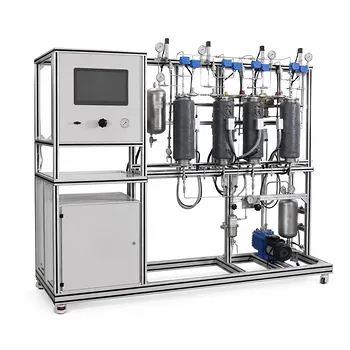
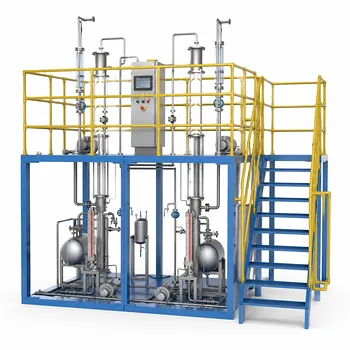
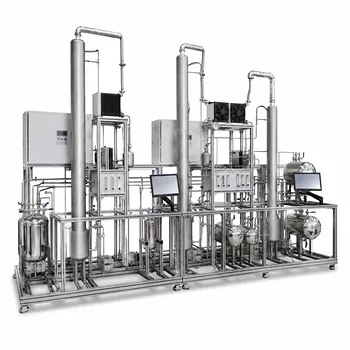
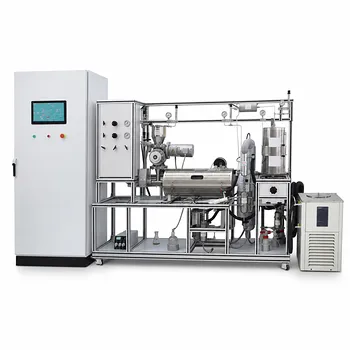
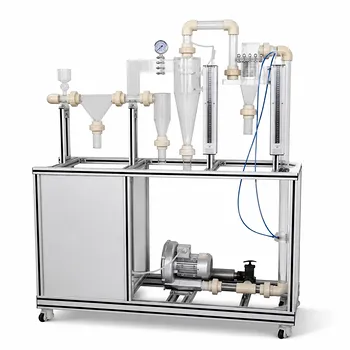
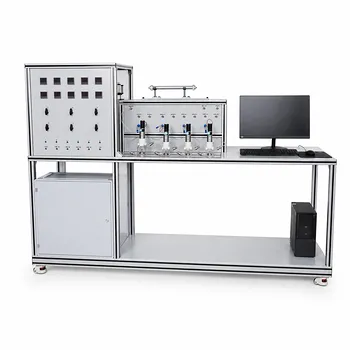
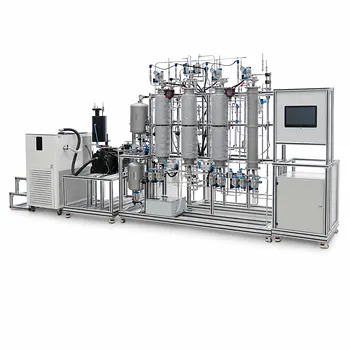
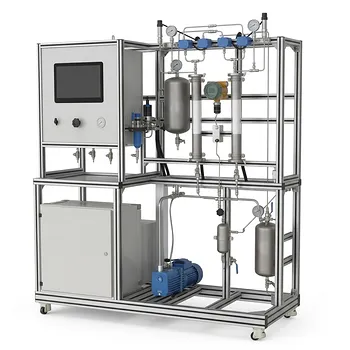
At its heart, a vocational or university pilot plant for gasification and syngas purification must demonstrate five cornerstone unit operations: gas–solid reaction (gasification), heat recovery, gas–liquid scrubbing, catalytic shift conversion, and selective solvent absorption. These steps replicate the industrial chain from raw feedstock to clean syngas, giving students and researchers hands‑on experience with the reaction engineering, separation science, and process integration that define modern chemical engineering.
A well-designed pilot plant is far more than a collection of hardware. It mirrors the real‑world sequence of converting solid or heavy feedstocks into clean synthesis gas, forcing learners to grapple with the interdependencies of heat integration, reaction kinetics, and multi‑stage mass transfer – the deep skills that turn theoretical knowledge into industrial competence.
The Core Reactor: Gasification and Heat Management
The journey begins in the gasifier, where the feedstock is contacted with a sub‑stoichiometric amount of oxygen and/or steam. This is the gas–solid reaction at the heart of syngas manufacture.
The Gasification Reactor as a Teaching Crucible
A pilot‑scale gasifier – whether fed with coal, biomass, or heavy residue – lets students manipulate steam‑to‑carbon ratios, operating temperature, and residence time. They observe first‑hand how the primary endothermic reaction (e.g., $CH_{1.5}O_{0.7} + 0.3H_2O \rightarrow CO + 1.05H_2$, $\Delta H = +74$ kJ/mol) must be thermally balanced by partial oxidation ($\Delta H = -113$ kJ/mol). Managing this dynamic heat balance teaches the practical realities of reactor stability and autothermal operation.
Heat Recovery and Steam Generation
Hot raw syngas leaves the gasifier at temperatures that can exceed 800 °C. A steam‑generating heat exchanger recovers this sensible heat, producing the steam needed elsewhere in the plant. Students learn to calculate pinch points, to visualize heat integration across the flowsheet, and to appreciate how effective waste‑heat recovery directly impacts the plant’s overall energy efficiency and carbon footprint.
Particulate and Tar Removal: Scrubbing and Filtration
Raw syngas is laden with char, ash, and sticky tars. If not removed, these contaminants foul downstream catalysts and plug equipment. The pilot plant must therefore showcase a staged cleaning train.
Multi‑Stage Dry and Wet Separation
A realistic sequence begins with cyclones for bulk solids, followed by fabric filters or electrostatic precipitators for fine particulates. The final polish comes from a gas–liquid scrubber – often a venturi or packed column – that captures residual dust and condenses tars. This multi‑stage approach teaches students how to match separation technology to particle size and how to handle the troublesome tarry and oily gas liquor that accumulates as a by‑product stream.
Dissolution of Trace Impurities
Scrubbing also removes water‑soluble trace contaminants such as ammonia, hydrogen cyanide, and chlorides. As the gas cools and water condenses, these volatile weak electrolytes dissolve and react. Demonstrating this on a pilot column forces students to confront simultaneous phase equilibrium, mass transfer, and chemical reaction – the kind of multi‑physics problem that defines industrial gas cleaning.
Catalytic Shift Conversion: Adjusting Syngas Composition
Raw syngas often contains more carbon monoxide than desired, especially if hydrogen is the target product. The water‑gas shift reactor is the key unit operation that converts CO and steam into additional H₂ and CO₂.
Teaching Reaction Kinetics and Equilibrium
In a pilot‑scale shift converter, students control the steam‑to‑CO ratio, bed temperature, and space velocity. They observe how the exothermic shift reaction is managed with inter‑stage cooling and learn to predict the equilibrium H₂/CO ratio. This hands‑on work cements the principles of catalysis, kinetic vs. equilibrium control, and adiabatic reactor design – all within a single, transparent unit.
Acid Gas Removal and Solvent Regeneration
Once the syngas is free of solids and condensable tars, the next challenge is removing acid gases – primarily H₂S and CO₂. This is where selective solvent absorption takes center stage.
The Absorption–Regeneration Loop
A pilot plant equipped with an amine washer or a physical‑solvent column provides a complete picture of gas–liquid mass transfer. Students manipulate solvent flow rates, temperature profiles, and gas‑to‑liquid ratios to optimize acid gas removal. Crucially, they also operate the regenerator, where the rich solvent is heated to strip the absorbed gases. This closed loop teaches solvent selection criteria, corrosion challenges, and the energy cost of regeneration – critical lessons for future process designers.
Handling Complex Aqueous Chemistry
When the gas stream contains both H₂S and NH₃, the scrubber liquor becomes a reactive, multi‑electrolyte system. Demonstrating this on a pilot unit forces students to go beyond simple Henry’s law and model reactive absorption with instantaneous or kinetically limited chemical reactions, a skill directly transferable to sour‑gas treating in industry.
Polishing and Final Purification: PSA and Membranes
For pathways that demand ultra‑pure hydrogen, a final polishing step is often added downstream of acid gas removal. Pressure swing adsorption (PSA) or membrane separation units demonstrate how molecular‑sieving or selective permeation can yield 99.9%+ hydrogen.
Pushing Separation to the Limit
A pilot PSA unit gives students hands‑on experience with adsorption isotherms, cycle timing, and pressure‑swing logic. A membrane separator illustrates the trade‑off between permeability and selectivity. Both technologies allow learners to bridge the gap between classical unit operations and modern, high‑purity gas processing.
Understanding the Trade‑offs
No pilot plant can include every possible step, and every demonstration scale brings its own compromises.
Pilot‑Scale Realities
- Feedstock variability can mask steady‑state kinetics; students must learn to manage this experimental noise.
- Tar and fouling are notoriously difficult to reproduce at small scale, yet they are the number‑one industrial headache – simplified simulants may be needed.
- Safety with flammable syngas and toxic H₂S demands rigorous containment and monitoring, which adds complexity to an educational setup.
- Cost vs. completeness: a plant that starts from feedstock and ends with high‑purity hydrogen is invaluable but expensive. Many universities therefore choose a modular approach, connecting separate skids for each key unit operation.
Making the Right Choice for Your Educational Goal
The optimal set of unit operations depends on the learning outcomes you want to emphasise.
- If your primary focus is reaction engineering and heat integration: Start with a gasifier and a shift reactor, backed by a working steam‑generating heat exchanger. This core delivers the richest lessons in thermochemistry and dynamic reactor control.
- If your primary focus is advanced separation and mass transfer: Build the downstream train – wet scrubbers, an amine absorption column with a regenerator, and a PSA or membrane unit. The absorption‑regeneration loop alone teaches a career’s worth of phase‑equilibrium and kinetic separation principles.
- If your primary focus is environmental control and industrial hygiene: Emphasise the particulate‑removal sequence (cyclone, baghouse, wet scrubber) and the handling of tarry gas liquor, demonstrating how industry meets emission standards.
- If your primary focus is hydrogen production and clean energy: Include every key block – gasifier, shift converter, acid gas removal, and PSA – to give students a complete, end‑to‑end understanding of decarbonised syngas manufacture.
By choosing the right combination of unit operations, you create a platform where vocational trainees and engineering undergraduates alike can move from abstract equations to the visceral reality of gas–liquid contactors, hot catalyst beds, and the quiet hum of a compressor in a fully integrated syngas plant.
Summary Table:
| Unit Operation | Key Function | Educational & Learning Focus |
|---|---|---|
| Gasification Reactor | Gas-solid reaction (sub-stoichiometric $O_2$/steam) | Kinetics, steam-to-carbon ratio, dynamic heat balance |
| Heat Recovery | Sensible heat recovery & steam generation | Pinch points, heat integration, energy efficiency |
| Gas-Liquid Scrubbing | Particulate, tar, and trace impurity removal | Multi-stage separation, phase equilibrium, mass transfer |
| Catalytic Shift Conversion | Water-gas shift (adjusting $H_2/CO$ ratio) | Catalysis, kinetic vs. equilibrium control, adiabatic design |
| Selective Solvent Absorption | Acid gas removal ($H_2S$ & $CO_2$ absorption) | Absorption-regeneration loop, multi-electrolyte chemistry |
Bring Industrial Process Reality to Your Lab with LABPARK
Are you looking to bridge the gap between abstract chemical engineering equations and hands-on industrial reality? LABPARK provides state-of-the-art Educational and Vocational Unit Operations Pilot Plants in chemical engineering, bioprocess & biotech, and environmental & water treatment.
Specifically designed for universities, research institutes, and enterprises, our custom pilot plants empower students and researchers to master heat integration, reaction kinetics, and multi-stage mass transfer in a safe, controlled environment.
Ready to elevate your training and research capabilities? Contact LABPARK today to discuss your pilot plant requirements!
Related Products
- Bench Scale Carbon Dioxide Capture Educational Unit Operations Pilot Plant
- Fixed-Bed Chemical Reaction and Gas Dust Tar Removal Unit Operations Pilot Plant
- Dual-Mode Gas Absorption and Desorption Unit Operations Training Pilot Plant
- Green Anhydrous Ethanol Purification Extractive Distillation Unit Operations Training Pilot Plant
- Dual-Mode Rectification Pilot Plant for Practical Training Unit Operations
People Also Ask
- What unit operations are critical for CCUS training pilot plants? Build hands-on engineering expertise.
- What are the differences between post- and pre-combustion carbon capture training pilot plants?
- How can pilot plants show tail gas vs flue gas CO2 capture differences? Key educational insights.
- How do temperature variations affect CO2 transport models in pilot plants? Model vs Reality
- How does operating pressure influence the transition between absorption and desorption in a CO2 pilot plant?