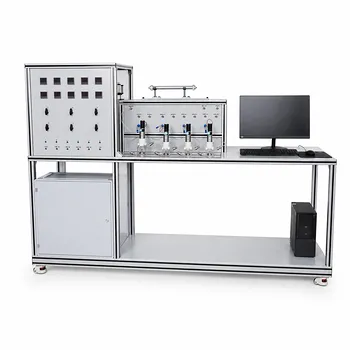
For endothermic reactions, the key advantage of a Reverse-Flow Reactor (RPFR) is its ability to drastically reduce the auxiliary heat carrier demand while achieving a near‑isothermal temperature profile. Compared to a conventional adiabatic fixed‑bed, an RPFR lowers the steam‑to‑reactant ratio from the typical 12‑17 mol/mol down to 8‑10 mol/mol, and it maintains the reactor inlet and outlet at approximately 640 K—far cooler than the reaction zone’s 890 K. This self‑contained thermal recuperation turns the reactor into an integrated heat‑exchange vessel, making it an unmatched teaching platform for advanced heat integration and transient‑reactor dynamics.
An RPFR traps reaction heat inside the catalyst bed by periodically reversing the flow, using inert‑bead beds as compact regenerative heat exchangers. For an endothermic process like styrene production, this cuts the required steam dilution by 30‑50 % and produces an almost flat, isothermal reaction zone. In a unit‑operations training system, it literally shows students how to build “energy efficiency” into the reactor itself.
Why Conventional Adiabatic Reactors Struggle with Endothermic Reactions
Endothermic reactions such as ethylbenzene dehydrogenation depend on a massive heat inflow just to sustain a usable reaction rate. In a standard fixed‑bed, that heat must be carried in by the feed stream.
The High‑Steam Burden
Superheated steam is the most common heat carrier, but it is expensive. To deliver enough sensible heat to the catalyst, conventional units operate with a steam‑to‑ethylbenzene molar ratio of 12–17 mol/mol.
This large steam excess inflates the volumetric flow through the bed, raising the pressure drop and taxing the downstream separation train.
A Steep, Unfavorable Temperature Profile
Because the reaction constantly consumes energy, the bed temperature plummets along the flow path. Only a short central section actually sits at the optimal kinetic temperature, while the inlet zone stays cold and the outlet temperature sags.
From a teaching perspective, this fixed, falling gradient masks the true kinetic potential of the catalyst and makes heat integration seem like an after‑the‑reactor problem.
How Reverse‑Flow Operation Restructures the Energy Balance
In an RPFR, the feed direction is periodically reversed, and the reactor ends are packed with inert ceramic beads. These beads act as regenerative heat exchangers—storing heat from the hot product gas and later releasing it to the cold incoming feed.
Recuperating the Reaction Heat
During one half‑cycle, hot products heat the downstream bead bed. When the flow reverses, the now‑cold feed absorbs that stored energy before it reaches the catalyst. This simple shift in flow logic reclaims the reaction heat that would otherwise be lost at the outlet.
The result is a dramatic reduction in the amount of fresh steam needed to carry heat into the system: the steam‑to‑reactant ratio drops to 8–10 mol/mol.
Near‑Isothermal Operation with Milder Inlet Temperatures
Because the regenerative beads preheat the feed, the reactant stream can enter the reactor at a modest 640 K while the catalyst zone holds a stable 890 K. The temperature profile flattens into a long, almost‑isothermal plateau, which maximizes the kinetic driving force over the entire catalyst bed.
Students can directly measure this flattened profile and compare it to the sharp gradient of a steady‑state bed—a visual lesson in how dynamic operation conquers thermodynamic limits.
Teaching Advanced Thermal Integration First‑Hand
The RPFR turns the reactor into a combined reactor‑heat exchanger. By logging axial temperatures during flow reversals, learners watch thermal wavefronts move back and forth.
This tangible demonstration of transient heat transfer and regenerative cycles is far more memorable than any textbook illustration, and it bridges reactor design directly with energy‑recovery strategies.
Illustrating Process Intensification and Sustainability
The lower steam load not only saves energy but also shrinks the size of downstream condensers and separators. The reduced inlet temperature eases materials selection and lowers the safety risk of high‑temperature piping.
From an educational standpoint, students can perform side‑by‑side energy balances and quantify the efficiency leap—transforming an abstract “process intensification” concept into a measurable improvement in steam economy.
Understanding the Trade‑offs
No teaching reactor configuration is without compromises. The RPFR’s thermal elegance comes with real‑world complexity.
Added Hardware and Control Complexity
Flow‑reversal valves, a programmable logic controller, and a robust data‑acquisition system are mandatory. These components raise the initial capital cost and the maintenance burden.
For labs with limited instrumentation support, the extra moving parts can become a distraction rather than an asset.
Transient Product Quality and Cycle Tuning
Each flow switch introduces a brief transient in product composition. Optimizing the cycle timing (switching frequency) is a delicate balance: too fast loses heat recovery, too slow destabilizes the temperature.
Students must understand dynamic control strategies and safety interlocks to prevent thermal runaway or excessive catalyst cooling—valuable lessons, but they require more instructor oversight and lab time.
Startup and Sustained Operation Limitations
An RPFR does not start up autothermally; the bed must first be heated externally to reach reaction temperature. Once running, it still needs a reduced but non‑zero steam supply to make up for inevitable thermal losses.
The system is self‑sustaining in the sense that it recycles most of the reaction heat, but it is not magic—thermodynamics still demands a net heat input to drive a continuous endothermic reaction.
Making the Right Choice for Your Unit Operations Lab
The decision between a conventional adiabatic reactor and an RPFR hinges on your educational goals, available runtime, and instrumentation budget.
- If your primary focus is teaching steady‑state kinetics and classical reactor design: A simple fixed‑bed gives clean, repeatable data on conversion versus feed temperature, with minimal operational distractions.
- If your goal is to demonstrate advanced heat integration and transient reactor behavior: The RPFR configuration lets students experience regenerative heat exchange, dynamic temperature profiles, and energy efficiency improvements firsthand—no textbook can match the impact of watching a thermal wave front travel the bed.
- If laboratory time or maintenance resources are extremely limited: The additional valves, controllers, and startup procedures of an RPFR may erode the time available for core concepts. A conventional system with a separately explained heat integration module might be more practical.
- If you aim to illustrate process intensification and sustainability concepts: An RPFR slashes steam consumption and makes energy efficiency a built‑in feature of the reactor. Students can quantify the environmental and economic gains, turning abstract “green engineering” into a concrete, data‑driven case study.
Whichever configuration you choose, the ultimate lesson remains the same: reactor engineering is not just about making molecules—it’s a powerful lever for energy efficiency, and that principle sticks best when students can see it in their own plant data.
Summary Table:
| Feature / Parameter | Conventional Adiabatic Reactor | Reverse-Flow Reactor (RPFR) |
|---|---|---|
| Steam-to-Reactant Ratio | High (12–17 mol/mol) | Low (8–10 mol/mol, 30–50% reduction) |
| Temperature Profile | Steep, falling gradient along the bed | Near-isothermal plateau in the reaction zone |
| Inlet Temperature | High (requires highly superheated feed) | Mild (approx. 640 K feed, 890 K reaction zone) |
| Thermal Efficiency | Low (heat is lost at the outlet) | High (self-contained regenerative heat recovery) |
| System Complexity | Low (steady-state operation) | High (requires cycle valves, PLC, and transient controls) |
| Primary Educational Focus | Steady-state kinetics & classic reactor design | Process intensification, transient heat transfer & dynamics |
Bring Advanced Process Intensification to Your Lab with LABPARK
Ready to equip your students with hands-on experience in dynamic reactor design and advanced heat integration? Contact LABPARK today to find the ideal pilot system for your curriculum.
LABPARK provides state-of-the-art Educational and Vocational Unit Operations Pilot Plants in:
- Chemical Engineering (including catalytic, adiabatic, and reverse-flow reactor systems)
- Bioprocess & Biotech
- Environmental & Water Treatment
We design safe, highly instrumented, and robust training systems tailored for universities, research institutes, and enterprises worldwide. Partner with us to transform abstract engineering concepts into measurable, real-world skills!
Related Products
- Internal Circulation Gradient Free Catalytic Reaction Educational Pilot Plant
- Gas Phase Mixing and Residence Time Distribution Determination Educational Unit Operations Pilot Plant
- Residence Time Distribution and Reactor Flow Characteristics Determination Educational Pilot Plant
- Multifunctional Membrane Separation Educational Pilot Plant with Ultrafiltration, Nanofiltration, Reverse Osmosis
- Steam Methane Reforming Hydrogen Production and Purification Educational Pilot Plant
People Also Ask
- Why is thermal management a major challenge in methane oxidative coupling? Reactor Solutions for Pilot Plants
- Why is a multibed configuration necessary for exothermic reactions? Optimize your pilot plant trajectory.
- How to distinguish Knudsen vs molecular diffusion in catalytic reactor pilot plants?
- Fluidized vs. Fixed Bed Reactors: Comparing Heat & Complexity in Pilot Plants
- Why Control WHSV & Residence Time in Catalytic Reactor Pilot Plants? Optimize Yield