Here’s the practical distinction: When operating a catalytic reactor pilot plant, you determine whether Knudsen diffusion or molecular diffusion dominates inside the pores by comparing the mean free path of the gas molecules to the catalyst pore diameter. In small pores at low pressure, gas molecules collide more often with the pore walls than with each other—that’s Knudsen diffusion. In large pores at high pressure, molecule-molecule collisions take over—that’s molecular (bulk) diffusion. The transition is captured by a dimensionless ratio, and crossing the threshold changes how you calculate effective transport rates inside the pellet.
The dominant mechanism hinges on the Knudsen number, \(Kn = \lambda / d_p\), where \( \lambda \) is the mean free path and \( d_p \) the pore diameter. For \(Kn > 10\), wall collisions control flux (Knudsen). For \(Kn < 0.01\), intermolecular collisions control flux (molecular). In pilot-scale troubleshooting, this single number tells you whether a pressure change will shift mass‑transfer resistance from one regime to the other, directly impacting apparent catalyst activity.
The Two Diffusion Regimes at a Glance
Knudsen Diffusion: When Molecules “See” Only the Wall
In Knudsen diffusion, the pore diameter is smaller than the distance a molecule travels before hitting another molecule. Gas‑phase collisions are rare; molecules bounce exclusively off the pore walls. The transport rate no longer depends on molecular collisions or gas composition. Instead, it scales with the pore radius and the square root of the ratio temperature over molecular weight \(\left( \sqrt{T/M} \right)\).
The Knudsen diffusion coefficient \(D_K\) is thus independent of total pressure and of other gas species.
This regime is common in micro‑ and mesoporous catalysts (e.g., 10 nm pores) at low operating pressures, often below \(5 \times 10^5\) Pa in pilot‑plant work.
Molecular (Bulk) Diffusion: Where Molecules Collide with One Another
When pore diameters are much larger than the mean free path, intermolecular collisions dominate. Gas molecules rarely touch the wall, and transport follows classical Stefan‑Maxwell relations—flux depends on concentration gradients, binary diffusivities, and the entire gas mixture. The diffusion coefficient here is sensitive to total pressure, temperature, and mixture composition, but far less to pore size alone.
This is the typical regime in wide‑pore pellets or when running the pilot plant at high pressure (e.g., above \(5 \times 10^6\) Pa for a 10‑nm pore catalyst).
The Critical Metric: Mean Free Path vs. Pore Diameter
Why the Primary Rule of Thumb Must Be Corrected
A common classroom simplification states that when \( \lambda \gg d_p\), Knudsen diffusion prevails, and when \( \lambda \ll d_p\), molecular diffusion prevails. The primary reference for this question includes a misleading expression (\(d_p / 2r_k\)), which is a mathematical misprint—it always equals 1 and doesn’t describe the ratio of interest. You should instead use the Knudsen number, \(Kn = \lambda / d_p\), and apply well‑established thresholds:
- \(Kn > 10\): Knudsen region (wall collisions govern flux)
- \(Kn < 0.01\): Molecular region (intermolecular collisions govern flux)
- \(0.01 \le Kn \le 10\): Transition region (both mechanisms contribute)
This correction aligns with decades of transport‑in‑porous‑media literature and with the example given in the supplementary references.
Calculating the Mean Free Path
The mean free path depends on pressure, temperature, and molecular size. For an ideal gas:
\[ \lambda = \frac{k_B T}{\sqrt{2} \pi \sigma^2 P} \]
where \(k_B\) is Boltzmann’s constant, \(T\) temperature, \(\sigma\) the collision diameter of the molecule, and \(P\) absolute pressure.
In a pilot plant, a higher operating pressure shrinks \(\lambda\), which can push a catalyst pellet from the Knudsen regime straight into the molecular regime—without any change in pore size.
How to Identify the Dominant Mechanism in Your Pilot Plant
Use a Simple Pressure‑Based Pulse Test
For a known catalyst pore size, calculate \(\lambda\) at your operating pressure and temperature, then compute \(Kn\).
A more hands‑on laboratory method: observe the effect of total pressure on mass‑transfer flux.
If increasing pressure reduces the effective diffusivity (while keeping everything else constant), you are likely in the molecular regime (because \(D \propto 1/P\) for binary bulk diffusion).
If total pressure has no effect on flux, you are in the Knudsen regime, where the diffusivity is pressure‑independent.
Apply the Published Pore‑Size Example
Take a catalyst pellet with an average pore size of 100 Å (10 nm).
Below about \(5 \times 10^5\) Pa (5 bar), Knudsen flow dominates; above roughly \(5 \times 10^6\) Pa (50 bar), molecular diffusion takes over.
In between lies a transition regime where neither mechanism can be ignored.
Correct for Pellet Microstructure
The effective diffusivity you actually measure in the pilot plant is not the Knudsen or molecular value alone.
You must account for void fraction (\(\varepsilon\)) and tortuosity (\(\tau\)):
\[ D_{eff} = \frac{\varepsilon}{\tau} \left( \frac{1}{1/D_K + 1/D_{mol}} \right)^{-1} \]
In the transition regime, the effective diffusivity is computed by adding the Knudsen and molecular conductances resistively (or following the Mason–Evans formulation).
Neglecting this correction can lead to significant errors when scaling from lab data to pilot‑plant performance.
Understanding the Trade‑offs
The Penalty of Misidentification
If you assume molecular diffusion but are actually in the Knudsen regime, your reactor model will over‑predict the sensitivity of rate to pressure and under‑predict the role of pore architecture.
Conversely, treating a system as Knudsen‑limited in the molecular regime can hide the benefits of increasing pressure to boost throughput. Both mistakes distort Thiele modulus estimates and selectivity predictions.
The Transition Regime Is Real and Messy
Real catalyst pores have a distribution of sizes, so many pellets operate with parts in Knudsen, parts in molecular, and parts in transition.
The common practice is to use a single effective diffusivity that blends contributions, but the blending law matters.
The Mason‑Evans approach rigorously combines Knudsen and multi‑component molecular diffusion; simpler serial addition is acceptable only for first‑pass scoping.
When Tortuosity and Porosity Become Your Dominant Uncertainty
In the Knudsen regime, the flux depends linearly on \(r_k\), so errors in mean pore size propagate directly.
In the molecular regime, tortuosity and void fraction dominate, and pore size matters less.
A pilot‑plant campaign should characterize these structural parameters using dedicated porosimetry or diffusion‑cell experiments to ground your identification.
Making the Right Choice for Your Pilot‑Plant Goal
Your action plan depends on what you need the diffusion distinction for:
- If your primary focus is troubleshooting mass‑transfer limitations: Start with the estimated Knudsen number. If \(Kn > 10\), test flux at two pressure levels—no change confirms Knudsen. If \(Kn < 0.01\), look for a \(1/P\) dependence to confirm molecular control.
- If your primary focus is scaling lab data to pilot‑plant conditions: Map out the operating pressure range. Identify whether you will cross the transition threshold as pressure scales up; if so, build a model that blends Knudsen and molecular contributions via the effective diffusivity corrected for porosity and tortuosity.
- If your primary focus is catalyst design or selection: Use the diffusion regime to guide pore‑structure targets. Knudsen‑limited reactions benefit from larger pores to remove wall‑collision resistance; molecular‑limited systems benefit more from higher porosity and lower tortuosity.
A clear, quantitative grasp of Knudsen vs. molecular diffusion transforms a pilot plant from a black‑box tool into a precise diagnostic instrument for your catalyst’s true performance.
Summary Table:
| Feature | Knudsen Diffusion | Molecular Diffusion |
|---|---|---|
| Knudsen Number ($Kn$) | $Kn > 10$ | $Kn < 0.01$ |
| Primary Collisions | Molecule-to-wall | Molecule-to-molecule |
| Pressure Dependency | Independent of pressure | Inversely proportional ($1/P$) |
| Key Parameters | Dependent on pore radius and $\sqrt{T/M}$ | Dependent on concentration gradients and gas mixture |
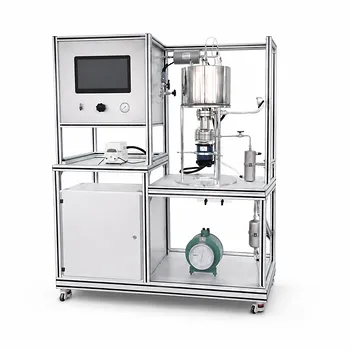
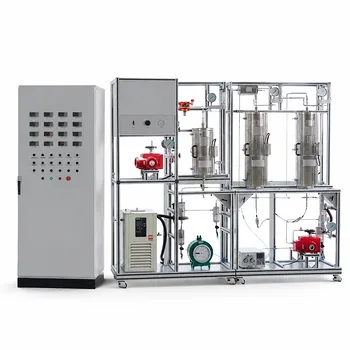
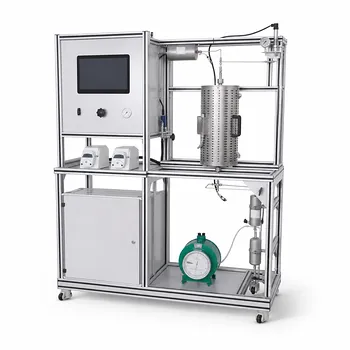
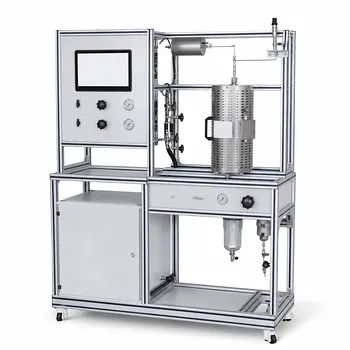
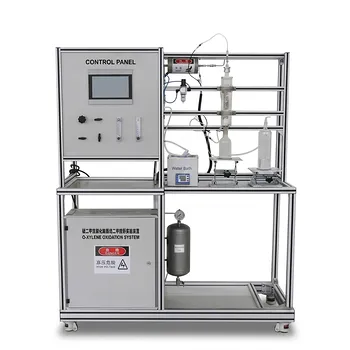
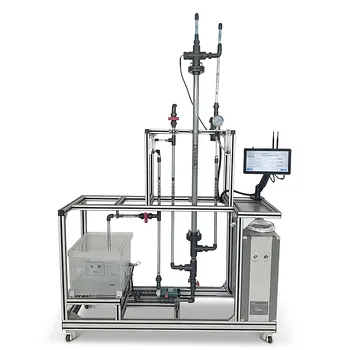
Optimize your catalytic research and engineering training with LABPARK. We provide advanced Educational and Vocational Unit Operations Pilot Plants in chemical engineering, bioprocess & biotech, and environmental & water treatment tailored for universities, research institutes, and enterprises. Our systems enable precise control and accurate modeling of complex mass-transfer phenomena, ensuring your students and researchers can study diffusion regimes under realistic process conditions.
Ready to elevate your laboratory capabilities? Contact LABPARK today to discover the ideal pilot plant solution for your institution!
Related Products
- Fixed Bed Gas Solid Catalytic Reaction Educational Pilot Plant
- Micro-Scale Gas-Solid Catalytic Reaction Educational Pilot Plant
- Fluidized Bed Gas Solid Catalytic Reaction Educational Pilot Plant
- Internal Circulation Gradient Free Catalytic Reaction Educational Pilot Plant
- Fixed-Bed Chemical Reaction and Gas Dust Tar Removal Unit Operations Pilot Plant
People Also Ask
- How to determine catalyst pore radius & porosity? Optimize your chemical engineering pilot plant.
- How does identifying the rate-limiting step optimize reaction conditions? Pilot Plant Guide
- How do reactor pilot plants safely study gas-solid reactions? Master kinetics with thermal & flow control.
- How does the Mears criterion evaluate transport resistance? Key Guide to Intrinsic Kinetics
- Fluidized vs. Fixed Bed Reactors: Comparing Heat & Complexity in Pilot Plants