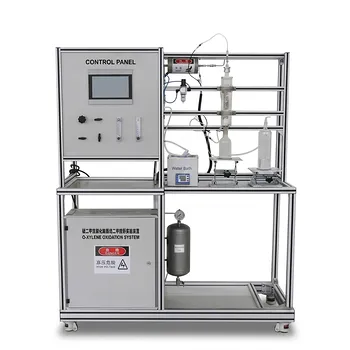
Transient kinetic studies demand techniques that can separate overlapping surface processes in real time. A Temperature‑Programmed Surface Reaction (TPSR) configuration does exactly that by ramping the temperature of a catalyst with pre‑adsorbed species while continuously monitoring the products that desorb. In a catalytic pilot plant, this turns the reactor into a dynamic analytical tool capable of revealing the reactivity of different surface intermediates, quantifying how catalyst aging or poisoning alters kinetics, and exposing the often‑hidden steps that govern overall reaction performance.
TPSR is not just a temperature ramp—it’s a direct window into surface reaction dynamics. By tracking exactly when products leave the surface, it decouples complex transient events that steady‑state experiments blend together, making it one of the most incisive methods for diagnosing catalytic behavior under non‑steady conditions.
The Core Principle: How TPSR Unlocks Transient Kinetics
Transient kinetics is the study of how a catalytic system responds to changes in its environment. While steady‑state experiments average out this response, TPSR deliberately introduces a controlled thermal perturbation to interrogate the surface.
From Steady‑State to Dynamic Interrogation
In a typical steady‑state run, you observe the overall conversion and selectivity, but the individual lifetimes and reactivities of surface species remain obscured.
TPSR takes the opposite approach. You first adsorb reactants or intermediates, then purge the gas phase and initiate a linear temperature ramp.
As the temperature rises, surface species either desorb, decompose, or react with intentionally introduced gas‑phase partners, and each event produces a product peak at a characteristic temperature.
This temperature‑resolved desorption pattern is effectively a thermal fingerprint of the surface chemistry.
The shape, position, and sequence of these peaks reveal the kinetic parameters—activation energies, rate‑determining steps, and relative coverages—that govern the transient behavior.
The Thermal Fingerprint of Surface Species
Not all carbon atoms on a nickel catalyst are equal. Some are loosely held atomic carbon, others more graphitic.
TPSR separates them because each species requires a different amount of thermal energy to become mobile and react.
By ramping the temperature, you sequentially activate these pools, and the resulting methane or water peaks appear at narrowly defined temperature windows.
This is exactly what the primary reference leverages: during CO/H₂ methanation, carbon is first deposited via CO disproportionation.
A subsequent TPSR under hydrogen reveals distinct CH₄ and H₂O peaks, each tied to a specific carbon form.
The ability to resolve these forms in a single experiment is a direct assistance to transient kinetic analysis.
Key Ways TPSR Configuration Assists Transient Studies
The pilot‑plant TPSR setup translates these principles into actionable kinetic insights. Below are the concrete ways it assists, drawn directly from the documented examples of methanation on nickel catalysts.
1. Deconvoluting Complex Surface Reactivity
A catalyst surface often hosts a mixture of reaction intermediates with similar chemical identities but different local structures.
TPSR discriminates them by their reactivity threshold temperature.
In the methanation example, carbon deposited from CO disproportionation is not uniform.
Some forms are highly reactive and hydrogenate to methane at a lower temperature; others are more refractory and react only at higher temperatures.
The TPSR trace maps out these populations, revealing how many distinct carbon pools exist and their relative amounts—information that is invisible in a steady‑state measurement where all carbon gets converted simultaneously.
2. Quantifying Catalyst Aging Effects
Catalyst aging often manifests as a loss of reactivity, but the root cause can be elusive.
TPSR directly measures how thermal aging shifts the reactivity of surface species.
The primary reference shows that after thermal aging, the carbon species on a nickel catalyst become less reactive.
In a TPSR experiment, this appears as a shift of the methane and water desorption peaks to higher temperatures.
The magnitude of this shift quantifies the aging impact, allowing engineers to correlate thermal history with the kinetic penalty.
This assists transient kinetic studies by providing a measurable metric for deactivation and by isolating which specific carbon pools are most affected.
3. Exposing Site‑Specific Poisoning Mechanisms
Contaminants like sulfur often do not uniformly deactivate a catalyst surface; they preferentially attack the most active sites.
TPSR reveals this selectivity by altering the desorption profile in a predictable way.
When sulfur poisons the high‑energy adsorption sites on nickel, these sites can no longer stabilize the most reactive carbon forms.
The corresponding low‑temperature TPSR peaks diminish or disappear, while the high‑temperature peaks become more prominent.
By comparing TPSR profiles before and after poisoning, you directly observe which kinetic pathways are shut down and how the remaining sites function. This is transient kinetic evidence of site‑specific poisoning that steady‑state turnover numbers alone cannot provide.
4. Probing Coadsorbate Interactions and Reaction Pathways
The TPSR configuration is not limited to a single adsorbate.
You can pre‑adsorb multiple species or introduce a gas‑phase reactant (like H₂) during the ramp.
This enables the study of how coadsorbed species influence each other’s reactivity and which reaction pathways dominate under transient conditions.
For example, in the methanation case, the reaction of deposited carbon with co‑fed H₂ is the central event.
The shape of the methane peak as a function of temperature carries information about the hydrogenation mechanism and whether the rate is limited by C‑H bond formation or by carbon diffusion.
These mechanistic details are vital for building microkinetic models that accurately predict behavior under industrial transients.
Understanding the Trade‑offs
While powerful, TPSR is a specialized tool with inherent limitations. A trusted technical advisor must present these objectively to ensure proper application.
The Ambiguity of Spectator vs. Intermediate
TPSR shows you what leaves the surface, not necessarily the surface species itself.
A product peak might originate from a true reaction intermediate or from a spectator species that converts only under the forcing conditions of a temperature ramp.
Without complementary spectroscopic evidence, you cannot definitively assign a TPSR peak to a kinetically competent intermediate.
Mass Transfer and Readout Considerations
The information you get depends on the ramp rate, gas velocity, and detection lag.
Too fast a ramp can merge peaks or cause temperature gradients across the catalyst bed.
Too slow a ramp can allow surface species to restructure, altering the chemistry you are trying to probe.
Careful experimental design is required to ensure that the measured peak temperatures reflect intrinsic kinetics, not mass transfer limitations.
Complementary Role of Spectroscopic Transient Methods
The supplementary references highlight how transient IR spectroscopy can directly track surface species during a perturbation.
Pairing TPSR with rapid‑scan FTIR closes the intermediate‑spectator gap.
You can, for instance, run a TPSR while simultaneously recording IR spectra to correlate a disappearing band with the onset of a product peak.
Isotopic labeling adds a further layer, confirming which surface fragments end up in which product.
So, while TPSR is superb at quantifying reactivity, combining it with spectroscopic transient techniques delivers the full mechanistic picture.
Making the Right Choice for Your Kinetic Study
Your application of TPSR should align with the specific transient question you are asking. Here is how to match the technique to the goal.
- If your primary focus is unraveling the number and reactivity of surface carbon pools: Use TPSR after carbon deposition to map distinct CH₄ and H₂O peaks and quantify the fraction of each species.
- If your primary focus is diagnosing catalyst deactivation due to aging or poisoning: Compare TPSR peak shifts pre‑ and post‑deactivation; the temperature shift directly reports the change in apparent activation barrier for the affected pathway.
- If your primary focus is building a microkinetic model with transient validation: Supplement TPSR with fast transient IR spectroscopy to identify the surface species behind the peaks, then use the peak shapes for kinetic parameter extraction.
- If your primary focus is screening reaction conditions for a scaled pilot plant: Begin with a few TPSR runs to identify the critical temperature windows for key steps, then design your transient operational protocols around those windows.
TPSR transforms a pilot plant reactor from a steady‑state performance meter into a genuine transient kinetic laboratory, giving you the power to isolate and quantify the very surface processes that define catalyst life and selectivity.
Summary Table:
| TPSR Capability | Kinetic Benefit | Practical Application |
|---|---|---|
| Deconvoluting Reactivity | Maps distinct active pools | Resolves intermediate species (e.g., carbon pools) |
| Quantifying Aging | Measures activation energy shifts | Evaluates thermal degradation impact over time |
| Exposing Poisoning | Identifies specific deactivated sites | Pinpoints contaminant (e.g., sulfur) effects |
| Probing Coadsorbates | Reveals multi-species pathways | Validates parameters for microkinetic models |
Accelerate Your Research & Training with LABPARK
To accurately capture transient kinetics and optimize catalytic processes, you need robust, reliable pilot-scale systems. LABPARK designs and delivers premium Educational and Vocational Unit Operations Pilot Plants in chemical engineering, bioprocess & biotech, and environmental & water treatment.
Whether you represent a university, a research institute, or a commercial enterprise, our advanced systems can be custom-tailored with dynamic analytical configurations like TPSR to elevate your research.
Contact LABPARK today to discuss your project requirements with our engineering team!
Related Products
- Fixed Bed Gas Solid Catalytic Reaction Educational Pilot Plant
- Fluidized Bed Gas Solid Catalytic Reaction Educational Pilot Plant
- Micro-Scale Gas-Solid Catalytic Reaction Educational Pilot Plant
- Internal Circulation Gradient Free Catalytic Reaction Educational Pilot Plant
- Multi Functional Catalytic Reaction and Reactor Evaluation Educational Unit Operations Pilot Plant
People Also Ask
- How do reactor pilot plants safely study gas-solid reactions? Master kinetics with thermal & flow control.
- How does the Mears criterion evaluate transport resistance? Key Guide to Intrinsic Kinetics
- Fluidized vs. Fixed Bed Reactors: Comparing Heat & Complexity in Pilot Plants
- Why is a multibed configuration necessary for exothermic reactions? Optimize your pilot plant trajectory.
- What are the differences between pseudohomogeneous and heterogeneous models in pilot plants?