Knowledge Chemical Engineering Education Why is bubble size distribution preferred in stirred tank pilot plants? PBM Limitations
Author avatar

Tech Team · LABPARK

Updated 1 month ago

Why is bubble size distribution preferred in stirred tank pilot plants? PBM Limitations


Heterogeneous mixing makes uniform assumptions dangerously inaccurate. In gas-liquid stirred tank reactors, the local bubble size varies dramatically—from sub-millimeter fines in the high-shear impeller zone to millimeter-scale caps in the bulk. Modeling this distribution is essential because it directly determines the slip velocity between gas and liquid and the interfacial area for mass transfer. Using a single, uniform bubble size misses these local variations, leading to significant errors in predicted reactor performance.

The core challenge is that stirred tanks create a spatial spectrum of turbulence that produces a spectrum of bubble sizes. Ignoring this reality undercuts your pilot plant’s predictive value. While complex population balance models (PBMs) can theoretically capture these dynamics, their practical deployment is crippled by computational cost, mesh sensitivity, and heavy reliance on tuning. A balanced approach—often a simplified bubble density function with a modified drag law—provides the necessary accuracy without the overhead.

Understanding the Physics of Bubbles in Stirred Tanks

The Turbulence Spectrum Creates a Bubble Size Spectrum

A stirred tank is not a uniform turbulence field. Energy dissipation rates are orders of magnitude higher near the impeller blades than at the vessel walls. This energy cascade directly governs bubble breakage.

In the impeller discharge stream, intense shear and turbulent eddies shatter gas into a swarm of very fine bubbles, often under 1 mm. Away from the impeller, in the calmer bulk circulation zones, turbulence decays. Here, coalescence dominates, and bubbles grow to a stable size around 5 mm or larger. Assuming a single mean diameter forces the model to pick a value that is wrong everywhere, systematically distorting key interfacial forces.

The Direct Link to Slip Velocity and Mass Transfer

A bubble’s rise velocity (slip velocity) is a strong function of its size. Small, rigid bubbles rise slowly; large, deformable caps rise quickly. This slip velocity then feeds directly into the calculation of the gas-liquid mass transfer area, a, and the volumetric mass transfer coefficient, kLa.

If you model all bubbles as one size, you will either overestimate slip in regions of small bubbles (predicting gas leaves too quickly) or underestimate it in regions of large bubbles (predicting artificially high gas holdup). Both errors cascade into flawed predictions of conversion, selectivity, and reaction rates. A distribution model, by contrast, preserves the local hydrodynamics and gives you an honest estimate of the true driving force for mass transfer.

The High Cost of High-Fidelity: Population Balance Model Limitations

The Computational and Resolution Burden

Population balance equations simulate the birth and death of bubble classes through breakage and coalescence kernels. This is a massive computational undertaking. To resolve these kernels accurately, the fluid mesh must be fine enough to capture the smallest turbulent eddies responsible for bubble breakage.

If the mesh is too coarse, the model underpredicts turbulence, directly underpredicting breakage rates and artificially shifting the distribution toward larger bubbles. The need for a fine mesh, combined with solving transport equations for dozens of bubble size classes, makes a full PBM impractical for rapid pilot-plant design iterations on typical engineering workstations.

The Achilles' Heel of Empirical Tuning

Beyond compute power, population balance models are fundamentally empirical. The breakage and coalescence kernel parameters—such as the critical energy for bubble splitting or the liquid film drainage time—are not universal constants. They must be tuned for your specific tank geometry, impeller type, and operating conditions.

This tuning requires expensive, high-resolution experimental data from the very same configuration you’re trying to simulate. Using a literature parameter from a different tank setup is a significant gamble. The model transfers poorly, undermining the predictive nature of the simulation.

Understanding the Trade-offs

When a White-Box Model Adds More Uncertainty

There is a common trap: believing a complex model is inherently more accurate. In PBM simulation, you trade one set of uncertainties (from simplified physics) for another set (from uncertain kernel parameters and mesh dependencies). If you cannot validate the tuning parameters for your specific pilot unit, a high-fidelity PBM can become a black box that generates precise-looking, but ultimately incorrect, results with tremendous effort.

The Practical Middle Ground

The primary reference suggests an effective alternative: couple a simplified bubble density function with a modified interphase drag coefficient. Instead of tracking dozens of size classes with population dynamics, you use a continuous function that describes the local bubble size as a function of local turbulence. You then modify the drag law to reflect the local slip behavior of that size distribution. This approach captures the first-order effect of spatial size variation (the deep need) while avoiding the computational and tuning nightmares of a full PBM.

How to Apply This to Your Pilot Plant Design

Before choosing your modeling approach, re-center on your actual purpose for the simulation. Are you aiming for fundamental physical insight or delivering a robust engineering design on a deadline?

  • If your primary focus is fundamental research on breakage mechanisms: A full population balance model is the right tool, but only if you have the high-resolution data and computational budget to tune and validate the kernel parameters for your specific system.
  • If your primary focus is rapid pilot plant design and scale-up prediction: Avoid the trap of PBM overkill. Adopt the simplified bubble density function approach with a modified drag coefficient. It preserves the critical local variations in slip velocity and mass transfer area at a fraction of the computational cost.
  • If your primary focus is troubleshooting an existing pilot unit: Start by measuring the actual bubble size distribution in multiple tank zones. Use that data not just to tune a PBM, but to directly inform a simpler, calibrated model that you can trust.

The most accurate model is not the most complex; it's the one whose uncertainties you have truly bounded for your specific application.

Summary Table:

Modeling Approach Mass Transfer Accuracy Computational Cost Tuning Effort Best For
Uniform Bubble Size Low (ignores local shear) Minimal None Preliminary screening
Complex PBM High (in theory) Extremely High Very High (empirical) Academic research
Simplified Density Function High (captures spatial slip) Low to Moderate Low Practical pilot plant design

Need to bridge the gap between simulation and real-world reactor performance? LABPARK provides state-of-the-art Educational and Vocational Unit Operations Pilot Plants in chemical engineering, bioprocess & biotech, and environmental & water treatment. Designed specifically for universities, research institutes, and enterprises, our pilot plants deliver the reliable, physical data needed to validate your scale-up models.

Contact LABPARK today to explore our customizable pilot plant solutions and accelerate your research!

Related Products

People Also Ask

Related Products

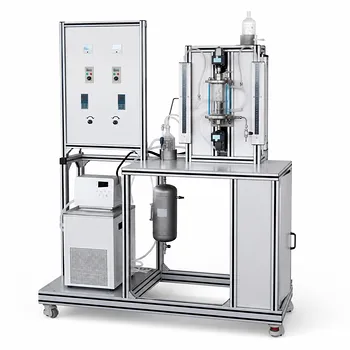
Dual-Drive Stirred Gas-Liquid Mass Transfer Coefficient Determination Pilot Plant

Dual-Drive Stirred Gas-Liquid Mass Transfer Coefficient Determination Pilot Plant

Pilot plant for determination of gas-liquid mass transfer coefficients with independent dual-drive agitation. Isolate gas and liquid film resistances via two-film theory control of speeds, flow rates, temperature. Borosilicate vessel provides visual access. Customizable for chemical, environmental, food, pharmaceutical engineering.

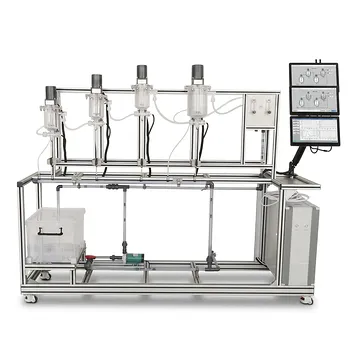
Multi-Stage Stirred Tanks in Series Residence Time Distribution and Mixing Performance Determination Educational Pilot Plant

Multi-Stage Stirred Tanks in Series Residence Time Distribution and Mixing Performance Determination Educational Pilot Plant

Explore residence time distribution and mixing performance in series stirred tanks with this educational pilot plant. Real-time conductivity sensors, interactive 3D simulation, and industrial-grade PC for chemical engineering lab training. Customizable to curricula.

Multi-Reactor Educational Pilot Plant for Reaction Engineering Unit Operations

Multi-Reactor Educational Pilot Plant for Reaction Engineering Unit Operations

Integrated bench-scale educational pilot plant for chemical engineering teaching featuring fixed bed fluidized bed and stirred tank reactors with web-based digital twin controls and safety interlocks for hands-on unit operations and reaction engineering comparative studies in one compact system.

Multi Functional Catalytic Reaction and Reactor Evaluation Educational Unit Operations Pilot Plant

Multi Functional Catalytic Reaction and Reactor Evaluation Educational Unit Operations Pilot Plant

Bench-scale educational pilot plant for catalytic reaction and reactor evaluation, integrating fixed bed, fluidized bed, and stirred tank reactors. Students compare reactor designs, evaluate catalysts, and study reaction kinetics and hydrodynamics. Perfect for unit operations labs in chemical engineering curricula.

Fixed-Bed Chemical Reaction and Gas Dust Tar Removal Unit Operations Pilot Plant

Fixed-Bed Chemical Reaction and Gas Dust Tar Removal Unit Operations Pilot Plant

Integrated educational pilot plant for studying catalytic gas-solid reactions and downstream gas purification. Features dual fixed-bed reactor, three-stage heating, and touchscreen control for hands-on engineering training. Ideal for chemical and environmental engineering curricula.

Gas Phase Mixing and Residence Time Distribution Determination Educational Unit Operations Pilot Plant

Gas Phase Mixing and Residence Time Distribution Determination Educational Unit Operations Pilot Plant

Integrated lab system for gas-phase mixing and RTD determination. Supports pulse and step tracer methods with dual CSTR and PFR reactors, industrial components, and PC data logging. Provides hands-on study of non-ideal flow and reactor behavior for university students.

Comprehensive Liquid-Liquid Extraction Pilot Plant for Engineering Education

Comprehensive Liquid-Liquid Extraction Pilot Plant for Engineering Education

Comprehensive liquid-liquid extraction pilot plant for engineering education, integrating rotary and vibratory columns for hands-on observation of phase behavior, flooding limits, and mass transfer efficiency, enabling precise HTU and mass transfer coefficient calculations.

Fixed Bed Gas Solid Catalytic Reaction Educational Pilot Plant

Fixed Bed Gas Solid Catalytic Reaction Educational Pilot Plant

Fixed-bed gas-solid catalytic reaction unit operations pilot plant for chemical engineering education. Features split-furnace, mass flow controllers, PID control, safety interlocks. Ideal for heterogeneous catalysis, reactor dynamics, catalyst evaluation studies. Fully customizable configurations for university laboratories and academic research.

Fluidized Bed Gas Solid Catalytic Reaction Educational Pilot Plant

Fluidized Bed Gas Solid Catalytic Reaction Educational Pilot Plant

Our educational fluidized bed gas-solid catalytic reaction pilot plant is ideal for chemical engineering labs. Students study fluidization dynamics, catalyst evaluation, and process control hands-on. Features include a customizable reactor, touchscreen HMI, and safety interlocks for safe, curriculum-aligned experiments.

Micro-Scale Gas-Solid Catalytic Reaction Educational Pilot Plant

Micro-Scale Gas-Solid Catalytic Reaction Educational Pilot Plant

Explore heterogeneous catalysis with this micro-scale gas-solid catalytic reaction educational pilot plant. Designed for university labs, it enables hands-on study of reaction kinetics and transport phenomena in a benchtop packed bed reactor with high-precision flow control and touchscreen automation.

Methane Cracking Educational Unit Operations Pilot Plant

Methane Cracking Educational Unit Operations Pilot Plant

This bench-scale methane cracking educational pilot plant provides hands-on catalytic conversion training with a 1000°C furnace, seven mass flow controllers, and real-time automation for safe, curriculum-aligned experiments. Designed for university teaching of unit operations and reaction engineering.

Two Phase Flow Pattern Velocity Resistance Measurement Educational Pilot Plant

Two Phase Flow Pattern Velocity Resistance Measurement Educational Pilot Plant

Benchtop educational pilot plant for university labs studying gas-liquid two-phase flow patterns, velocity, and resistance across circular, square, and rectangular conduits. Features 15.6-inch touchscreen, 5G connectivity, differential pressure sensors, safe water-air operation. Supports chemical engineering curricula.

Educational Unit Operations Pilot Plant for Intraparticle Diffusion Effective Factor Measurement

Educational Unit Operations Pilot Plant for Intraparticle Diffusion Effective Factor Measurement

Designed for chemical engineering university labs, this pilot plant allows hands-on determination of catalyst particle intraparticle diffusion effective factors and gas-solid reaction kinetics using a fixed-bed tubular reactor with industrial touchscreen control, bridging theory and practical reactor design.

Liquid-Liquid Mass Transfer Coefficient Determination Educational Pilot Plant

Liquid-Liquid Mass Transfer Coefficient Determination Educational Pilot Plant

This bench-scale educational pilot plant for liquid-liquid mass transfer coefficient determination offers precise control of phase boundary, temperature, and agitation, enabling hands-on study of transport phenomena and unit operations in chemical engineering labs for teaching.

Residence Time Distribution and Reactor Flow Characteristics Determination Educational Pilot Plant

Residence Time Distribution and Reactor Flow Characteristics Determination Educational Pilot Plant

This versatile educational pilot plant is designed for comprehensive study of residence time distribution and reactor flow characteristics, featuring multiple CSTRs in series, a tubular reactor, variable recycle loop, and automated real-time data acquisition, perfect for hands-on chemical engineering education.

Methanol Synthesis and Catalyst Performance Evaluation Educational Unit Operations Pilot Plant

Methanol Synthesis and Catalyst Performance Evaluation Educational Unit Operations Pilot Plant

Bench-scale methanol synthesis and catalyst evaluation educational pilot plant for chemical engineering labs to study catalytic kinetics, high-pressure operations, process control, and unit operations under realistic conditions with industrial safety features, precision gas delivery, data acquisition, and intelligent monitoring.

100L Continuous Loop Hydrogenation Educational Unit Operations Pilot Plant

100L Continuous Loop Hydrogenation Educational Unit Operations Pilot Plant

This 100L continuous loop hydrogenation pilot plant is designed for chemical engineering education, featuring 316 stainless steel construction, advanced gas-liquid mass transfer components, explosion-proof safety systems, and a 15.6-inch touchscreen with 5G connectivity, cloud data logging, bridging theory and industry.

Absorption and Desorption Educational Unit Operations Pilot Plant

Absorption and Desorption Educational Unit Operations Pilot Plant

Dual packed column absorption and desorption pilot plant for chemical engineering education, offering real-time mass transfer coefficient measurement, durable mobile frame, industrial touch-screen interface, and customizable design for varied laboratory curricula, enabling hands-on study of gas absorption and stripping.

Crude Benzene Hydrogenation Educational Unit Operations Pilot Plant

Crude Benzene Hydrogenation Educational Unit Operations Pilot Plant

Advanced pilot plant for higher education, enabling hands-on study of crude benzene hydrogenation and gas-liquid catalytic reactions. Triple-stage reactor system with precision flow and temperature control, AI-driven PID, remote monitoring, and comprehensive safety interlocks. Customizable for curriculum integration.

Bench Scale Dual Column Gas Separation and Capture Educational Pilot Plant

Bench Scale Dual Column Gas Separation and Capture Educational Pilot Plant

This dual-column educational pilot plant provides hands-on teaching of gas adsorption, separation, and capture processes. It features stainless steel columns, regeneration up to 400°C, and a 15.6-inch touchscreen PLC for TSA and PSA studies in chemical engineering curricula, process simulation.


Leave Your Message