Here’s the core principle: you can confidently translate your oxygen-water mass transfer data to another gas-liquid system using a simple, diffusion-based scaling law. In pilot-scale bioreactors and environmental reactors, the oxygen-water system serves as the universal calibration standard. To adjust its volumetric mass transfer coefficient ((k_La)) to a new system, you apply a correction factor derived from the ratio of the gas’s diffusion coefficient in the new liquid to that of oxygen in water.
The most direct and trusted method is to multiply your measured ((k_La){\mathrm{O_2\text{-}water}}) by (\left(\frac{D{\text{new}}}{D_{\mathrm{O_2\text{-}water}}}\right)^{0.5}), where (D_{\mathrm{O_2\text{-}water}} = 2.4 \times 10^{-9} , \mathrm{m^2/s}). This square-root dependence on diffusivity captures the dominant physical change, but it is only your starting point. Real fluids often demand additional corrections for bubble behavior and liquid chemistry.
Why the Oxygen-Water Baseline Matters
Oxygen-water data is the lingua franca of mass transfer characterization. Nearly every pilot plant manual, scale-up correlation, and standard operating procedure begins there.
The Universal Starting Point
Engineers use the dynamic gassing-out technique to generate clean, reproducible (k_La) values. You purge dissolved oxygen with nitrogen, then track the re-aeration curve. The slope of (\ln[(C^* - C_0)/(C^* - C_t)]) versus time gives you (k_La). This is your empirical anchor.
The Shift to Process-Relevant Fluids
Your real process liquid—fermentation broth, ionic solution, or solvent—changes how gas moves. A single baseline cannot predict performance in these media without adjustment. The primary need is to preserve the value of your experimental calibration while translating it to the system that matters.
The Fundamental Adjustment: The Diffusion Coefficient Ratio
The direct path from your primary reference is the most powerful one for initial estimates. It isolates the gas-liquid diffusivity effect, assuming no drastic change in interfacial area or bubble size.
The Square-Root Rule
Apply this formula directly to your measured oxygen-water (k_La) value:
[ (k_La){\text{system}} = (k_La){\mathrm{O_2\text{-}water}} \times \sqrt{\frac{D_{\text{system}}}{D_{\mathrm{O_2\text{-}water}}}} ]
Here, (D_{\mathrm{O_2\text{-}water}}) is (2.4 \times 10^{-9} , \mathrm{m^2/s}). The principle stems from surface renewal and penetration theories, where (k_L \propto D^{0.5}). For many low-viscosity, non-coalescing-inhibiting systems, this gives a fast, defensible prediction.
Applying It to Different Gases or Liquids
If you switch from oxygen to carbon dioxide in the same water, use (D_{\mathrm{CO_2\text{-}water}}). If you switch the liquid from water to a dilute alcohol solution, use (D_{\mathrm{O_2\text{-}alcohol}}). The correction works both ways, letting you quickly scope new operating scenarios without duplicating years of pilot plant trials.
When the Simple Correction Is (and Isn’t) Enough
Diffusivity is a critical piece, but it is not the whole puzzle. Over-relying on the square-root rule without understanding its limits can mislead your scale-up.
The Hidden Hand of Bubble Behavior
The (k_La) term lumps together the liquid-side mass transfer coefficient ((k_L)) and the specific interfacial area ((a)). The diffusion correction adjusts (k_L), but it assumes the interfacial area (a) stays constant. That assumption breaks easily.
Ionic solutions and fermentation media often suppress bubble coalescence. Smaller bubbles mean a much larger (a), and the (k_La) can jump independently of diffusivity. Van’t Riet’s correlation quantifies this: for pure water, (k_La \propto (P_g/V)^{0.4} u_g^{0.5}); for ionic solutions, the dependence shifts to ((P_g/V)^{0.7} u_g^{0.2}), reflecting a completely different bubble regime.
The Danger in Fermentation Broths
Broths contain salts, proteins, and surfactants. These can lower (k_L) by creating a stagnant film, even as they increase (a) by preventing coalescence. The net effect is unpredictable from a simple diffusion ratio alone. The Fair method, while also using a ((D_{\text{system}}/D_{\text{water}})^{0.5}) factor, explicitly cautions that experimental calibration is non-negotiable once surfactants appear.
Pressure-Driven Measurement Nuances
When you measure (k_La) via the pressure-drop method in a closed, degassed reactor, the driving force for mass transfer is the headspace pressure change. This gives you a direct uptake rate. That data is still your starting point, but adjusting it requires the same vigilance: if the new liquid changes the hydrodynamics (viscosity, density), the agitation-to-interfacial-area relationship changes, and a pure diffusion correction will underestimate or overestimate the true rate.
Making the Right Choice for Your Pilot Plant Goal
Your adjustment strategy must match your system’s complexity. Use the following decision logic to avoid the most common scale-up traps.
- If your primary focus is on pure, low-viscosity liquids where only the gas or solvent changes: Apply the square-root diffusion correction directly. It will give you a rapid, engineering-quality estimate to size equipment or set initial operating ranges.
- If your primary focus is on ionic solutions or media with known coalescence suppression: Start with the diffusion correction, but immediately check your prediction against the Van’t Riet constants for ionic systems. Expect a larger interfacial area and a shifted power input exponent.
- If your primary focus is on complex fermentation broths or surfactant-laden fluids: The diffusion correction is only a first guess. You must run a dedicated dynamic gassing-out experiment in the actual process fluid at pilot scale to generate a reliable, process-specific (k_La) value. Do not rely on translation alone.
Your oxygen-water pilot data is a launchpad, not a final answer. Use the square-root rule to interrogate the physical change, but always verify the hydrodynamic reality of your unique liquid.
Summary Table:
| System Type | Recommended Adjustment Method | Primary Limitation & Risk |
|---|---|---|
| Low-Viscosity Pure Liquids | Square-root diffusion ratio: $(k_La){\text{sys}} = (k_La){\text{ref}} \times \sqrt{D_{\text{sys}}/D_{\text{ref}}}$ | Assumes interfacial area ($a$) remains constant. |
| Ionic Solutions | Van’t Riet correlation correction | Coalescence suppression significantly increases $a$. |
| Fermentation Broths | Empirical dynamic gassing-out validation | Surfactants and proteins change $k_L$ and $a$ unpredictably. |
Optimize Your Scale-Up with LABPARK Pilot Plants
Accurate mass transfer data is critical for scaling up biochemical and environmental processes. LABPARK provides state-of-the-art Educational and Vocational Unit Operations Pilot Plants in chemical engineering, bioprocess & biotech, and environmental & water treatment. Designed specifically for universities, research institutes, and enterprises, our pilot plants ensure reliable, reproducible data for precise process design.
Ready to enhance your laboratory and research capabilities? Contact LABPARK today to find the perfect pilot plant solution for your needs!
Related Products
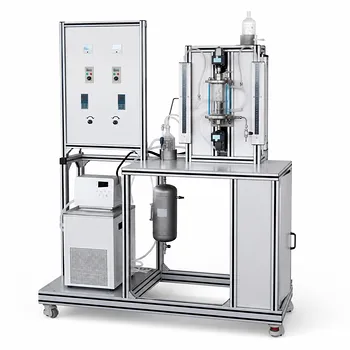
- Dual-Drive Stirred Gas-Liquid Mass Transfer Coefficient Determination Pilot Plant
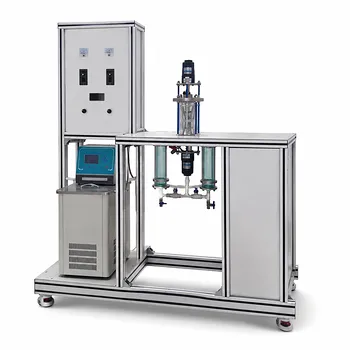
- Liquid-Liquid Mass Transfer Coefficient Determination Educational Pilot Plant
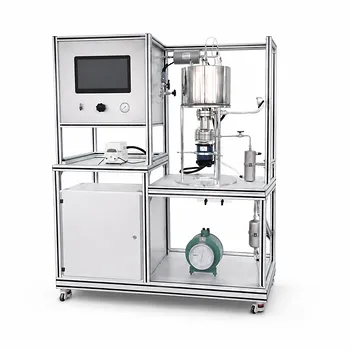
- High-Gravity Emulsification and Mass Transfer Educational Pilot Plant
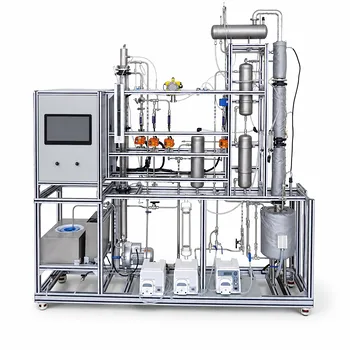
- Absorption and Desorption Educational Unit Operations Pilot Plant
- Carbon Dioxide Absorption and Desorption Educational Pilot Plant for Carbon Capture Studies
People Also Ask
- How does column packing affect absorption intensification, and how is it evaluated experimentally?
- Why Compare Membrane-Reservoir Models with Pilot Plant Data? Ensure Successful Process Scale-Up
- Why is pilot plant gas absorption lower than isothermal model predictions? Interfacial heating explained.
- Which interphase forces dominate gas dispersion in stirred reactors? Master Gas Holdup Models
- What key factors influence the rate of diffusion in liquids? Optimize Mass Transfer Pilot Plant Design