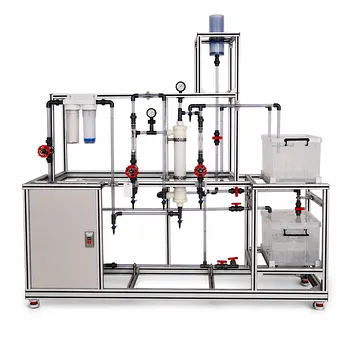
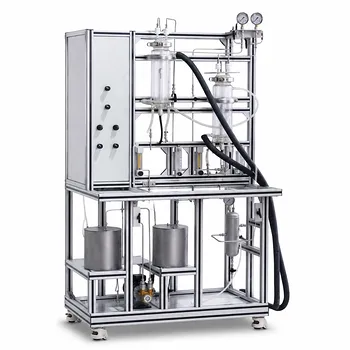
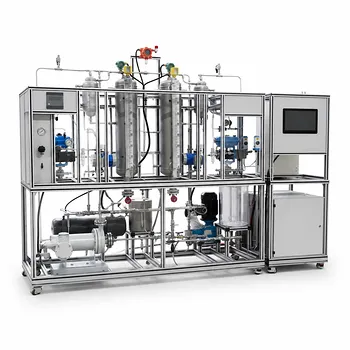
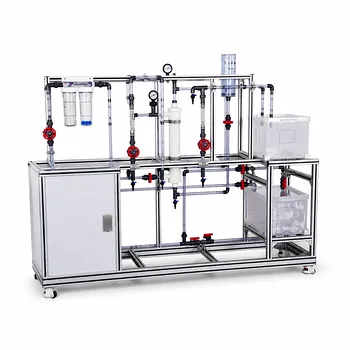
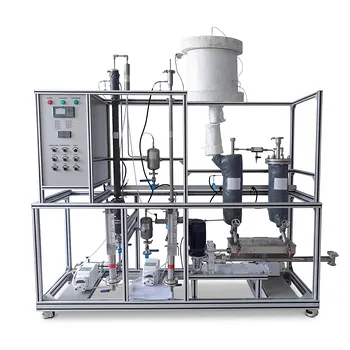
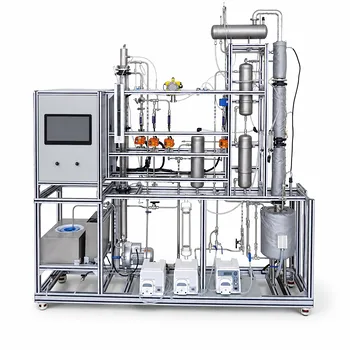
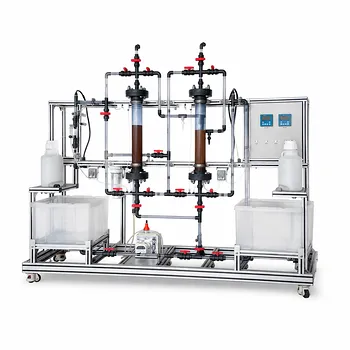
The answer to your question is straightforward: In a membrane-based nitrogen-generation pilot plant, nitrogen purity is directly controlled by manipulating the gas's residence time within the membrane module, typically by adjusting the product draw rate. To ensure stable and repeatable operation, the compressed feed air must first be cleaned up through a sequence of pretreatment steps—filtration, organic vapor removal, and drying—while its temperature is precisely regulated.
The core principle is that membrane selectivity depends on contact time and feed conditions. In an educational pilot plant, you regulate purity by varying how fast you withdraw the nitrogen product, and you protect the membrane's integrity and performance with a carefully designed pretreatment train that removes condensate, oils, particulates, and moisture. Everything else—data reproducibility, membrane lifetime, and meaningful student experiments—rests on these two controls.
How Nitrogen Purity is Regulated in the Membrane Pilot Plant
The membrane module contains a bundle of hollow fibers or a spiral-wound element that selectively allows oxygen and water vapor to permeate faster than nitrogen. The purity of the retained nitrogen stream is a function of how much oxygen has been given the chance to escape through the membrane walls.
The Residence-Time Control Mechanism
In your plant, you are not changing the membrane material or the absolute pressures mid-experiment. Instead, you control the oxygen concentration in the product by altering the residence time of the gas inside the module.
A longer residence time means the gas mixture spends more time in contact with the membrane, allowing more oxygen molecules to permeate through the wall and exit as the “sweep” or “permeate” stream.
The standard knob to turn is the product draw rate. By throttling the outlet valve on the nitrogen-rich retentate side, you slow down the flow. This keeps the gas inside the module longer, giving oxygen a greater opportunity to diffuse through the membrane.
The result is a higher-purity nitrogen stream—often leaving between 0.5% and 2.0% oxygen, depending on the feed properties and the selectivity of the membrane.
The Direct Relationship Between Flow and Purity
You can demonstrate this relationship clearly to students: a reduced flow rate directly correlates with lower residual oxygen. This is a mass-transfer concept in action—permeation is rate-limited, and time is the variable you command directly.
In an educational setting, the control loop may be a simple manual needle valve or a low-flow mass flow controller on the product line. The resulting purity is monitored in real time with an oxygen analyzer, allowing the plant to immediately show the cause‑and‑effect link.
Key point: Purity is not set by a computer algorithm; it is a direct consequence of a physical operating variable—residence time—which you manipulate through the product withdrawal rate.
The Pretreatments Required for Feed Air
Compressed atmospheric air is a dirty feed. Without rigorous pretreatment, the membrane module in your pilot plant will suffer from rapid performance decline or even permanent damage. The following steps are mandatory, not optional.
Mechanical Filtration: Removing Condensate, Mist, and Particulates
The first line of defense is a coalescing filter and a general particulate filter. After compression, the air is hot and saturated with water vapor. As it cools, liquid water condenses. This condensate, along with oil mists and tiny solid particles from the compressor and ambient air, must be removed.
Without this step, slugs of water or oil would block the narrow flow channels of the membrane fibers, creating localized dead zones and dramatically reducing the effective membrane area.
Particle filters rated at 0.01 µm or finer are common to eliminate aerosols and fine dust. In a pilot plant, a transparent housing with an automatic drain can visually reinforce the lesson that clean gas is essential.
Organic Vapor Removal: Carbon Filtration or Absorption
Even after mechanical filtration, trace oil vapors and hydrocarbon gases persist. These organics can plasticize or coat the membrane surface, permanently altering its permeability and selectivity.
You must install an activated carbon bed or a similar adsorption column downstream of the coalescing filter. The carbon’s large surface area adsorbs these vapors, leaving the air stream chemically inert toward the membrane material.
For educational runs, it is instructive to periodically test the carbon bed’s efficiency—colour-change indicators or a simple gas analyzer can show the breakthrough point, linking adsorption theory to practical operation.
Drying: Protecting Moisture-Sensitive Membranes
Many commercially available polymeric membranes are extremely moisture-sensitive. Water can swell the polymer, permanently reducing its separation performance, or in extreme cases, degrade the fiber structure.
A dedicated drying step is therefore critical. This is often accomplished with a refrigerated dryer that chills the air to a dew point of about 3°C, followed by a desiccant dryer (e.g., activated alumina or molecular sieves) to achieve a pressure dew point as low as −70°C or below.
The supplementary references highlight that under proper drying conditions, the product nitrogen’s dew point can fall below −80°C—a testament to how thoroughly moisture must be eliminated. This dry air not only protects the membrane but also ensures the permeation data you collect in the lab is reproducible and not skewed by humidity variation.
Temperature Control: Permeability and Selectivity Are Temperature-Dependent
The primary reference stresses that membrane permeability and selectivity are strongly temperature-dependent. Warmer feed air will generally increase permeation rates but can alter the oxygen/nitrogen selectivity, potentially shifting the purity you get for a given residence time.
Therefore, the pilot plant must include a heat exchanger or a temperature-controlled zone that stabilizes the feed air temperature to a setpoint (often around 25–40°C). This ensures that when students vary the flow rate, they are observing the effect of residence time alone and not a confounding change in membrane transport properties.
Stable temperature control also prevents thermal shock to the membrane module, which can cause physical damage, especially during startup.
Understanding the Trade‑offs in a Teaching Environment
No control strategy is free of compromises. It is essential to present these to students as part of a complete unit-operations understanding.
Purity Versus Productivity
The deeper you push the purity (by lowering the draw rate), the less nitrogen product you produce per hour. At some point, you may recover less than 10–20% of the feed air as high-purity nitrogen, with the rest lost as oxygen-rich permeate.
In an educational context, this trade-off teaches the concept of stage cut and the economic reality that you cannot simultaneously maximize purity and recovery without additional membrane area or multistage designs.
Membrane Sensitivity to Upset Conditions
A pilot plant used by multiple student groups will inevitably experience operational errors. Oil or water carryover from a saturated carbon bed or a clogged coalescer can foul the membrane in minutes.
The lesson here is that the pretreatment train is as critical as the membrane itself. One must monitor differential pressure across filters, check carbon bed condition, and verify dryer performance before every run. Such discipline mirrors industrial practice.
The Limits of a Single-Stage Membrane
A single-membrane stage can typically produce nitrogen with an oxygen content of 0.5–2.0%. To reach electronic-grade purity (<5 ppm O₂), you would need a catalytic deoxygenation step or a secondary membrane stage. The pilot plant’s design intentionally stops at the core membrane unit to focus on fundamentals, not ultra-purity.
This complexity shows that the equipment is an excellent platform for discussing unit operation interactions—compression, filtration, adsorption, mass transfer, and heat exchange—all centred around a single separation goal.
Making the Right Choice for Your Teaching or Research Goal
The answer to how you regulate purity and what pretreatments are required depends on what you want your students or researchers to absorb. Use the following guidelines to set up the plant deliberately.
- If your primary focus is demonstrating mass-transfer fundamentals: Keep the draw-rate control simple (manual valve) and use a real-time oxygen analyzer. Emphasize the direct link between residence time and permeate flux. The pretreatment train then becomes a checklist for system stability, not the main event.
- If your primary focus is teaching an integrated unit-operations sequence: Elevate the pretreatment steps to equal importance. Let students characterize the coalescing filter’s pressure drop over time, map the carbon bed’s breakthrough, and measure the dryer’s outlet dew point. Then link all these variables to membrane performance over a long-duration experiment.
- If your primary focus is data reproducibility and research-grade measurements: Invest in active temperature control and separate flow controllers for feed, retentate, and permeate. Document pretreatment maintenance rigorously, because any drift in feed purity or humidity will mask the phenomena you aim to study—such as pressure or composition effects on intrinsic membrane selectivity.
Ultimately, the nitrogen purity in a membrane pilot plant is not just a number on an analyzer; it is the product of an elegantly simple control variable (residence time) layered on top of a rigorous, multi‑stage pretreatment protocol. Mastering both is the real lesson.
Summary Table:
| Process Step | Control / Equipment | Primary Function |
|---|---|---|
| Purity Regulation | Product draw rate / needle valve | Adjusts residence time to control oxygen permeation |
| Mechanical Filtration | Coalescing & particulate filters | Removes water condensate, oil mists, and particulates |
| Organic Vapor Removal | Activated carbon bed | Adsorbs trace hydrocarbons to protect membrane surface |
| Drying | Refrigerated & desiccant dryers | Lowers dew point to prevent moisture-induced degradation |
| Temperature Control | Heat exchanger | Stabilizes feed temperature for reproducible selectivity |
Bring Industrial-Scale Learning to Your Lab
Ready to enhance your curriculum or research? LABPARK provides premium Educational and Vocational Unit Operations Pilot Plants in chemical engineering, bioprocess & biotech, and environmental & water treatment for universities, research institutes, and enterprises.
Our advanced membrane pilot plants are designed to help students master mass-transfer fundamentals, gas separation, and feed pretreatment systems with ease and safety.
Contact LABPARK today to request a quote or customize a pilot plant tailored to your institution's specific educational goals!
Related Products
- Multifunctional Membrane Separation Educational Pilot Plant with Ultrafiltration, Nanofiltration, Reverse Osmosis
- Ultrafiltration Membrane Separation Educational Pilot Plant
- Photocatalytic Membrane Separation and Degradation Unit Operations Pilot Plant
- Multi Functional Membrane Crystallization Educational Unit Operations Pilot Plant
- Multi-Functional Membrane Separation Educational Pilot Plant for Unit Operations Lab
People Also Ask
- How do PEI, PVDF, and PSU membranes compare in pilot plants? Find the best fit.
- Pervaporation vs. Vapor Permeation: Handling Suspended Solids in Membrane Pilot Plants
- What are the trade-offs of polymer vs inorganic membranes in teaching pilot plants? Key laboratory comparison.
- How can operators optimize operating conditions and cleaning protocols in membrane separation pilot plants to mitigate fouling?
- What are the advantages of membrane separation in pilot plants? Efficient Organic Vapor Recovery