The golden rule in vapor permeation is to feed the membrane as close to saturation as possible.
Superheating the vapor feed is a critical mistake because, at constant pressure, it fails to increase the driving force for separation—partial pressure. Instead, it lowers vapor density and the activity coefficients of the permeating components, directly degrading membrane performance. Condensation, often feared in gas-phase processes, acts as an unexpected ally. It provides the latent heat needed for local permeate evaporation, prevents temperature polarization, and creates a liquid-vapor mixing effect that reduces the concentration boundary layer at the membrane surface.
The core insight is that separation in a vapor permeation unit is not driven by temperature alone but by the effective partial pressure of each component. Superheating weakens this driver without adding energy to it, while controlled condensation actively reinforces the driving force by stabilizing the thermal and concentration profiles right where separation happens.
Why Superheating Sabotages Separation
The False Promise of Extra Heat
At first glance, adding more heat to the feed vapor seems like it would increase volatility and improve permeation.
At constant system pressure, however, the saturation partial pressure of each component is fixed by the condensation temperature.
Superheating merely raises the sensible heat content—it does not increase the partial pressure driving force that pushes molecules across the membrane.
How Activity Coefficients Collapse
The activity (or fugacity) coefficient quantifies how far the chemical potential of a component deviates from ideal gas behavior.
When you superheat a vapor at constant pressure, its density drops.
This reduced molecular proximity lowers the fugacity coefficients, effectively making the components appear "less available" for sorption into the membrane.
The result is a permeation rate that can fall well below the value measured for the same mixture at its dew point.
Performance Degrades Below Saturation-Level Values
Even a small degree of superheat makes the vapor behave as though it were supplied at a lower saturation temperature.
With larger superheating, the combined effects of reduced density and lowered activity coefficients cause a substantial drop in separation factor and flux.
Pilot plant data consistently shows that the highest membrane performance is achieved when the feed is just at the dew line—precision matters.
The Surprising Benefit of Partial Condensation
Latent Heat as a Built-In Thermal Regulator
As the vapor feed contacts the cooler membrane surface, thermodynamic effects like the Joule-Thomson expansion (a 1–3°C drop) and ambient heat losses can cause a small portion to condense.
When that liquid evaporates during permeation, it releases its latent heat directly at the membrane interface.
This local heat injection prevents the feed side from cooling down excessively—it acts as a self-regulating mechanism that sustains the vapor-liquid equilibrium needed for separation.
Breaking the Temperature Polarization Barrier
Permeate evaporation is endothermic; without a compensating heat source, a cold boundary layer forms on the feed side, reducing local temperature and driving force.
The condensation described above supplies exactly that compensating heat.
In effect, the system trades a tiny loss of vapor into a thin liquid film for a stable thermal profile across the entire membrane element.
Mixing That Fights Concentration Polarization
As the remaining vapor flows over a surface holding a thin liquid film, the liquid-phase mixing disrupts the build-up of a slow-moving, component-depleted layer.
This vapor-liquid interaction reduces concentration polarization, keeping the local partial pressures of the fast-permeating species higher at the membrane face.
Instead of being a wetting problem, this controlled condensation actively improves mass transfer.
Understanding the Trade-offs
Saturation vs. Superheat: A Delicate Balance
While saturated feed is the target, operating exactly at the dew point leaves zero margin for process upsets.
A control hiccup that causes inadvertent condensation upstream can send slugs of liquid to the membrane, potentially blocking active area.
Practical systems therefore operate with a tiny, deliberate superheat (1–3°C) and rely on the Joule-Thomson effect to bring the vapor just back to saturation at the membrane entry—giving the best of both worlds.
When Condensation Can Become a Problem
The thin, relatively uniform liquid film described here is beneficial.
However, if condensation is excessive or unevenly distributed, it can form thicker films that introduce a liquid-phase mass transfer resistance.
This is rarely a concern in well-designed vapor permeation modules, where the high gas velocities and structured spacers prevent pooling, but it underlines the need for careful hydrodynamic design.
Permeate-Side Phase Change: The Real Energy Sink
The discussion of condensation should not distract from the main energy consumer: the vacuum or sweep-gas system that evaporates the permeate.
Every unit of permeate requires its latent heat of vaporization, and that heat must come from somewhere—either the feed itself or interstage reheating.
The condensation on the feed side merely recycles a fraction of that energy; it does not eliminate the need to manage the overall temperature profile along the membrane stages.
How to Apply This to Your Project
Tailor your operational approach based on your specific separation target and system configuration.
- If your primary focus is maximizing selectivity for a high-value product: Operate with the feed exactly at its dew point. Use a pre-heater and a downstream static mixer to eliminate any hot spots, and accept the controlled condensation as a gift that sharpens your concentration profile.
- If your primary focus is long-term membrane stability and uptime: Introduce a minimal superheat (1–3°C) upstream, then use the module’s inlet pressure drop (Joule-Thomson) to bring the vapor back to saturation. This prevents accidental liquid slugs while still enjoying condensation benefits inside the membrane.
- If your primary focus is designing a multi-stage pilot plant: Calculate the temperature drop stage by stage based on the Arrhenius-type flux equation, and size interstage reheaters to restore saturation conditions. Remember that the condensation effect in one stage reduces the interstage reheat duty— factor this into your energy balance.
A vapor permeation unit is not a simple heat exchanger; it is a mass transfer device fueled by partial pressure. Treat the feed’s thermodynamic state as the primary lever you have to control performance, and you will unlock the full potential of the membrane.
Summary Table:
| Parameter | Superheated Feed | Saturated Feed (With Controlled Condensation) |
|---|---|---|
| Driving Force | Lowers activity & density; reduces partial pressure | Optimizes fugacity & maintains max driving force |
| Thermal Profile | Leads to temperature polarization (cooling) | Latent heat release stabilizes membrane temperature |
| Mass Transfer | Suffers from concentration boundary layers | Liquid-vapor mixing reduces concentration polarization |
| Overall Performance | Degraded flux and separation selectivity | Peak membrane performance and separation efficiency |
Master Membrane Separation with LABPARK Pilot Plants
Optimizing thermodynamics in vapor permeation requires precision-engineered systems. LABPARK provides state-of-the-art Educational and Vocational Unit Operations Pilot Plants in chemical engineering, bioprocess & biotech, and environmental & water treatment. Designed specifically for universities, research institutes, and enterprises, our pilot units help you accurately control feed states, analyze boundary layer effects, and train the next generation of engineers on real-world process optimization.
Ready to elevate your laboratory or training facility? Contact LABPARK today to discuss your custom pilot plant requirements!
Related Products
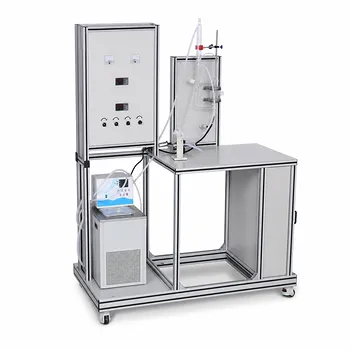
- Binary System Vapor Liquid Equilibrium Data Determination Educational Unit Operations Pilot Plant
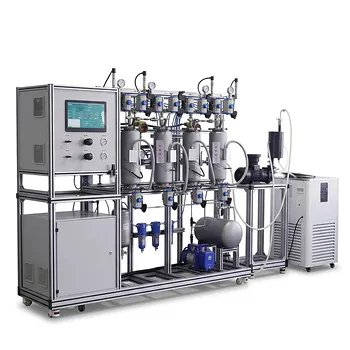
- Multi-Functional Membrane Separation Educational Pilot Plant for Unit Operations Lab
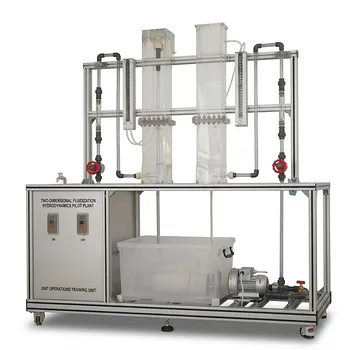
- Two-Dimensional Fluidization Hydrodynamics Educational Pilot Plant for Unit Operations Training
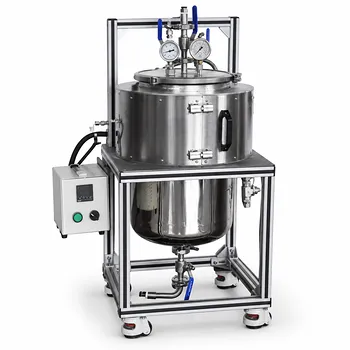
- Multi-Reactor Educational Pilot Plant for Reaction Engineering Unit Operations
- Multi-Modal Distillation Unit Operations Training Pilot Plant
People Also Ask
- Why correlate VLE pilot plant data using Wilson, NRTL, and UNIQUAC? Achieve Accurate Column Scale-Up
- For VLE Experiments: Fugacity vs. Activity Coefficient Method Selection Criteria
- How do pilot plants assist in teaching & researching non-ideal VLE? Bridge Theory & Physical Validation
- How to Model VLE for Supercritical & Unstable Components? Pilot Plant Methods
- Why is accurate VLE data critical? Optimize Unit Operations & Process Scale-Up