Knowledge Chemical Engineering Education For VLE Experiments: Fugacity vs. Activity Coefficient Method Selection Criteria
Author avatar

Tech Team · LABPARK

Updated 1 month ago

For VLE Experiments: Fugacity vs. Activity Coefficient Method Selection Criteria


You face a core decision before modeling any vapor-liquid equilibrium (VLE) experiment: will you use a single equation of state for both phases, or a hybrid approach that treats the liquid separately?
The selection of the fugacity coefficient method (Equation of State, EOS) versus the activity coefficient method depends primarily on system pressure and the chemical nature of your mixture. The fugacity coefficient method works best for non-polar or weakly polar systems at medium to high pressures, while the activity coefficient method dominates for polar, non-ideal liquid mixtures at low to moderate pressures. This fundamental distinction determines the accuracy of your simulation and the physical relevance of your pilot‑plant data.

The fugacity coefficient method (EOS) is the right choice for high‑pressure, simple fluids where you can describe both vapor and liquid with the same model. The activity coefficient method is built for polar, complex liquid mixtures at low‑to‑moderate pressures—exactly the conditions that most educational and vocational distillation pilot plants operate under. Match the method to your pressure and polarity, and you align theory with reality.

Understanding the Fugacity Coefficient Method (Equation of State)

This method calculates the fugacity coefficient (\phi_i) for both the vapor and the liquid phase using the same equation of state. It eliminates the need for separate liquid‑phase models and standard states.

How the EOS Method Works

A single pressure‑volume‑temperature (PVT) relationship describes all fluid phases.
You obtain (\phi_i) from the EOS by integrating the departure from ideal‑gas behavior, (\ln \phi_i = \int_0^P (Z_i - 1) \frac{dP}{P}).
This simplicity is powerful when the EOS captures the behavior of both phases accurately.

Ideal Operating Window

High‑pressure systems (typically above 10 bar) and near‑critical or supercritical conditions are natural homes for the EOS method.
It excels with non‑polar or weakly polar mixtures—light hydrocarbons, natural gas fractions, and simple inert gases.
No arbitrary standard states are needed, making it mathematically convenient for supercritical components.

Where the EOS Method Stumbles

Polar compounds, electrolytes, and large molecules quickly break the assumptions of simple cubic EOS models.
Results become highly sensitive to mixing rules; there is no universally excellent EOS that covers all densities and chemical families.
In pilot‑plant settings with complex organic solvents, the EOS method often fails to reproduce measured VLE.

Mastering the Activity Coefficient Method

This hybrid method treats the liquid phase through activity coefficients ((\gamma_i)) while handling the vapor phase with a fugacity coefficient (often simplified to ideal gas or a simple EOS). It is the workhorse for non‑ideal liquid mixtures.

A Split Approach to Real Mixtures

The liquid‑phase fugacity is expressed as (f_i^L = \gamma_i x_i f_i^0), where (f_i^0) is the standard‑state fugacity.
The activity coefficient (\gamma_i) captures the excess Gibbs energy arising from molecular interactions—hydrogen bonding, polarity, size differences.
This split allows you to use a robust liquid‑mixture model without forcing a single EOS to describe everything.

When to Choose the Activity Coefficient Method

Use it for strongly non‑ideal, polar systems—alcohol‑water, ketone‑solvent mixtures, and many biochemical separations.
It shines at low to moderate pressures (often atmospheric), where the liquid‑phase non‑ideality dominates and vapor‑phase corrections are small.
Most educational and vocational distillation pilot plants run exactly in this regime, making the activity coefficient method the most frequently applied choice.

You Must Pair It with a Liquid‑Phase Model

The method itself only provides the framework; you still need a specific model for (\gamma_i).
Wilson works well for miscible polar/non‑polar mixtures but cannot predict liquid‑liquid splitting.
NRTL and UNIQUAC handle both VLE and liquid‑liquid equilibrium, critical if your pilot plant involves decanters or partial miscibility.
Picking the right model is a second‑layer decision, but the overall method selection (activity coefficient) remains the same.

Understanding the Trade‑offs for Pilot‑Plant VLE

Both methods have distinct limitations that directly impact the reliability of your simulation and the interpretation of experimental data.

Pressure Limitations Define the Boundary

The activity coefficient method fails near the critical region because standard‑state fugacities become ill‑defined.
The EOS method can operate through the critical point but loses accuracy for polar compounds long before you reach high pressure.
Choosing the wrong method for your operating pressure will introduce systematic errors in separation predictions.

Complexity of Standard States

The EOS method avoids standard states entirely, a major advantage for supercritical components.
The activity coefficient method requires a separate determination of (f_i^0), often using vapor pressure and Poynting correction, which adds steps and potential inaccuracies for compressed liquids.
For mixtures with dissolved gases or supercritical fluids, the activity coefficient path becomes cumbersome.

Practical Consequences in Pilot Plants

Mismatching the method to the chemistry can destroy mass‑balance closure between experiments and simulations.
Students and operators who observe deviations between measured and simulated column profiles often find the root cause is an inappropriate thermodynamic framework—not a faulty experiment.
The right method also dictates which experimental data (PTxy curves, density data) you need to regress model parameters.

Making the Right Choice for Your Pilot‑Plant Goals

Select your thermodynamic method by evaluating the concrete conditions of your experiment, not by habit.

  • If your primary focus is high‑pressure, non‑polar separations: The fugacity coefficient (EOS) method is your natural fit. It handles supercritical regions gracefully and avoids the burden of standard‑state definitions.
  • If your primary focus is atmospheric or low‑pressure polar mixtures: The activity coefficient method will give you far greater accuracy. Pair it with a liquid model that can capture the specific interactions—Wilson for fully miscible, NRTL or UNIQUAC for partially miscible systems.
  • If your primary focus is educating students on industrial‑realistic systems: Start with the activity coefficient method. Most vocational pilot plants run polar, near‑atmospheric distillations; this method mirrors the calculation strategy used in industry for such separations.

Once you anchor your method in the pressure and polarity of the system, your experimental VLE data and simulations will speak the same physical language.

Summary Table:

Method Key System Nature Operating Pressure Typical Pilot Plant Application
Fugacity Coefficient (EOS) Non-polar / weakly polar Medium to High (>10 bar) Hydrocarbons, supercritical fluids
Activity Coefficient Polar, non-ideal mixtures Low to Moderate (Atmospheric) Ethanol-water distillation, organic solvents

Optimize Your VLE Experiments with LABPARK

Need the right setup to align your thermodynamic models with real-world pilot data? LABPARK provides state-of-the-art Educational and Vocational Unit Operations Pilot Plants in chemical engineering, bioprocess & biotech, and environmental & water treatment.

We help universities, research institutes, and enterprises bridge the gap between theory and practice with reliable, industrial-grade systems.

Contact LABPARK today to find the perfect pilot plant for your curriculum or research goals!

Related Products

People Also Ask

Related Products

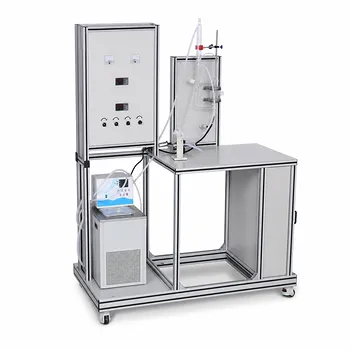
Binary System Vapor Liquid Equilibrium Data Determination Educational Unit Operations Pilot Plant

Binary System Vapor Liquid Equilibrium Data Determination Educational Unit Operations Pilot Plant

This educational pilot plant determines vapor-liquid equilibrium data for binary systems under atmospheric pressure. Students observe phase behavior, measure T-P-X-Y, and construct phase diagrams for unit operations labs. Features transparent cell, dual circulation. Ideal for chemical engineering curricula.

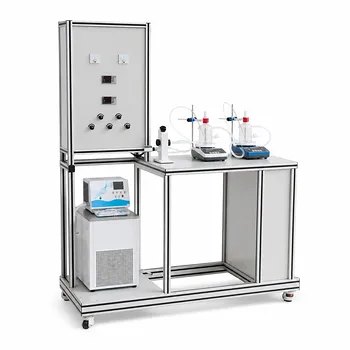
Ternary Liquid-Liquid Equilibrium Educational Pilot Plant

Ternary Liquid-Liquid Equilibrium Educational Pilot Plant

An integrated laboratory training system for engineering students to determine ternary liquid-liquid equilibrium data, construct phase diagrams, and gain hands-on experience with industrial instrumentation, including Abbe refractometer and magnetic stirrers, for precise data acquisition and curriculum-aligned experiments.

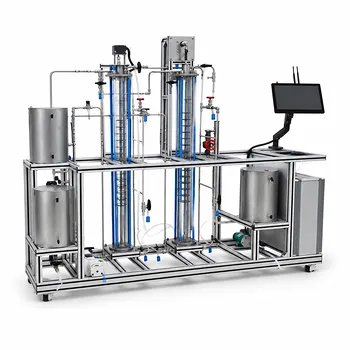
Comprehensive Liquid-Liquid Extraction Pilot Plant for Engineering Education

Comprehensive Liquid-Liquid Extraction Pilot Plant for Engineering Education

Comprehensive liquid-liquid extraction pilot plant for engineering education, integrating rotary and vibratory columns for hands-on observation of phase behavior, flooding limits, and mass transfer efficiency, enabling precise HTU and mass transfer coefficient calculations.

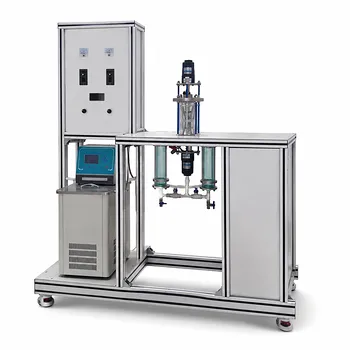
Liquid-Liquid Mass Transfer Coefficient Determination Educational Pilot Plant

Liquid-Liquid Mass Transfer Coefficient Determination Educational Pilot Plant

This bench-scale educational pilot plant for liquid-liquid mass transfer coefficient determination offers precise control of phase boundary, temperature, and agitation, enabling hands-on study of transport phenomena and unit operations in chemical engineering labs for teaching.

Multi-Functional Special Distillation Educational Pilot Plant

Multi-Functional Special Distillation Educational Pilot Plant

Versatile multi-functional special distillation pilot plant for chemical engineering education. Supports continuous, vacuum, azeotropic, reactive, extractive distillation. Transparent glass columns enable real-time visual observation of hydrodynamics and separation processes.

Comprehensive Fluid Mechanics Educational Unit Operations Pilot Plant

Comprehensive Fluid Mechanics Educational Unit Operations Pilot Plant

Hands-on fluid mechanics pilot plant for engineering education covering over 13 principles including pipe flow, minor losses, flowmeter calibration, and pump performance with industrial-grade components, smooth and rough piping, venturi and orifice flowmeters, and centrifugal pump testing and analysis.

Two Phase Flow Pattern Velocity Resistance Measurement Educational Pilot Plant

Two Phase Flow Pattern Velocity Resistance Measurement Educational Pilot Plant

Benchtop educational pilot plant for university labs studying gas-liquid two-phase flow patterns, velocity, and resistance across circular, square, and rectangular conduits. Features 15.6-inch touchscreen, 5G connectivity, differential pressure sensors, safe water-air operation. Supports chemical engineering curricula.

Water Electrolysis Hydrogen Production and Storage Educational Pilot Plant

Water Electrolysis Hydrogen Production and Storage Educational Pilot Plant

Integrated pilot-scale training system for higher education engineering labs. Features AWE/PEM electrolysis, adjustable DC power, PLC controls, gas-liquid separation, and pressurized hydrogen storage. Hands-on learning in green hydrogen, process control, and safety, ideal for chemical and energy departments.

Electrolytic Hydrogen Production Educational Unit Operations Pilot Plant

Electrolytic Hydrogen Production Educational Unit Operations Pilot Plant

Bench-scale electrolytic hydrogen production pilot plant designed for university engineering labs. Provides hands-on training in water electrolysis, gas-liquid separation, and process safety. Fully customizable system with digital PID control, corrosion-resistant components, and hydrogen gas detector. Ideal for chemical engineering curricula.

Multi-Reactor Educational Pilot Plant for Reaction Engineering Unit Operations

Multi-Reactor Educational Pilot Plant for Reaction Engineering Unit Operations

Integrated bench-scale educational pilot plant for chemical engineering teaching featuring fixed bed fluidized bed and stirred tank reactors with web-based digital twin controls and safety interlocks for hands-on unit operations and reaction engineering comparative studies in one compact system.

100L Continuous Loop Hydrogenation Educational Unit Operations Pilot Plant

100L Continuous Loop Hydrogenation Educational Unit Operations Pilot Plant

This 100L continuous loop hydrogenation pilot plant is designed for chemical engineering education, featuring 316 stainless steel construction, advanced gas-liquid mass transfer components, explosion-proof safety systems, and a 15.6-inch touchscreen with 5G connectivity, cloud data logging, bridging theory and industry.

Plate Column Hydrodynamics Tray Demonstration Educational Pilot Plant

Plate Column Hydrodynamics Tray Demonstration Educational Pilot Plant

Advanced transparent educational pilot plant for chemical engineering labs demonstrates plate column hydrodynamics with industrial sieve bubble cap serrated valve trays for visual observation of gas-liquid contact pressure drop measurement and operational limit analysis including flooding weeping entrainment

Centrifugal Pump Performance and Orifice Flowmeter Calibration Educational Pilot Plant

Centrifugal Pump Performance and Orifice Flowmeter Calibration Educational Pilot Plant

This versatile educational pilot plant enables engineering students to conduct centrifugal pump performance tests, orifice flowmeter calibration, and fluid mechanics experiments using a transparent flow loop, industrial HMI, and 3D virtual simulation for a comprehensive hands-on learning experience.

Continuous Batch Extractive Distillation Educational Pilot Plant

Continuous Batch Extractive Distillation Educational Pilot Plant

Versatile pilot plant for continuous, batch, and extractive distillation training. High-borosilicate glass column for visualizing hydraulics, 15.6-inch touchscreen with data logging, precise reflux ratio control 1-99, and durable corrosion-resistant frame. Ideal for chemical engineering education and process research.

Fixed-Bed Chemical Reaction and Gas Dust Tar Removal Unit Operations Pilot Plant

Fixed-Bed Chemical Reaction and Gas Dust Tar Removal Unit Operations Pilot Plant

Integrated educational pilot plant for studying catalytic gas-solid reactions and downstream gas purification. Features dual fixed-bed reactor, three-stage heating, and touchscreen control for hands-on engineering training. Ideal for chemical and environmental engineering curricula.

Multi Functional Catalytic Reaction and Reactor Evaluation Educational Unit Operations Pilot Plant

Multi Functional Catalytic Reaction and Reactor Evaluation Educational Unit Operations Pilot Plant

Bench-scale educational pilot plant for catalytic reaction and reactor evaluation, integrating fixed bed, fluidized bed, and stirred tank reactors. Students compare reactor designs, evaluate catalysts, and study reaction kinetics and hydrodynamics. Perfect for unit operations labs in chemical engineering curricula.

Supercritical High-Gravity Flash Evaporation Educational Unit Operations Pilot Plant

Supercritical High-Gravity Flash Evaporation Educational Unit Operations Pilot Plant

Bench-scale integrated teaching system for advanced separation and mass transfer, combining supercritical high-gravity flash evaporation with heating, chemical reaction, and material collection, featuring modular design, Stainless Steel 316L construction, transparent visualization, touchscreen control, and safety systems for chemical engineering education.

Educational Unit Operations Pilot Plant for Intraparticle Diffusion Effective Factor Measurement

Educational Unit Operations Pilot Plant for Intraparticle Diffusion Effective Factor Measurement

Designed for chemical engineering university labs, this pilot plant allows hands-on determination of catalyst particle intraparticle diffusion effective factors and gas-solid reaction kinetics using a fixed-bed tubular reactor with industrial touchscreen control, bridging theory and practical reactor design.

Green Anhydrous Ethanol Refining Practical Training Pilot Plant

Green Anhydrous Ethanol Refining Practical Training Pilot Plant

Advanced integrated pilot plant for university labs demonstrating extractive distillation to produce high-purity absolute ethanol from crude feedstock, featuring multi-column continuous operation, closed-loop solvent recycling, and customizable controls for hands-on engineering education, ideal for chemical engineering training and research.

Multi-Functional Drying Educational Unit Operations Pilot Plant

Multi-Functional Drying Educational Unit Operations Pilot Plant

Versatile multi-functional drying educational unit operations pilot plant integrating tunnel, fluidized bed, and spray drying. Enables hands-on study of drying curves, psychrometry, and gas-solid separation for chemical engineering curriculum in higher education labs.


Leave Your Message