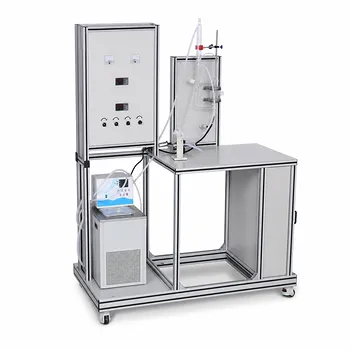
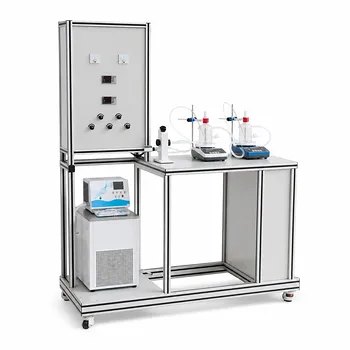
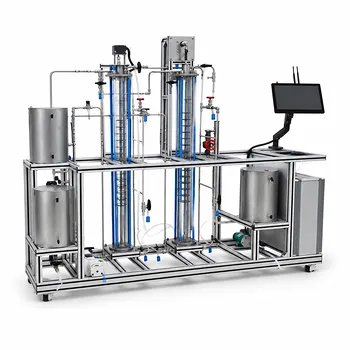
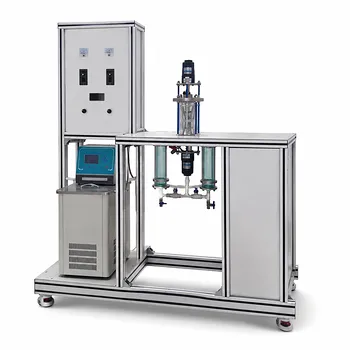
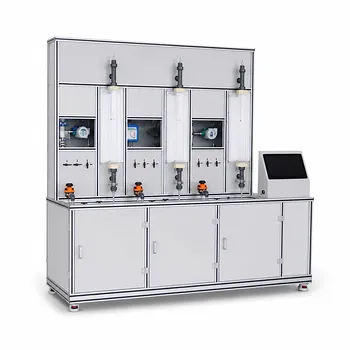
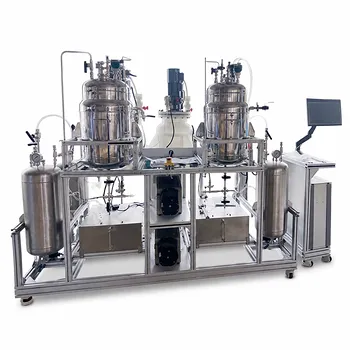
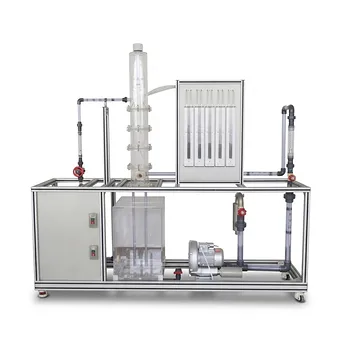
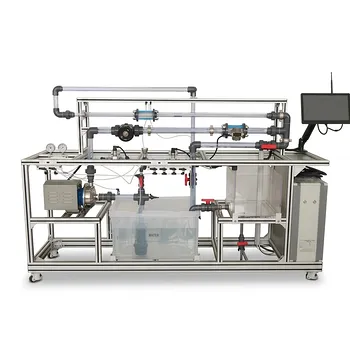
The true power of a unit operations pilot plant lies in turning abstract thermodynamic equations into tangible, physical measurements. A pilot distillation column, equipped with multiple liquid and vapor sampling ports, allows students and researchers to directly measure phase compositions under steady-state operation. This transforms a theoretical concept into a hands-on exercise where they calculate experimental activity coefficients ($\gamma$) and map the real-world vapor-liquid equilibrium (VLE) curve, visibly demonstrating how and why systems like ethanol-water deviate from Raoult's Law.
Non-ideal VLE behavior is not just a footnote in a textbook—it's the rule, not the exception. Pilot plants bridge the critical gap between theory and reality by providing the physical data needed to see molecular interactions in action. They expose the limitations of predictive models and make abstract concepts like azeotrope formation and activity coefficients concrete, building the intuition that is essential for sound process design.
Bridging the Gap Between Theory and Reality
Most real-world chemical systems behave non-ideally due to molecular interactions, and this is where theoretical models often stumble. Pilot plants provide the experimental platform needed to confront these deviations directly.
The Core of Non-Ideality: Visualizing Activity
The primary reference equation ($p_i = p_i^0 x_i \gamma_i$) shows that a system's non-ideality is captured entirely by the activity coefficient ($\gamma_i$). A pilot plant’s sampling ports are the critical tool for unlocking this value. By chemically analyzing the liquid ($x_i$) and vapor ($y_i$) phases at a known temperature and pressure, students can back-calculate the activity coefficients, giving a numerical value to the "non-ideal" molecular interactions they've only read about.
Why Models Fail Without Physical Validation
Predictive thermodynamic models, like UNIFAC, are valuable but inherently limited. They rely on group contribution methods that separate activity coefficients into combinatorial and residual parts, but often lack reliable interaction parameters for complex mixtures.
The Necessity of Empirical Data
This scarcity of reliable data means theoretical calculations can deviate significantly from actual performance. A pilot plant act as a reality check. By generating high-quality, real-world P-T-x-y data, students and researchers can directly validate the accuracy of models like Wilson, NRTL, and UNIQUAC. This empirical validation is not just academic—it’s a fundamental prerequisite for safe and efficient industrial process design, proving that simulation software cannot replace physical experimentation.
Manipulating Thermodynamics: The Pressure-Swing Revelation
One of the most powerful teaching moments a pilot plant offers is the ability to manipulate a pressure-controlled distillation system to demonstrate how azeotropic behavior isn't a dead end but a condition that can be shifted.
Shifting the Azeotropic Goalpost
An azeotrope is the ultimate expression of non-ideality, where the liquid and vapor compositions become identical, making conventional separation impossible. The ethanol-water system is the classic example. In a pressurized pilot plant, lowering the operating pressure from 101.33 kPa to 13.33 kPa shifts the azeotropic composition dramatically, from 0.894 to 0.992 mole fraction of ethanol. This hands-on observation cements the concept of pressure-swing distillation as a viable industrial strategy for breaking azeotropes.
Experiencing the Physical Consequences
Non-ideal behavior extends far beyond phase equilibrium equations. Molecular interactions in mixtures like alcohol-aldehydes can create real physical effects, such as viscosity peaks and volume contraction. In a pilot plant, students experience these deviations firsthand as unexpected pressure drops across a column or altered heat transfer rates. This direct experience teaches a critical lesson: ideal mixing rules are insufficient, and measuring real fluid properties is mandatory for the proper design of pumps, heat exchangers, and piping.
Understanding the Trade-offs
While pilot plants are indispensable, their value is directly tied to a significant investment of effort and an understanding of their limitations.
The Hidden Effort of Physical Validation
The primary reference emphasizes collecting samples under steady-state operation. Achieving and confirming this state requires patience and precision, one of the hardest skills for new engineers to learn. The process is time- and resource-intensive, involving chemical analysis of multiple samples, which introduces experimental error. The trade-off is between the speed of an imperfect computer simulation and the messy, costly, but ultimately definitive reality of a physical pilot plant experiment.
Data Limitations and Safety
Most standard VLE data is recorded at atmospheric pressure, yet many industrial processes run at elevated pressures up to 15 atm to optimize energy efficiency. Pilot plants capable of high-pressure operation address this gap directly. However, operating at high pressure and temperature introduces significant safety risks and equipment complexity, which must be the primary consideration before generating such data.
Making the Right Choice for Your Educational or Research Goal
How you use a pilot plant to study non-ideal VLE should depend on your specific objective. The equipment is a flexible tool, not a one-size-fits-all solution.
- If your primary focus is teaching core thermodynamics: Use atmospheric pressure columns with ethanol-water to demonstrate the fundamental deviation from Raoult's Law and allow students to calculate activity coefficients from physical samples.
- If your primary focus is validating predictive models: Use a dynamic VLE apparatus or pilot still to generate high-precision P-T-x-y data for systems with unknown interaction parameters and benchmark it directly against UNIFAC or NRTL simulations.
- If your primary focus is industrial separation design: Use a pressurized pilot plant to collect VLE data at elevated pressures and demonstrate the pressure-swing distillation technique for separating azeotropic mixtures.
- If your primary focus is understanding whole-process impact: Measure physical properties like viscosity and density alongside VLE data to observe the direct consequences of non-ideal mixing on fluid dynamics and equipment design.
A pilot plant is the most powerful teacher of non-ideal thermodynamics because it forces you to measure what you cannot reliably predict.
Summary Table:
| Focus Area | Pilot Plant Capability | Educational & Research Value |
|---|---|---|
| Thermodynamics | Sampling ports & steady-state VLE | Back-calculate activity coefficients ($\gamma$) to prove deviations |
| Model Validation | High-precision P-T-x-y data generation | Verify Wilson, NRTL, and UNIFAC simulations empirically |
| Azeotropic Systems | Pressurized distillation column | Demonstrate pressure-swing distillation to shift azeotropes |
| Fluid Dynamics | Physical property measurements | Observe volume contraction and viscosity peaks in mixtures |
Bridge the Gap Between Thermodynamic Theory and Practical Engineering
At LABPARK, we empower universities, research institutes, and enterprises to transition from abstract equations to hands-on physical validation. Our state-of-the-art Educational and Vocational Unit Operations Pilot Plants in chemical engineering, bioprocess & biotech, and environmental & water treatment are designed to safely and precisely model real-world processes.
Whether you are demonstrating non-ideal vapor-liquid equilibrium (VLE), validating predictive thermodynamic models, or training the next generation of process engineers, our reliable pilot systems provide the empirical precision you need.
Ready to elevate your laboratory's teaching and research capabilities? Contact us today to discover how LABPARK can customize a pilot plant solution for your institution.
Related Products
- Binary System Vapor Liquid Equilibrium Data Determination Educational Unit Operations Pilot Plant
- Ternary Liquid-Liquid Equilibrium Educational Pilot Plant
- Comprehensive Liquid-Liquid Extraction Pilot Plant for Engineering Education
- Liquid-Liquid Mass Transfer Coefficient Determination Educational Pilot Plant
- Multi-Functional Special Distillation Educational Pilot Plant
People Also Ask
- Why correlate VLE pilot plant data using Wilson, NRTL, and UNIQUAC? Achieve Accurate Column Scale-Up
- For VLE Experiments: Fugacity vs. Activity Coefficient Method Selection Criteria
- How to Model VLE for Supercritical & Unstable Components? Pilot Plant Methods
- Why is accurate VLE data critical? Optimize Unit Operations & Process Scale-Up
- How Gibbs Energy & VLE Activity Coefficients Relate to Distillation Pilot Plant Education