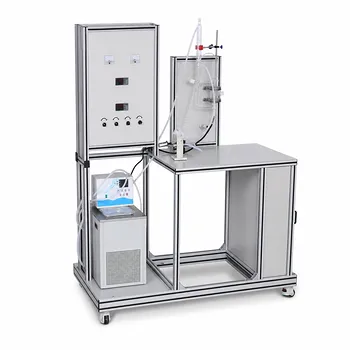
Liquefaction occurs when intermolecular attractions overcome molecular kinetic motion, while vaporization occurs when thermal motion enables molecules to escape those attractions. Cooling reduces molecular translational kinetic energy, and compression brings molecules closer together, allowing attractive forces to produce a liquid phase. Heating increases molecular energy and raises vapor pressure, promoting vaporization; however, compression alone cannot liquefy a gas above its critical temperature.
The balance between molecular attraction, kinetic energy, temperature, and pressure determines phase behavior. In vapor-liquid pilot plants, this molecular theory becomes an engineering tool for predicting equilibrium, calculating heat and material duties, and controlling separation performance.
How Molecular Motion and Attraction Compete
Thermal motion favors the gas phase
In kinetic theory, the average translational kinetic energy of ideal-gas molecules increases directly with absolute temperature. Faster molecular motion promotes dispersion and makes it more difficult for attractive forces to hold molecules together.
Real molecules also store energy in rotational and vibrational modes. These additional modes affect heat capacity and energy requirements, although gas pressure is primarily associated with momentum transfer from translational molecular collisions.
Intermolecular attraction favors the liquid phase
Molecules attract one another through forces such as dispersion, dipole-dipole interactions, and hydrogen bonding. These forces reduce the tendency of molecules to separate and are therefore central to condensation, boiling behavior, and equilibrium vapor pressure.
A liquid forms when molecules are close enough, and their thermal energy is low enough, for these attractions to dominate their dispersive motion. Compression promotes this condition by reducing intermolecular distance.
The Lennard-Jones potential explains molecular distance
The Lennard-Jones potential represents the interaction energy between two molecules as a function of their separation distance. Its attractive contribution varies approximately with the inverse sixth power of distance, while short-range repulsion increases approximately with the inverse twelfth power.
At large distances, the interaction is weak. As molecules approach, attraction lowers their potential energy until a preferred separation is reached; at still shorter distances, strong repulsion prevents molecular overlap.
This potential provides a molecular explanation for why gases can condense when cooled or compressed. It also illustrates why liquid properties depend on both the strength of attraction and the molecular spacing imposed by temperature and pressure.
How Liquefaction and Vaporization Occur
Cooling drives condensation
When a gas is cooled, its average molecular kinetic energy decreases. Molecules then move less energetically and remain close enough for intermolecular attractions to produce a condensed liquid phase.
During condensation, latent heat must be removed. The phase change occurs at nearly constant temperature for a pure substance at fixed pressure, while the material releases its enthalpy of vaporization to the surroundings.
Compression promotes liquefaction within limits
Increasing pressure forces molecules closer together and raises the likelihood that attractive interactions will stabilize a liquid. This is the operating principle behind many gas-liquefaction processes.
There is an important limitation: a substance cannot be liquefied by pressure alone above its critical temperature. Below that temperature, sufficient pressure may produce a liquid; above it, no distinct liquid-vapor transition exists.
Heating drives vaporization
Heating increases molecular kinetic energy and makes it more likely that molecules at the liquid surface can escape into the vapor phase. Vaporization continues until the vapor becomes saturated or until the available liquid is depleted.
At equilibrium, escaping molecules and returning vapor molecules balance statistically. The resulting pressure is the liquid’s equilibrium vapor pressure at that temperature.
Stronger attraction lowers vapor pressure
A molecule must acquire enough energy to overcome its surrounding attractions before entering the vapor phase. Stronger intermolecular forces therefore generally produce lower vapor pressure at a given temperature and higher boiling temperature.
Molecular size, shape, polarity, and hydrogen bonding all influence these forces. Molecular weight alone is not a sufficient predictor, because molecular structure and polarity can substantially change the strength of interaction.
Why Vapor-Liquid Equilibrium Matters
Equilibrium defines the operating boundary
A vapor-liquid system is at thermodynamic equilibrium when three conditions are satisfied:
- Thermal equilibrium: (T^L = T^V)
- Mechanical equilibrium: (p^L = p^V)
- Chemical equilibrium: (\hat{f}_i^L = \hat{f}_i^V) for every component (i)
The final condition means that each component has equal chemical potential, or equivalently equal fugacity, in both phases. Without chemical equilibrium, mass transfer continues even if temperature and pressure are equal.
VLE determines composition changes
In a distillation column, the vapor and liquid leaving each stage generally have different compositions. Their relationship is determined by vapor-liquid equilibrium rather than by temperature alone.
For ideal or sufficiently dilute systems, volatility may be approximated using vapor-pressure relationships. For non-ideal mixtures, activity-coefficient models such as NRTL and UNIQUAC, or appropriate equations of state and Henry’s law relationships, may be required.
Bubble-point, dew-point, and flash calculations guide design
Bubble-point calculations determine when the first vapor forms from a liquid. Dew-point calculations determine when the first liquid forms from a vapor.
Flash calculations determine the equilibrium amounts and compositions of vapor and liquid after a feed reaches a specified temperature and pressure. These calculations support estimates of reflux ratio, theoretical stages, condenser duty, reboiler duty, and phase-split behavior.
Why Pilot Plants Need This Theory
Pilot plants connect molecular behavior to equipment performance
A vapor-liquid unit operation pilot plant provides a controlled environment in which temperature, pressure, composition, flow rate, and heat duty can be measured. These measurements allow engineers to compare observed phase behavior with equilibrium models.
The molecular theory explains why changing a reboiler temperature, condenser pressure, or feed composition changes the vapor and liquid compositions. It turns experimental observations into transferable design knowledge.
Distillation depends directly on relative volatility
Distillation separates components because they do not have identical tendencies to enter the vapor phase. The component with the greater effective volatility becomes enriched in the vapor, while the less volatile component remains relatively concentrated in the liquid.
Intermolecular interactions can change this relationship significantly. Azeotropes, for example, may create separation boundaries that cannot be crossed by ordinary distillation at a specified pressure.
Reboilers and condensers must be matched to phase behavior
The reboiler supplies the energy required for partial vaporization and sensible heating. The condenser removes energy and promotes partial or complete condensation.
Accurate vapor-pressure and VLE information is necessary to select practical operating temperatures, estimate heat-transfer duties, and prevent conditions in which the desired phase split cannot be achieved.
Instrumentation makes equilibrium testable
Pilot plants equipped with accurate temperature and pressure sensors, flow meters, and phase-composition sampling systems can test the equilibrium assumptions used in design.
The measured data can reveal pressure drops, heat losses, non-equilibrium operation, entrainment, foaming, and mass-transfer limitations. These effects explain why an actual stage may perform below its theoretical equilibrium limit.
Atomization combines thermodynamics and transport
In spray drying and evaporative cooling, atomization divides liquid into small droplets and greatly increases surface-area-to-volume ratio. This accelerates heat and mass transfer and allows the liquid to approach vaporization conditions rapidly.
Small droplets can also have different interfacial thermodynamic properties from a bulk liquid. Their effective fugacity and chemical potential may increase the driving force for evaporation, although the practical outcome still depends on temperature, surrounding-gas humidity, pressure, and residence time.
Understanding the Trade-offs
Compression is not a substitute for cooling
Compression can promote liquefaction only when the substance is below its critical temperature and the pressure is sufficient. Compressing a gas above its critical temperature increases pressure without creating a conventional liquid phase.
Industrial liquefaction therefore commonly combines compression, heat rejection, expansion, and staged cooling. The exact sequence depends on the substance and the refrigeration or process-integration strategy.
Equilibrium does not guarantee rapid separation
Thermodynamic equilibrium specifies the final phase compositions, not how quickly the system reaches them. Actual pilot-plant performance depends on interphase area, mixing, residence time, diffusion, and equipment configuration.
A column can therefore operate near the correct equilibrium temperature and pressure while still showing poor separation because mass transfer is incomplete.
Ideal-gas and ideal-solution assumptions can fail
Ideal-gas kinetic theory is useful for explaining temperature and pressure relationships, but real gases deviate from ideality near condensation conditions and at elevated pressures. Equations of state are needed when molecular volume and attraction materially affect phase behavior.
Likewise, liquid mixtures may show strong non-ideal interactions. Using simple Raoult’s-law assumptions in such systems can lead to incorrect bubble points, dew points, heat duties, and predicted product purities.
More energy is not always better
Increasing reboiler duty generally promotes vaporization, but excessive heating can increase utility consumption, thermal degradation, foaming, or entrainment. Higher condenser duty may improve condensation while increasing cooling requirements.
Pilot plants are valuable because they reveal the operating range in which equilibrium, transport rates, product quality, and energy use are acceptably balanced.
Property data must match the operating range
Pilot-plant design requires more than normal boiling points. Important data include critical properties, vapor pressures, heat capacities, phase-transition enthalpies, densities, viscosities, and mixture-equilibrium information.
For complex systems, VLE or vapor-liquid-liquid equilibrium diagrams and residue curve maps may be necessary to identify azeotropes, phase-splitting regions, and practical separation limits before scale-up.
How to Apply This to Your Project
The most useful approach is to connect the molecular explanation to measurable operating variables and equipment decisions.
- If your primary focus is gas liquefaction: Establish the critical temperature and pressure, then design cooling and compression steps that move the fluid into the liquid region while accounting for real-gas behavior and latent heat removal.
- If your primary focus is distillation: Use reliable VLE data to calculate bubble points, dew points, flash behavior, relative volatility, reflux requirements, stage numbers, and condenser and reboiler duties.
- If your primary focus is evaporation or spray drying: Combine vapor-pressure and fugacity relationships with droplet-size, surface-area, heat-transfer, and mass-transfer measurements to predict evaporation rates.
- If your primary focus is pilot-plant scale-up: Measure temperature, pressure, compositions, flow rates, and energy duties so equilibrium-model predictions can be separated from hydraulic and mass-transfer limitations.
- If your primary focus is non-ideal mixtures: Select activity-coefficient models, equations of state, or Henry’s law parameters appropriate to the system, and check for azeotropes or liquid-liquid splitting before choosing the separation method.
Understanding the balance between intermolecular attraction and molecular kinetic energy gives engineers the basis for predicting phase change and operating vapor-liquid pilot plants with control, accuracy, and defensible scale-up decisions.
Summary Table:
| Key concept | Effect on phase behavior | Pilot-plant application |
|---|---|---|
| Molecular kinetic energy | Higher temperature promotes vaporization; cooling supports condensation | Set reboiler, condenser, and cooling conditions |
| Intermolecular forces | Stronger attractions lower vapor pressure and raise boiling temperature | Predict volatility and separation difficulty |
| Pressure and critical temperature | Compression supports liquefaction only below the critical temperature | Design compression, cooling, and expansion steps |
| Vapor-liquid equilibrium | Determines the composition of coexisting vapor and liquid phases | Calculate flash behavior, stages, reflux, and product purity |
| Bubble and dew points | Identify when the first vapor or liquid forms | Establish safe and effective operating limits |
| Non-ideal behavior | Molecular interactions can cause azeotropes or phase splitting | Select suitable VLE models and separation methods |
| Heat and mass transfer | Determines how quickly equilibrium is approached | Evaluate reboiler, condenser, column, and spray-drying performance |
| Pilot-plant measurements | Validate equilibrium models against real operating data | Support scale-up and identify pressure drop, entrainment, or heat-loss effects |
Ready to turn phase-equilibrium theory into reliable process data? Contact LABPARK to discuss an Educational or Vocational Unit Operations Pilot Plant tailored to your needs. LABPARK helps universities, research institutes, and enterprises study gas liquefaction, distillation, evaporation, spray drying, and other vapor-liquid operations with controlled temperature, pressure, flow, composition, and heat-duty measurements. Our chemical engineering, bioprocess and biotech, and environmental and water-treatment pilot plants support hands-on teaching, VLE validation, process optimization, equipment evaluation, and defensible scale-up decisions.
Related Products
- Binary System Vapor Liquid Equilibrium Data Determination Educational Unit Operations Pilot Plant
- Two-Dimensional Fluidization Hydrodynamics Educational Pilot Plant for Unit Operations Training
- Quantitative Dosing and Liquid Flow Control Educational Unit Operations Pilot Plant
- Continuous Sieve-Plate Distillation Pilot Plant for Unit Operations Laboratory Education
- Comprehensive Liquid-Liquid Extraction Pilot Plant for Engineering Education
People Also Ask
- How can pilot plants assist in validating VLE models? Bridge theory and physical reality.
- Why Collect Isothermal vs. Isobaric VLE Data? Key Pilot Unit Advantages
- How Do Equations of State Predict VLE in Pilot Plants? Optimize Your Separation Design
- For VLE Experiments: Fugacity vs. Activity Coefficient Method Selection Criteria
- Why is hands-on training with VLE and LLE pilot plants critical? Bridge the gap between theory and simulation.