Knowledge Chemical Engineering Education Why is hands-on training with VLE and LLE pilot plants critical? Bridge the gap between theory and simulation.
Author avatar

Tech Team · LABPARK

Updated 3 months ago

Why is hands-on training with VLE and LLE pilot plants critical? Bridge the gap between theory and simulation.


Theoretical models are not a crystal ball—they’re an educated guess. Hands-on training with vapor-liquid equilibrium (VLE) and liquid-liquid equilibrium (LLE) pilot plants is critical for engineering students because it forces them to collect, interpret, and validate empirical equilibrium data against flawed predictions. This skill directly addresses the dangerous gap between what software says should happen and what actually occurs in real separation processes—an ability essential for designing safe, energy-efficient units in the chemical and bioprocess industries.

Predictive thermodynamic models regularly stumble on industrial mixtures that contain polar compounds, heavy hydrocarbons, or complex macromolecules. By operating physical distillation columns and extraction units, students learn to generate the missing data themselves, test the limits of simulation software, and build the hard-won judgment needed when theoretical models simply fail.

The Hidden Flaws in Thermodynamic Predictions

Standard equations of state and group contribution methods (like UNIFAC or ASOG) are built on simplifying assumptions and a limited database of interaction parameters. For many real-world mixtures, the foundation under these models starts to crack—and the resulting predictions can be off by an order of magnitude.

Why Standard Models Break Down with Polar Mixtures

Non‑polar hydrocarbon systems are relatively well behaved, but as soon as highly polar molecules appear, equilibrium predictions become unreliable. Mixtures involving glycols, phenolics, or water–CO₂ show severe non‑idealities that simple cubic equations of state cannot capture.

One notorious example is the Redlich‑Kwong correlation. When applied to the solubility of water in supercritical CO₂, the model predicted a 2.1 mole percent solubility—while the real value is just 0.25 mole percent. That eight‑fold error can turn a separation column design from efficient to catastrophic.

The Massive Data Void in Industry-Relevant Systems

Industry demand for phase equilibrium data is staggering: about 70% of all engineering data requests focus on VLE or LLE, yet consistent binary data for hydrocarbons above C₁₀ is practically non-existent. When naphthenic, aromatic, or multicomponent systems are involved, the thermodynamic database becomes nearly silent.

For students, this means the data they need to run a reliable simulation often does not exist. Only physical pilot plants can fill that void, providing the high‑quality temperature‑, pressure‑, and composition‑specific measurements that validated models require.

Bridging Theory and Reality: The Role of Pilot Plants

When students step into a unit operations lab and start up a fractional distillation column or a liquid‑liquid extraction skid, they encounter the messy reality that theory leaves behind. They measure distribution coefficients directly, calculate stage efficiencies, and see firsthand how variables like reflux ratio or solvent choice swing separation performance.

From Simulation to Physical Validation

Process simulation software relies on the very equations of state that can fail. Operating a pilot plant teaches students to confront the discrepancy between simulated stage predictions and real hardware performance. They quickly learn that a model is only a hypothesis, and that every design must be stress‑tested with experimental data.

By comparing their plant measurements against predictions from NRTL, UNIQUAC, or UNIFAC, students develop a critical habit: verifying software outputs before trusting a design. This turns them into engineers who can validate a process, not just press “run” on a simulator.

Developing the “Engineer’s Instinct” for Non‑Idealities

Hands‑on training does more than generate numbers; it builds pattern recognition. Students begin to sense when a mixture is likely to deviate wildly, and they learn to select appropriate local composition models or apply activity coefficient corrections.

In practice, that means they can spot an unrealistic simulation before it becomes a safety or cost disaster. They understand that a simple flash calculation may be dangerously misleading for a phenolic‑water system, and they know how to fall back on experimental data to guide the design.

Understanding the Trade‑offs and Pitfalls

Pilot plants are not a magic bullet. They are expensive, limited in scale, and subject to their own experimental errors—measurement drift, imperfect mixing, or sampling bias. Students must also learn that real empirical data is fallible and must be evaluated with the same rigor as a model prediction.

A common pitfall is to assume that “plant data is always right.” Without careful error analysis and an understanding of mass transfer limitations across small‑scale equipment, students can make the opposite mistake: dismissing a valid model because of a poorly run experiment. The true skill lies in synthesizing both theory and experiment to arrive at a reliable design.

Making the Right Choice for Your Goal

How you prioritize pilot plant training depends heavily on your intended engineering path. Below are concrete recommendations based on different primary focuses.

  • If your primary focus is designing safe industrial distillation or extraction systems: Immerse yourself in pilot plant work early. The habit of directly validating VLE and LLE data against process simulations is non‑negotiable for avoiding costly over‑ or under‑sized equipment.
  • If your primary focus is researching new solvent‑based separation processes: Prioritize hands‑on measurement campaigns. Generating your own high‑quality equilibrium data will often make the difference between a publishable breakthrough and a failed scale‑up.
  • If your primary focus is mastering process simulation software: Pair every software project with at least one physically measured benchmark. This will give you a visceral feel for where the error bars truly lie and keep you from becoming a “trust‑the‑output” user.
  • If your primary focus is scale‑up of pharmaceutical crystallization or liquid‑liquid extraction: Combine pilot plant runs with thermodynamic modeling. Use the data to regress missing interaction parameters, then validate the improved model on a follow‑up run—this iterative loop is how real process design succeeds.

Hands‑on pilot plant training transforms an engineering student who memorizes equations into a professional who can navigate the uncertain boundary between theory and reality—a boundary that, when ignored, has real safety and economic consequences.

Summary Table:

Aspect Thermodynamic Models (Simulation) Physical Pilot Plants (Empirical)
Accuracy Educated guesses; prone to errors in polar/complex mixtures Direct validation of actual equilibrium data
Data Availability Lacks binary data for complex/heavy hydrocarbon systems Generates missing temperature, pressure, & composition data
Educational Value Teaches software operation and theory Builds practical verification, troubleshooting, and scaling instincts

Bridge the gap between theoretical simulation and real-world chemical engineering in your curriculum. LABPARK provides high-quality Educational and Vocational Unit Operations Pilot Plants in chemical engineering, bioprocess & biotech, and environmental & water treatment.

Designed specifically for universities, research institutes, and enterprises, our pilot plants empower students and researchers to generate precise empirical data and master separation processes. Ready to upgrade your lab's training capabilities? Contact us today to discuss your custom pilot plant requirements!

Related Products

People Also Ask

Related Products

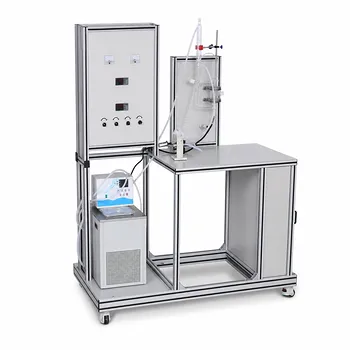
Binary System Vapor Liquid Equilibrium Data Determination Educational Unit Operations Pilot Plant

Binary System Vapor Liquid Equilibrium Data Determination Educational Unit Operations Pilot Plant

This educational pilot plant determines vapor-liquid equilibrium data for binary systems under atmospheric pressure. Students observe phase behavior, measure T-P-X-Y, and construct phase diagrams for unit operations labs. Features transparent cell, dual circulation. Ideal for chemical engineering curricula.

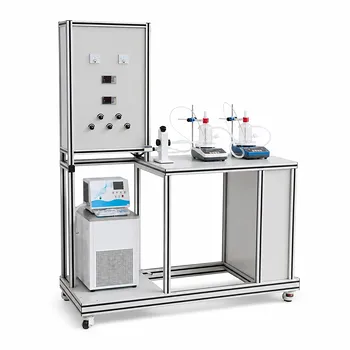
Ternary Liquid-Liquid Equilibrium Educational Pilot Plant

Ternary Liquid-Liquid Equilibrium Educational Pilot Plant

An integrated laboratory training system for engineering students to determine ternary liquid-liquid equilibrium data, construct phase diagrams, and gain hands-on experience with industrial instrumentation, including Abbe refractometer and magnetic stirrers, for precise data acquisition and curriculum-aligned experiments.

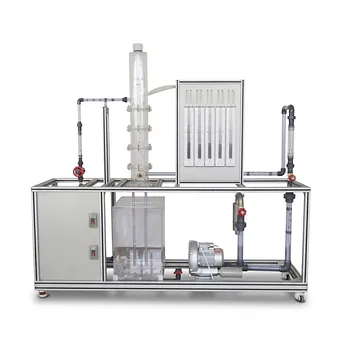
Comprehensive Liquid-Liquid Extraction Pilot Plant for Engineering Education

Comprehensive Liquid-Liquid Extraction Pilot Plant for Engineering Education

Comprehensive liquid-liquid extraction pilot plant for engineering education, integrating rotary and vibratory columns for hands-on observation of phase behavior, flooding limits, and mass transfer efficiency, enabling precise HTU and mass transfer coefficient calculations.

Liquid-Liquid Mass Transfer Coefficient Determination Educational Pilot Plant

Liquid-Liquid Mass Transfer Coefficient Determination Educational Pilot Plant

This bench-scale educational pilot plant for liquid-liquid mass transfer coefficient determination offers precise control of phase boundary, temperature, and agitation, enabling hands-on study of transport phenomena and unit operations in chemical engineering labs for teaching.

Multi-Functional Special Distillation Educational Pilot Plant

Multi-Functional Special Distillation Educational Pilot Plant

Versatile multi-functional special distillation pilot plant for chemical engineering education. Supports continuous, vacuum, azeotropic, reactive, extractive distillation. Transparent glass columns enable real-time visual observation of hydrodynamics and separation processes.

Comprehensive Fluid Mechanics Educational Unit Operations Pilot Plant

Comprehensive Fluid Mechanics Educational Unit Operations Pilot Plant

Hands-on fluid mechanics pilot plant for engineering education covering over 13 principles including pipe flow, minor losses, flowmeter calibration, and pump performance with industrial-grade components, smooth and rough piping, venturi and orifice flowmeters, and centrifugal pump testing and analysis.

Two Phase Flow Pattern Velocity Resistance Measurement Educational Pilot Plant

Two Phase Flow Pattern Velocity Resistance Measurement Educational Pilot Plant

Benchtop educational pilot plant for university labs studying gas-liquid two-phase flow patterns, velocity, and resistance across circular, square, and rectangular conduits. Features 15.6-inch touchscreen, 5G connectivity, differential pressure sensors, safe water-air operation. Supports chemical engineering curricula.

Water Electrolysis Hydrogen Production and Storage Educational Pilot Plant

Water Electrolysis Hydrogen Production and Storage Educational Pilot Plant

Integrated pilot-scale training system for higher education engineering labs. Features AWE/PEM electrolysis, adjustable DC power, PLC controls, gas-liquid separation, and pressurized hydrogen storage. Hands-on learning in green hydrogen, process control, and safety, ideal for chemical and energy departments.

Electrolytic Hydrogen Production Educational Unit Operations Pilot Plant

Electrolytic Hydrogen Production Educational Unit Operations Pilot Plant

Bench-scale electrolytic hydrogen production pilot plant designed for university engineering labs. Provides hands-on training in water electrolysis, gas-liquid separation, and process safety. Fully customizable system with digital PID control, corrosion-resistant components, and hydrogen gas detector. Ideal for chemical engineering curricula.

Multi-Reactor Educational Pilot Plant for Reaction Engineering Unit Operations

Multi-Reactor Educational Pilot Plant for Reaction Engineering Unit Operations

Integrated bench-scale educational pilot plant for chemical engineering teaching featuring fixed bed fluidized bed and stirred tank reactors with web-based digital twin controls and safety interlocks for hands-on unit operations and reaction engineering comparative studies in one compact system.

100L Continuous Loop Hydrogenation Educational Unit Operations Pilot Plant

100L Continuous Loop Hydrogenation Educational Unit Operations Pilot Plant

This 100L continuous loop hydrogenation pilot plant is designed for chemical engineering education, featuring 316 stainless steel construction, advanced gas-liquid mass transfer components, explosion-proof safety systems, and a 15.6-inch touchscreen with 5G connectivity, cloud data logging, bridging theory and industry.

Plate Column Hydrodynamics Tray Demonstration Educational Pilot Plant

Plate Column Hydrodynamics Tray Demonstration Educational Pilot Plant

Advanced transparent educational pilot plant for chemical engineering labs demonstrates plate column hydrodynamics with industrial sieve bubble cap serrated valve trays for visual observation of gas-liquid contact pressure drop measurement and operational limit analysis including flooding weeping entrainment

Centrifugal Pump Performance and Orifice Flowmeter Calibration Educational Pilot Plant

Centrifugal Pump Performance and Orifice Flowmeter Calibration Educational Pilot Plant

This versatile educational pilot plant enables engineering students to conduct centrifugal pump performance tests, orifice flowmeter calibration, and fluid mechanics experiments using a transparent flow loop, industrial HMI, and 3D virtual simulation for a comprehensive hands-on learning experience.

Continuous Batch Extractive Distillation Educational Pilot Plant

Continuous Batch Extractive Distillation Educational Pilot Plant

Versatile pilot plant for continuous, batch, and extractive distillation training. High-borosilicate glass column for visualizing hydraulics, 15.6-inch touchscreen with data logging, precise reflux ratio control 1-99, and durable corrosion-resistant frame. Ideal for chemical engineering education and process research.

Fixed-Bed Chemical Reaction and Gas Dust Tar Removal Unit Operations Pilot Plant

Fixed-Bed Chemical Reaction and Gas Dust Tar Removal Unit Operations Pilot Plant

Integrated educational pilot plant for studying catalytic gas-solid reactions and downstream gas purification. Features dual fixed-bed reactor, three-stage heating, and touchscreen control for hands-on engineering training. Ideal for chemical and environmental engineering curricula.

Supercritical High-Gravity Flash Evaporation Educational Unit Operations Pilot Plant

Supercritical High-Gravity Flash Evaporation Educational Unit Operations Pilot Plant

Bench-scale integrated teaching system for advanced separation and mass transfer, combining supercritical high-gravity flash evaporation with heating, chemical reaction, and material collection, featuring modular design, Stainless Steel 316L construction, transparent visualization, touchscreen control, and safety systems for chemical engineering education.

Multi Functional Catalytic Reaction and Reactor Evaluation Educational Unit Operations Pilot Plant

Multi Functional Catalytic Reaction and Reactor Evaluation Educational Unit Operations Pilot Plant

Bench-scale educational pilot plant for catalytic reaction and reactor evaluation, integrating fixed bed, fluidized bed, and stirred tank reactors. Students compare reactor designs, evaluate catalysts, and study reaction kinetics and hydrodynamics. Perfect for unit operations labs in chemical engineering curricula.

Educational Unit Operations Pilot Plant for Intraparticle Diffusion Effective Factor Measurement

Educational Unit Operations Pilot Plant for Intraparticle Diffusion Effective Factor Measurement

Designed for chemical engineering university labs, this pilot plant allows hands-on determination of catalyst particle intraparticle diffusion effective factors and gas-solid reaction kinetics using a fixed-bed tubular reactor with industrial touchscreen control, bridging theory and practical reactor design.

Multi-Functional Drying Educational Unit Operations Pilot Plant

Multi-Functional Drying Educational Unit Operations Pilot Plant

Versatile multi-functional drying educational unit operations pilot plant integrating tunnel, fluidized bed, and spray drying. Enables hands-on study of drying curves, psychrometry, and gas-solid separation for chemical engineering curriculum in higher education labs.

Green Anhydrous Ethanol Refining Practical Training Pilot Plant

Green Anhydrous Ethanol Refining Practical Training Pilot Plant

Advanced integrated pilot plant for university labs demonstrating extractive distillation to produce high-purity absolute ethanol from crude feedstock, featuring multi-column continuous operation, closed-loop solvent recycling, and customizable controls for hands-on engineering education, ideal for chemical engineering training and research.


Leave Your Message