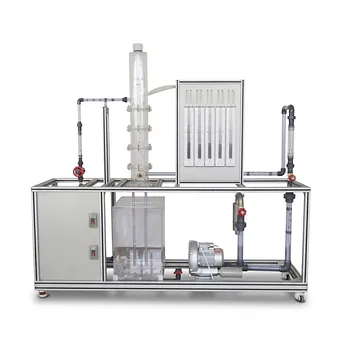
Theoretically-based equations of state translate atomic-scale physics into the macroscopic data pilot plants demand. They predict vapor-liquid equilibrium (VLE) by logically separating molecular behavior into two dominant and opposing forces: a hard-sphere reference for repulsion and an attractive perturbation term for cohesion. For mixtures, models like the Mansoori-Carnahan-Starling-Leland (MCSL) framework extend this logic using mixing rules, allowing engineers to calculate pseudo-critical properties and phase boundaries without relying exclusively on costly or unavailable experimental measurements.
The core insight is that by anchoring a model to a physically rigorous description of molecular repulsion, you create a predictive foundation that is mathematically clean and thermodynamically consistent. In a pilot plant, this fundamentally reduces the guesswork in mixture separation design by providing reliable fugacity calculations for each component in every phase, directly addressing the limitations of purely empirical models.
The Physics Behind Predictive Power
To understand why these models are so effective in a pilot plant, you must look under the hood at the fundamental forces governing molecular systems. Standard cubic equations often fit parameters against bulk fluid data, which can mask inaccuracies for complex mixtures. A theoretically-based equation decomposes the problem into manageable, physically real parts.
The Hard-Sphere Foundation for Repulsion
At very short distances, molecules strongly resist compression. This is the dominant effect in dense liquid phases. A theoretically-based model represents this with a hard-sphere reference term. This is a precise mathematical description of how perfectly rigid, non-attracting spheres pack together. It directly defines the reference compressibility factor.
The Attractive Perturbation for Cohesion
Layered on top of the repulsive core is the attractive perturbation term, which accounts for the cohesive forces that pull molecules together and enable condensation. By treating attraction as a systematic perturbation, the model avoids the oversimplification of a uniform attractive field. This separation is powerful because the hard-sphere structure dictates much of the liquid’s non-ideal entropy, while the attraction term fine-tunes the energy.
Bridging the Gap from Pure Components to Mixtures
Your pilot plant separates mixtures, not single chemicals. The true genius of a sound theoretical framework is how it scales from a known molecule to an unknown blend. It doesn't just guess; it follows composition-dependent mixing rules grounded in statistical mechanics.
From Molecular Packing to Pseudo-Critical Properties
A separating mixture, especially one containing asymmetric components, acts like a new hypothetical pure substance. The MCSL equation, an extension of Carnahan-Starling hard-sphere logic, provides a rigorous way to calculate pseudo-critical properties for mixtures. It computes the effective size and energy parameters based on composition, directly influencing the predicted critical point and phase envelope. For a pilot plant separating non-polar hydrocarbons and polar gases like CO₂, this provides a physically consistent way to handle size asymmetry, preventing the gross liquid density errors common with simpler models.
Reducing Pilot Plant Over-design
Historically, process designers used short-cut methods like Fenske-Underwood-Gilliland, which required significant over-design to compensate for thermodynamic imprecision. This meant oversized columns, excessive stages, and larger-than-necessary reboilers. A theoretically-based EOS supplies more precise fugacities across the concentration range. This directly translates into a pilot plant that serves as a sharper validation tool, reducing the conservative fudge factors and creating a tighter feedback loop between prediction and physical measurement.
Understanding the Trade-offs
No model is perfect, and intellectual honesty about limitations is what separates a trusted tool from blind faith. When applying these equations in a pilot plant, you encounter practical constraints.
The Compressibility Factor Dilemma
Standard three-parameter models often assume a fixed critical compressibility factor (Zc), like Peng-Robinson’s 0.307. Real substances in your pilot plant have Zc values that typically vary between 0.2 and 0.3. A theoretically-based hard-sphere model can better capture this variance, but at the cost of increased mathematical complexity. You are trading the simplicity of a cubic equation for the greater physical fidelity of a theory that acknowledges real molecular asymmetry.
The Empirical Bridge for Thermal Instability
Purely predictive power breaks down when a molecule like ethylene glycol decomposes before reaching its critical point. You cannot measure its physical critical properties. In these cases, even the most rigorous theoretical EOS must rely on an empirical crutch. Group contribution methods are required to estimate the input parameters for the EOS. The model’s predictive strength for VLE then becomes entirely contingent on the accuracy of that initial estimation.
Narrowing the Valid Range
While robust, an EOS built on a simple hard-sphere plus mean-field attraction framework can still struggle near the critical point and for highly polar, associating molecules. In an advanced pilot plant curriculum, this limitation is instructive. Comparing these predictions against a three-parameter corresponding states model (like the Lee-Kesler correlation) helps you directly visualize how compressibility accuracy impacts column sizing and energy duty calculations.
Making the Right Choice for Your Pilot Plant Goal
Your selection of a theoretically-based equation of state should align with the specific separation challenge in your unit operation. The goal dictates the required level of molecular detail.
- If your primary focus is separating asymmetric, non-polar mixtures (e.g., hydrocarbon/CO₂): Prioritize a model with a rigorous hard-sphere reference term, like the MCSL framework. This provides superior liquid molar volume predictions—often within ±2%—which is essential for correct column hydraulics and condenser sizing.
- If your primary focus is handling thermally unstable or supercritical components: Select a modeling framework that allows for consistent transition to hypothetical liquid states or Henry’s Law. A theoretically-based EOS provides a mathematically clean thermodynamic stage for making these extrapolations, even when empirical inputs are necessary.
- If your primary focus is an educational pilot plant demonstrating thermodynamic principles: Compare a cubic equation like Peng-Robinson directly against a theoretically-based model. This reveals how the Zc limitation impacts overall enthalpy and vapor pressure predictions, demonstrating the vital compromise between computational simplicity and physical realism.
The power of a theoretically-based equation of state in a pilot plant is not omniscience, but rather the ability to predict complex mixture behavior from physics, providing a coherent map for your experiments and a structure for diagnosing where and why reality deviates from elegant theory.
Summary Table:
| Model Element / Term | Core Physics | Impact on VLE & Pilot Plant Design |
|---|---|---|
| Hard-Sphere Reference | Repulsive forces & molecular packing | Defines compressibility; critical for dense liquid phases. |
| Attractive Perturbation | Cohesive forces between molecules | Fine-tunes energy calculations; enables condensation modeling. |
| MCSL Framework | Size asymmetry & mixing rules | Computes pseudo-critical properties; prevents liquid density errors. |
| Predictive EOS vs. Cubic | Physical realism vs. fixed $Z_c$ | Reduces over-design (oversized columns/reboilers) in separations. |
Bring Thermodynamic Theory to Life with LABPARK
Bridge the gap between molecular models and physical chemical engineering processes. LABPARK provides premium Educational and Vocational Unit Operations Pilot Plants in chemical engineering, bioprocess & biotech, and environmental & water treatment.
Tailored for universities, research institutes, and enterprises, our pilot plants empower your teams to:
- Validate VLE predictions and compare equation of state models (like MCSL vs. Cubic).
- Minimize column and reboiler over-design through hands-on empirical testing.
- Enhance training and research with reliable, industrial-grade equipment.
Ready to upgrade your lab's capabilities? Contact LABPARK today to find the perfect pilot plant solution for your institution!
Related Products
- Binary System Vapor Liquid Equilibrium Data Determination Educational Unit Operations Pilot Plant
- Ternary Liquid-Liquid Equilibrium Educational Pilot Plant
- Liquid-Liquid Mass Transfer Coefficient Determination Educational Pilot Plant
- Comprehensive Liquid-Liquid Extraction Pilot Plant for Engineering Education
- Two Phase Flow Pattern Velocity Resistance Measurement Educational Pilot Plant
People Also Ask
- How can pilot plants assist in validating VLE models? Bridge theory and physical reality.
- Why Collect Isothermal vs. Isobaric VLE Data? Key Pilot Unit Advantages
- How do intermolecular forces and molecular kinetic energy govern gas liquefaction and vaporization? Explore VLE pilot plants
- For VLE Experiments: Fugacity vs. Activity Coefficient Method Selection Criteria
- Why is hands-on training with VLE and LLE pilot plants critical? Bridge the gap between theory and simulation.