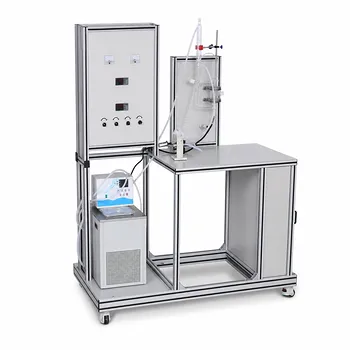
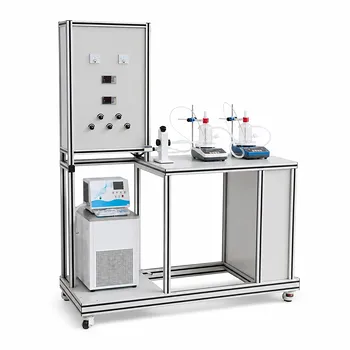
Model validation isn’t a theoretical exercise—it’s a physical necessity. Chemical engineering unit operations pilot plants, such as fractional distillation or gas absorption columns, allow students and researchers to generate real-world VLE data under controlled conditions. By directly measuring temperature, pressure, and phase compositions, they can compare experimental results against predictions from thermodynamic models (e.g., NRTL, UNIQUAC, UNIFAC), confirm or correct model parameters, and build confidence in the separation processes that software alone cannot provide.
Pilot plants turn abstract thermodynamic equations into testable, real-world tools. They provide controlled experimental VLE data that exposes model deviations, enables regression of accurate binary interaction parameters, and ensures process designs rest on physical evidence—not just estimated coefficients.
The Gap Between Theory and Reality in VLE Models
Why do we even need pilot plants when commercial simulators come pre-loaded with activity-coefficient models? Because the underlying interaction parameters are often unreliable, and real mixtures rarely follow ideal behavior.
Why Textbook Models Often Miss the Mark
Most thermodynamic models used for VLE prediction—Wilson, NRTL, UNIQUAC—rely on binary interaction parameters that are regressed from existing data. When those parameters are scarce, estimated, or extrapolated, the model’s predictions can deviate dramatically from actual behavior.
Non-ideality, azeotrope formation, and strong molecular interactions (as in ethanol-water) invalidate Raoult’s law. The result is a dangerous gap between simulation and reality that can lead to oversized columns, poor separation efficiency, or unsafe operating conditions.
The Four Variables That Define VLE
Vapor-liquid equilibrium hinges on four measurable quantities: temperature (T), pressure (P), liquid-phase composition (xi), and vapor-phase composition (yi). Phase equilibrium is reached when the chemical potential of each component is identical in both phases.
In a pilot plant, you can hold pressure and temperature constant, wait for steady state, and sample both phases directly. This hands-on control is impossible in a purely computational exercise and is the key to validation.
How Pilot Plants Close the Validation Loop
Unit operations pilot plants don’t just illustrate VLE—they provide the experimental anchor that transforms a model from “plausible” to “proven.”
Generating Reliable Experimental Data
A well-designed distillation or absorption pilot unit features multiple liquid and vapor sampling ports along the column height. Under steady-state operation, students and researchers can:
- Extract physical samples without disturbing equilibrium,
- Measure phase compositions via gas chromatography or refractometry,
- Calculate experimental activity coefficients (γ) from the data,
- Map the real, non-ideal VLE curve—complete with any azeotropic point.
This process directly demonstrates the equilibrium condition ( p_i = p_i^0 x_i \gamma_i ) and shows how activity coefficients capture deviations from ideality.
From Raw Data to Verified Models: The Validation Workflow
With experimental T–x–y data in hand, the validation workflow typically follows three steps:
- Compare: Overlay experimental VLE data on the same plot as model predictions (e.g., an x–y or T–x–y diagram). Where the curves diverge, the model is inaccurate.
- Regress: Use the experimental points to optimize model parameters. For example, binary interaction parameters in NRTL or UNIQUAC can be regressed directly from pilot plant data, minimizing the sum of squared errors between predicted and measured mole fractions.
- Re-validate: Run the updated model against new pilot-plant runs to confirm the corrections hold across a range of conditions.
This closed-loop approach—experiment, compare, regress, and confirm—directly addresses the industry reality that phase equilibrium data accounts for roughly 70% of all engineering data requests in process design. Without pilot plants, those requests would be answered with conjecture, not fact.
Understanding the Trade-offs and Limitations
Pilot-scale VLE validation brings enormous value, but it is not a silver bullet. Researchers and educators must navigate several practical constraints.
Time and Resource Commitment
Reaching steady state, sampling multiple points, and analyzing compositions is labor-intensive. A single VLE data set can take hours of operation, plus chemical analysis time. This trade-off between data richness and throughput must be factored into curriculum planning or research project timelines.
Handling Complex or Hazardous Mixtures
Pilot plants are well-suited to classic teaching mixtures (e.g., ethanol-water, acetone-chloroform), but for toxic, high-pressure, or highly corrosive systems, specialized materials and safety protocols are required. That can limit the range of models you can test at the pilot scale.
Scale-Dependent Non-Idealities
Lab-scale columns may not perfectly replicate the hydrodynamic and mass-transfer characteristics of industrial towers. While VLE is fundamentally independent of scale, trace impurities or heat loss can subtly distort experimental data. Careful insulation, calibration, and repeat runs are necessary to ensure the VLE data you generate truly reflects thermodynamic equilibrium and not just equipment quirks.
Model Applicability Limits
Even validated pilot-scale data has boundaries. A model tuned on a distillation column at atmospheric pressure may fail when extrapolated to high-pressure absorption or reactive distillation. The validation is only as good as the domain of the experiment; researchers must be explicit about the range of conditions for which their regressed parameters are valid.
Making the Right Choice for Your Goal
How you use a pilot plant for VLE model validation should align with your ultimate objective—whether that is deep learning, model development, or practical design confidence.
- If your primary focus is educational understanding: Use a pilot distillation unit to run classic non-ideal mixtures. Have students sample both phases, calculate activity coefficients, and plot the real VLE curve against Raoult’s law. The direct observation of azeotrope formation cements thermodynamic theory better than any textbook.
- If your primary focus is regressing model parameters for research: Operate the pilot plant under a design of experiments that spans the temperature and composition range of interest. Use the resulting T–x–y data to optimize NRTL or UNIQUAC binary interaction parameters via regression tools, then validate with a separate test run to confirm predictive power.
- If your primary focus is process design assurance: Run the pilot plant with the actual multi-component mixture you plan to separate industrially. Generate VLE data and compare it against your simulator’s predictions. If discrepancies arise, update the thermodynamic package before scaling up—this is the most cost-effective insurance against a failed plant design.
When theory meets the physical pilot plant, thermodynamics becomes a living, testable science. Use these tools not as a mere demonstration, but as your laboratory for turning estimated models into trusted engineering decisions.
Summary Table:
| Aspect | Theoretical/Simulation Models | Pilot Plant Validation |
|---|---|---|
| Data Source | Estimated/extrapolated binary interaction parameters | Real-world physical samples & experimental T-x-y data |
| Non-Ideality & Azeotropes | Often missed or poorly predicted | Directly observed, measured, and mapped in real time |
| Key Variables (T, P, x, y) | Computed mathematically via equations of state | Directly measured at steady-state using sensor arrays |
| Design Reliability | Higher risk of sizing errors & inefficiency | Proven model accuracy for confident process scale-up |
Bring Thermodynamics to Life with LABPARK
Are you looking to bridge the gap between theoretical equations and physical chemical processes?
LABPARK provides state-of-the-art Educational and Vocational Unit Operations Pilot Plants in chemical engineering, bioprocess & biotech, and environmental & water treatment. Engineered specifically for universities, research institutes, and enterprises, our pilot plants empower you to:
- Generate precise experimental data to validate complex thermodynamic and VLE models.
- Equip students and researchers with hands-on, industry-grade physical systems.
- De-risk process scale-up by verifying simulation data before commercial implementation.
Ready to upgrade your laboratory or research capabilities? Contact LABPARK today to discuss your project requirements.
Related Products
- Binary System Vapor Liquid Equilibrium Data Determination Educational Unit Operations Pilot Plant
- Ternary Liquid-Liquid Equilibrium Educational Pilot Plant
- Supercritical High-Gravity Flash Evaporation Educational Unit Operations Pilot Plant
- Rising and Falling Film Evaporation Educational Unit Operations Pilot Plant
- Two-Dimensional Fluidization Hydrodynamics Educational Pilot Plant for Unit Operations Training
People Also Ask
- Why Collect Isothermal vs. Isobaric VLE Data? Key Pilot Unit Advantages
- How Do Equations of State Predict VLE in Pilot Plants? Optimize Your Separation Design
- How do intermolecular forces and molecular kinetic energy govern gas liquefaction and vaporization? Explore VLE pilot plants
- For VLE Experiments: Fugacity vs. Activity Coefficient Method Selection Criteria
- Why is hands-on training with VLE and LLE pilot plants critical? Bridge the gap between theory and simulation.