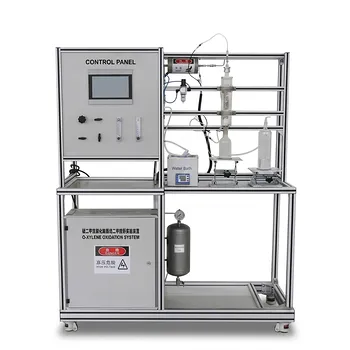
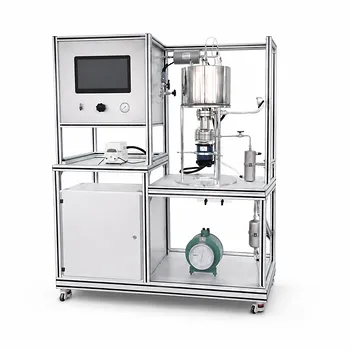
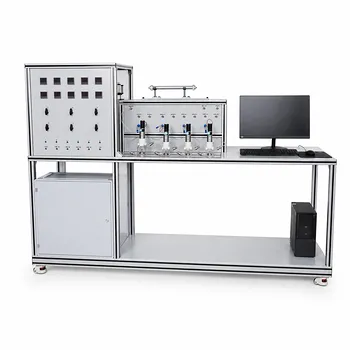
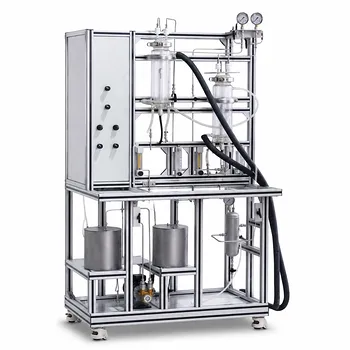
Nu is not a single, universal constant in a fixed-bed reactor—it’s a local value that changes with flow and position. For turbulent conditions, you’ll lean on correlations like Whitaker’s that depend on Reynolds (Re) and Prandtl (Pr) numbers. For laminar flow, the Nu must be treated as an axial-position-dependent profile, often using correlations such as Sundaram and Froment. In a pilot plant, these calculations directly feed the fluid-to-particle heat transfer coefficient, enabling you to predict temperature distributions, size cooling systems, and avoid hotspots that could ruin catalyst activity or lead to thermal runaway.
The Nusselt number in a gas-solid fixed-bed catalytic reactor is determined empirically through regime-specific correlations—axial-dependent for laminar, Re- and Pr-driven for turbulent—and, critically, must often be corrected for catalyst shape factors. Its application is the practical translation of those values into reliable temperature control and safe pilot-scale operation.
Why the Nusselt Number Is a Non-Negotiable Safety Tool
In a pilot plant, you are rarely just making product—you are generating the kinetic and thermal data that will scale the process. Losing temperature control distorts kinetics and can kill a catalyst batch.
Small-Scale Reactors Hide Big Thermal Gradients
Fixed beds suffer from notoriously poor radial heat transfer. The Nu directly quantifies the heat purge from the fluid to the catalyst surface. An underestimated Nu means you could be flying blind toward a hotspot.
Hotspots Are Data Killers
An exothermic reaction with inadequate heat removal creates a localized high-temperature zone. That zone produces false rate constants, promotes side reactions, and in the worst case triggers an unstoppable temperature excursion. The Nusselt number is your earliest warning metric.
How the Nusselt Number Is Determined in a Pilot Fixed Bed
There is no single equation. The path you choose depends entirely on the flow regime inside the bed and the geometry of your catalyst particles.
Correlations for Turbulent Flow
When Re is high enough for fully turbulent interstitial flow, the standard workhorse is the Whitaker correlation:
[ Nu = 2 + (0.4 , Re^{1/2} + 0.06 , Re^{2/3}) , Pr^{0.4} , \left(\frac{\mu}{\mu_s}\right)^{1/4} ]
It packages the convection physics cleanly. However, many industrial and educational pilot plants use a more comprehensive approach from Gnielinski, which blends laminar and turbulent contributions:
[ Nu = \left(Nu_{lam}^2 + Nu_{turb}^2\right)^{1/2} ]
Here, ( Nu_{turb} ) builds on Reynolds and Prandtl numbers, and the combination covers transitional regimes gracefully.
Correlations for Laminar Flow Depend on Where You Look
In pilot monoliths or at low flow rates where the bed behaves like a laminar system, the local Nu is not a plateau; it drops along the axial length. You cannot just insert ( Nu = 3.655 ).
Correlations like those from Sundaram and Froment explicitly make Nu a function of axial position. In practice, this means you either integrate the local value over the reactor length or you use a 2D model that respects this gradient. Applying a constant Nu here leads to under-predicted outlet temperatures and a false sense of safety.
The Overlooked Role of Catalyst Shape
Pellets aren’t all spheres. The supplementary correlations introduce a shape factor ( f_a ) that modifies the Nusselt number:
- Spheres: ( f_a = 1.0 )
- Cylinders (extrudates): ( f_a = 1.6 )
- Raschig rings: ( f_a = 2.1 )
A Raschig ring’s higher shape factor directly boosts the effective Nusselt number relative to a sphere at the same flow condition. Ignoring particle geometry in a pilot plant that tests multiple catalyst supports leads to inconsistent thermal baselines.
Applying Nu to Make Your Pilot Plant Tell the Truth
Determination is academic until you use it. The bridge is the fluid-to-solid heat transfer coefficient:
[ h = \frac{Nu \cdot k}{d_p} ]
Plug that ( h ) into your energy balance, and you own the temperature profile.
Predicting the Temperature Distribution
A local energy balance couples ( h ), the specific surface area of the bed, and the reaction enthalpy. With an accurate axial profile of Nu, you can map exactly where the peak temperature will form and at what magnitude. This tells you whether a single adiabatic run is even feasible.
Designing for Heat Removal from the Start
If your predicted axial temperature rise exceeds the catalyst’s thermal stability limit, the Nu calculation gives you the quantitative lever. You know how much you must increase gas velocity (raising Re, hence Nu) or switch to a catalyst shape with a higher ( f_a ) to flatten the profile.
Interpreting Pilot Data for Scale-Up
When you use a position-dependent Nu to fit kinetic parameters, those parameters become flow-independent. If you fit data with a flawed constant Nu, you bake a flow artefact into the activation energy. That error amplifies exponentially at commercial scale.
Understanding the Trade-offs and Hidden Pitfalls
Even the best correlation is a model, not a mirror.
Constant-Nu Shortcuts Lead to Dangerous Optimism
Plugging a terminal Nu value for laminar flow (e.g., 3.66) over the entire reactor length understates the inlet heat transfer rate. For an exothermic reaction where the inlet region is the most reactive, your predicted wall temperature and required coolant duty will be wrong precisely where it matters most.
Correlations Inherit the Errors of Their Database
The Whitaker correlation was developed for packed beds of spheres. Extending it blindly to structured packing or high-aspect-ratio cylinders without the shape factor correction introduces systematic bias. Always cross-check against the specific geometric range cited in the correlation’s original paper.
Turbulence Is Often Assumed but Rarely Fully Developed at Pilot Scale
Many pilot beds operate in transitional regimes. Applying a strictly turbulent correlation when Re is marginal will overestimate Nu, leading to an over-designed cooling system that quenches the front of the bed and yields misleading product distributions.
Making the Right Choice for Your Pilot Plant
Your goal determines how aggressively you must pursue the Nusselt number’s details.
- If your primary focus is safe operation during exothermic runs: Never use a constant Nu in laminar flow. Implement an axial-dependent correlation (like Sundaram and Froment) or a 2D simulation from day one to anticipate the true hot-spot location.
- If your primary focus is accurate kinetic parameter estimation: Use the Gnielinski or Whitaker correlation with the correct particle shape factor, and then sensitivity-check your fitted energy parameters against a 10% perturbation in Nu to ensure robustness.
- If your primary focus is comparing catalyst geometries fairly: Normalize all thermal comparison runs by reducing the temperature data with the shape-adjusted Nusselt number; this separates the geometric heat transfer effect from the true catalytic activity.
Knowing your Nusselt number is more than a calculation—it’s the difference between a pilot plant that produces generic results and one that delivers a scalable, safe, and economically viable process.
Summary Table:
| Flow Regime / Factor | Key Correlations & Parameters | Application & Design Implications |
|---|---|---|
| Turbulent Flow | Whitaker & Gnielinski (using $Re$ and $Pr$) | Blends laminar/turbulent regimes; prevents over-designed cooling. |
| Laminar Flow | Sundaram & Froment (axial-position dependent) | Captures local $Nu$ drop along reactor length; avoids under-predicting inlet heat. |
| Catalyst Shape Factor | Shape factor ($f_a$: 1.0 for spheres, 2.1 for Raschig rings) | Adjusts $Nu$ for non-spherical geometries to ensure accurate thermal baselines. |
| Thermal Balancing | Heat transfer coefficient: $h = \frac{Nu \cdot k}{d_p}$ | Maps temperature profiles to prevent thermal runaway and fit kinetic parameters. |
Optimize Your Process Scale-Up with LABPARK Pilot Plants
Precise heat transfer modeling is critical for successful pilot-scale operations. LABPARK provides premium Educational and Vocational Unit Operations Pilot Plants across chemical engineering, bioprocess & biotech, and environmental & water treatment.
Designed specifically for universities, research institutes, and enterprises, our pilot plants enable safe, reliable, and hands-on process simulation to validate your kinetic models and thermal safety margins.
Ready to elevate your research or training facilities? Contact LABPARK today to find the ideal pilot plant solution for your application.
Related Products
- Fixed Bed Gas Solid Catalytic Reaction Educational Pilot Plant
- Fixed-Bed Chemical Reaction and Gas Dust Tar Removal Unit Operations Pilot Plant
- Fluidized Bed Gas Solid Catalytic Reaction Educational Pilot Plant
- Micro-Scale Gas-Solid Catalytic Reaction Educational Pilot Plant
- Educational Unit Operations Pilot Plant for Intraparticle Diffusion Effective Factor Measurement
People Also Ask
- How do reactor pilot plants safely study gas-solid reactions? Master kinetics with thermal & flow control.
- How does the Mears criterion evaluate transport resistance? Key Guide to Intrinsic Kinetics
- Fluidized vs. Fixed Bed Reactors: Comparing Heat & Complexity in Pilot Plants
- Why is a multibed configuration necessary for exothermic reactions? Optimize your pilot plant trajectory.
- What are the differences between pseudohomogeneous and heterogeneous models in pilot plants?