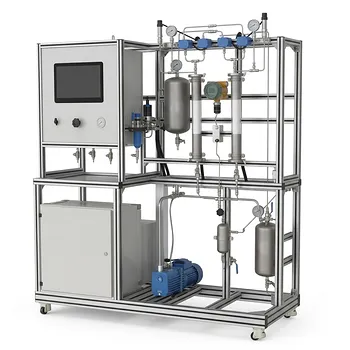
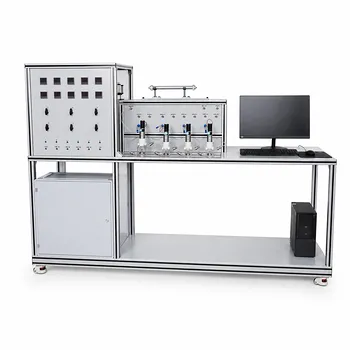
In a pilot plant, understanding multiple equilibria is how you predict which reactions will happen, in what ratios, and how to steer them for maximum efficiency. The concept directly applies to the design and operation of multi-component gas-solid reaction systems by allowing engineers to mathematically link simultaneous reactions—like the reduction of a metal oxide with both CO and H2 in syngas—into a single, manageable network. This integrated thermodynamic view lets you optimize feed gas compositions, set reaction temperatures, and accurately model mass balances long before committing to costly trial-and-error experimental runs.
The core challenge in a gas-solid pilot plant is navigating a web of interconnected reactions. The principle of multiple equilibria transforms this complexity from a liability into a design tool: by adding individual reaction steps and multiplying their equilibrium constants, you gain a single, predictive model that governs net conversion, simplifies process monitoring, and underpins reliable scale-up.
The Thermodynamic Foundation: Why Reactions Don’t Act Alone
When a solid material contacts a gas mixture containing multiple reactive species, you are not dealing with a single, isolated equilibrium. You are facing a network of simultaneous equilibria, each competing for reactants and dictating the final state.
The Mathematical Key: Multiplying Equilibrium Constants
According to the rules of multiple equilibria and Hess’s Law, if a target reaction is the sum of two or more individual steps, its overall equilibrium constant is the product of the individual constants.
For example, in the reduction of cobalt oxide (CoO) using syngas, two concurrent equilibria exist:
- CoO + CO ⇌ Co + CO₂ (with equilibrium constant Kp₁)
- CoO + H₂ ⇌ Co + H₂O (with Kp₂)
The net reduction process is the sum of these steps, and its overall constant Kp₃ is Kp₁ × Kp₂. This simple multiplication, derived directly from the additive relationship of standard Gibbs free energies (where ΔG₃ = ΔG₁ + ΔG₂), gives you a single thermodynamic anchor point for the whole gas-solid system.
From Individual Steps to a Unified Network
This principle extends beyond two reactions. In any multi-component system, you can combine any number of known equilibria to derive the unknown equilibrium constant of a complex net reaction.
In pilot plant simulation, this means you can mathematically reconstruct the reaction network. You determine mass balances and conversion limits for the combined process using thermodynamic data of simpler, well-characterized steps, without running the full-scale experiment first.
Applying Multiple Equilibria to Pilot Plant Design and Operation
This thermodynamic rulebook isn’t an abstract concept—it’s a practical toolkit that directly shapes how you design, run, and monitor a gas-solid pilot plant.
Optimizing Feed Gas Ratios and Temperature
In unit operations like the reduction of metal oxides, the product of equilibrium constants instantly reveals how changing the CO/H₂ ratio shifts conversion. If Kp₁ is larger than Kp₂, CO is the more effective reductant; you can bias the feed toward CO to improve efficiency.
Temperature is equally direct. Because each individual equilibrium constant has its own dependency on temperature (via the van’t Hoff equation), the net constant Kp₃ responds predictably. You use these calculations to select an operating temperature that maximizes the net driving force while staying within material and kinetic constraints, ensuring a pilot plant that runs at peak reduction efficiency from day one.
Simplifying Process Monitoring with the Heterogeneous Rule
Gas-solid reactions have a powerful simplification: the activity of pure solid phases is constant and equal to one. This means solids like CoO or Co drop out of the equilibrium constant expression entirely.
In a pilot plant, you don’t need to track the bulk mass of the solid bed to gauge equilibrium. The state of the system is fully determined by monitoring gas-phase partial pressures (pCO, pCO₂, pH₂, pH₂O). A single well-placed gas analyzer can tell you if you’re near equilibrium or far from it, eliminating complex sensor integration and letting operators make faster, data-driven adjustments.
Enabling Accurate Scale-Up from Computer Simulation
Pilot plants exist to predict how a process will behave at commercial scale. Multiple equilibria calculations bridge the gap between a thermodynamic model and a physical unit.
By minimizing the total Gibbs free energy of the reaction network—equalizing chemical potentials across all phases—you can compute phase compositions and boundaries for any proposed operating envelope. These simulations predict column behavior, identify optimal feed stages, and set control strategies without exhaustive trial-and-error. A distillation, extraction, or gas-solid reactor pilot plant can then be scaled up directly from these validated thermodynamic models, dramatically reducing the risk and cost of moving from bench to demonstration scale.
Understanding the Trade-offs and Pitfalls
No thermodynamic model is a perfect mirror of reality. Blind faith in equilibrium calculations will undermine a pilot plant’s value.
Thermodynamic Limits vs. Kinetic Reality
An equilibrium constant tells you where a reaction will end, not how fast it will get there. A highly favorable net equilibrium may never be reached if the kinetics are slow at your chosen temperature or if mass transfer limitations inside the solid phase throttle the rate. The pilot plant’s real job is to expose these kinetic bottlenecks; the equilibrium framework only tells you the ceiling.
Sensitivity to Non-Ideal Behavior
The simple product-of-constants rule assumes ideal gas behavior and ideal solid phases. In real syngas streams at high pressure or in systems where solid phases form non-stoichiometric compounds, activity coefficients deviate from unity. Over-reliance on ideal models, without correction from solution and multiple sublattice models, leads to errors in predicted conversion and temperature profiles.
Data Gaps Cascade Through the Network
Multiplying equilibrium constants amplifies uncertainty. If the individual K values have even modest experimental error, the error in the net constant grows rapidly. Pilot plant designs based on a poorly measured Kp₂ will yield an unreliable Kp₃, potentially steering you toward a suboptimal feed ratio. Cross-validating thermodynamic data with even a few targeted pilot runs is essential.
Making the Right Choice for Your Pilot Plant Goal
Multiple equilibria are a tool, not a dogma. Apply them in a way that serves your specific pilot plant objective.
- If your primary focus is maximizing reduction efficiency: Use the product of equilibrium constants to calculate the optimal CO/H₂ ratio and to identify the temperature that pushes Kp₃ to its highest value. Then run kinetic tests around that optimum to verify that it is practically attainable.
- If your primary focus is simple and reliable process monitoring: Exploit the heterogeneous phase rule to design your sensor strategy entirely around gas-phase measurements. Monitor only species that appear in the reduced equilibrium expression to track thermodynamic state without needing solid-level sensors.
- If your primary focus is reducing scale-up risk: Build a Gibbs energy minimization model using the multiple equilibria framework to generate phase maps. Validate the model’s predictions with a minimal set of pilot plant data points, then use the confirmed model to design the full-scale unit with high confidence.
When wielded with a clear-eyed understanding of both its power and its limits, the principle of multiple equilibria turns the chaos of simultaneous gas-solid reactions into a structured, predictable system you can design, monitor, and scale with precision.
Summary Table:
| Application Area | Thermodynamic Principle | Operational Benefit |
|---|---|---|
| Feed & Temp Optimization | van 't Hoff & $K_p$ multiplication | Maximizes net reaction driving force and efficiency |
| Process Monitoring | Heterogeneous rule (solid activity = 1) | Simplifies tracking to gas-phase partial pressures |
| Process Scale-Up | Gibbs free energy minimization | Predicts phase boundaries and minimizes scale-up risks |
Streamline Your Process Scale-Up with LABPARK
Transitioning from theoretical thermodynamics to physical operation requires precision. LABPARK offers state-of-the-art Educational and Vocational Unit Operations Pilot Plants in chemical engineering, bioprocess & biotech, and environmental & water treatment.
Engineered for universities, research institutes, and enterprises, our pilot plants empower you to validate complex reaction networks, optimize feed compositions, and scale up with absolute confidence.
Ready to elevate your research and engineering capabilities? Contact us today to discuss your project requirements.
Related Products
- Fixed Bed Gas Solid Catalytic Reaction Educational Pilot Plant
- Fluidized Bed Gas Solid Catalytic Reaction Educational Pilot Plant
- Micro-Scale Gas-Solid Catalytic Reaction Educational Pilot Plant
- Fixed-Bed Chemical Reaction and Gas Dust Tar Removal Unit Operations Pilot Plant
- Educational Unit Operations Pilot Plant for Intraparticle Diffusion Effective Factor Measurement
People Also Ask
- Fixed-Bed vs. Fluidized-Bed Reactor: How to Choose the Right Pilot Plant for Gas-Solid Catalytic Reactions
- How to determine catalyst pore radius & porosity? Optimize your chemical engineering pilot plant.
- What reactor configurations study gas-solid reactions? Guide to key types and applications.
- How does identifying the rate-limiting step optimize reaction conditions? Pilot Plant Guide
- How do reactor pilot plants safely study gas-solid reactions? Master kinetics with thermal & flow control.