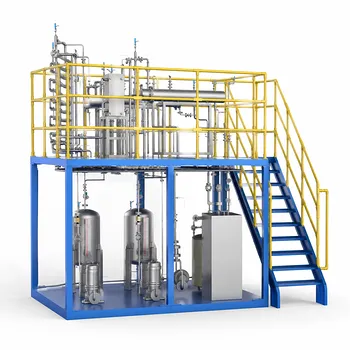
Microchannel-based unit operations fundamentally redefine what’s possible in heat and mass transfer efficiency.
Where conventional pilot plant equipment relies on macro-scale geometries with inherent transport limitations, microchannel architectures achieve rates that are orders of magnitude higher. This leap comes from shrinking flow channels to sub-millimeter dimensions, collapsing the diffusion path and exploding the surface-area-to-volume ratio. The result is a hardware volume reduction of 10 to 1,000 times—without sacrificing throughput—and the ability to operate at a catalyst’s true kinetic limit, not its heat-removal limit.
The central challenge in conventional pilot plants is not a lack of chemical potential, but the slow pace of heat and mass movement across large equipment. Microchannel process intensification directly attacks this bottleneck by shortening every transport distance to the micron scale, enabling heat fluxes 100 times greater than traditional reactors and eliminating mass transfer resistances that plague larger systems. The deep need isn’t just “comparing” two technologies—it’s understanding why the micro-scale creates a new performance ceiling that makes conventional equipment appear fundamentally transport-limited.
The Physical Basis for Superior Transport
How Surface-to-Volume Ratio Dictates Heat and Mass Transfer
Heat and mass transfer rates scale directly with the surface area available per unit of fluid volume. Conventional pilot-scale vessels—think jacketed stirred tanks or packed columns—have relatively low surface-to-volume ratios, often on the order of 100 m²/m³. Microchannels, with at least one dimension under 1 mm, push this ratio into the 10,000–50,000 m²/m³ range.
This thousand-fold increase means that a microchannel unit can exchange heat or mass across an enormous area within a tiny physical envelope. Every molecule of the process fluid is, on average, only microns away from a wall or an interface, drastically accelerating transport.
Eliminating the Diffusion Bottleneck
In conventional equipment, molecules must diffuse across boundary layers that can be millimeters thick. That might sound small, but for heat conduction and molecular diffusion, those distances represent a major resistance. Microchannels reduce the maximum diffusion path length to the half-width of the channel—often 100–500 microns.
This short path virtually eliminates concentration and temperature gradients within the fluid. Mass transport resistance becomes negligible, meaning reaction rates are governed only by the intrinsic catalyst activity and kinetic rate constant, not by how fast species can move to the active site. This is why microchannel reactors can achieve contact times under 10 milliseconds for reactions like steam methane reforming, something unthinkable in a conventional fixed-bed pilot reactor.
Heat Transfer Efficiency: 100x the Performance
A Direct Comparison of Heat Flux
Conventional pilot plant heat exchangers and reactors typically manage heat fluxes around 1 W/cm². This limit is set by conductive and convective resistances across thick metal walls, boundary layers, and the bulk fluid. Microchannel devices, however, routinely operate at heat fluxes of 100 W/cm²—two orders of magnitude higher.
This 100-fold improvement means that a microchannel pilot plant can add or remove the same amount of heat using a fraction of the surface area, or handle dramatically more exothermic/endothermic duty in the same footprint. For endothermic reactions like steam reforming (49.3 kcal/mol), the heat required can be delivered so rapidly that the reaction operates isothermally, even at millisecond contact times.
Integrating Process Steps Through Thermal Coupling
The extreme heat transfer capability enables a design philosophy impossible in conventional pilot setups: close thermal coupling of unit operations within a single device. In a microchannel architecture, an exothermic combustion channel (releasing 147.5 kcal/mol for methane) can be placed directly adjacent to an endothermic reforming channel.
Heat flows across a wall only microns thick at fluxes of 100 W/cm², directly powering the reforming reaction with minimal thermal gradient and negligible heat loss to the environment. This eliminates the need for a separate, bulky furnace, recuperator, and interconnecting pipework. In a conventional pilot plant, those unit operations would be physically separated by insulated piping, incurring heat losses, pressure drops, and control lags. The microchannel design compresses an entire flowsheet into a modular, palm-sized stack.
Mass Transfer Efficiency: Moving Beyond Transport Control
Achieving True Kinetic Limitation
Mass transfer resistance is the silent thief of reactor performance. In conventional packed-bed pilot reactors, especially for fast reactions like Fischer-Tropsch synthesis, pore diffusion in catalyst pellets creates concentration gradients that reduce selectivity and the effective reaction rate. The measured performance reflects a compromised mix of kinetics and mass transfer.
Microchannels sidestep this entirely. Because the catalyst is often coated as a thin layer on the channel wall, the diffusion path is negligible. Carbon monoxide conversion in Fischer-Tropsch can exceed 69% with minimal methane selectivity, while a slurry-bed pilot plant would struggle to match that combination of conversion and selectivity because of slower mass transport. The pilot-scale result is a demonstration of a catalyst’s full potential, not a blurred picture of its capabilities.
Handling Temperature-Sensitive Chemistry
Many pilot-plant demonstrations involve reactions where selectivity is exquisitely sensitive to temperature excursions. The water-gas shift and preferential oxidation (PROX) of CO are classic examples. A hot spot in a conventional fixed-bed reactor can trigger a runaway or side reaction that ruins the experiment. Microchannels, with their rapid heat removal, maintain near-isothermal temperature profiles even for highly exothermic reactions.
The heat released by the reaction is conducted to a cooling fluid in an adjacent set of channels almost instantaneously. This precise thermal control prevents side reactions, broadens the safe operating window, and allows pilot plants to explore higher throughput conditions without risk. In a conventional system, achieving that same temperature uniformity would demand extensive dilution or a massive, external heat exchanger.
The Practical Payoff for Pilot Plants and Education
Drastic Footprint Reduction and Safety
The primary reference highlights orders-of-magnitude reductions in hardware volume and mass. A microchannel pilot plant occupying a bench-top can replace a conventional unit that fills a laboratory bay. This saves expensive floor space and allows research labs to house multiple demonstration units in parallel.
Lower chemical inventory is a direct consequence. A microchannel reactor, with its tiny internal volume, holds only a few grams of catalyst and a few milliliters of process fluid at any moment. In an educational setting, this drastically improves safety because the potential energy release from an upset is minuscule. Students can safely explore extreme operating conditions—high pressure, high temperature, explosive mixtures—that would be prohibitively hazardous in a large pilot rig.
Faster Response and Modular Scalability
Conventional pilot plants suffer from thermal inertia; heating or cooling a large mass of steel takes time. Microchannel units, with their low thermal mass and rapid heat transfer, reach steady state in minutes, not hours. This enables faster experimental turnaround and real-time demonstration of process dynamics in a teaching lab.
Scaling up throughput is achieved by numbering up rather than scaling up. Identical microchannel plates are stacked, and manifolds distribute flow uniformly. For example, in a microchannel condenser, interleaving air-cooled channels with process channels allows continuous, integrated phase separation. This modularity means the pilot-scale performance data directly predict commercial-scale behavior, avoiding the scale-up uncertainty that plagues conventional pilot plants.
Understanding the Trade‑offs and Boundaries
What Microchannels Won’t Solve Automatically
No technology is without limits, and the microchannel approach comes with its own set of practical challenges. Because channels are extremely small, they can be susceptible to clogging from particulates or polymerization byproducts. Feedstock must often be filtered to a level not required for a conventional pilot plant.
The high surface-to-volume ratio also amplifies any uneven flow distribution. A poorly designed manifold can create channel-to-channel maldistribution that undermines the very uniformity microchannels promise. Achieving uniform flow across hundreds or thousands of parallel channels demands careful fluidic design—a manufacturing and engineering challenge absent in a simple stirred tank.
Manufacturing Complexity and Pressure Drop
The sandwich-like multi-layer structures with interleaved channels require precision fabrication and bonding techniques. While this cost is amortized over the operational benefits, it can make a single microchannel device more expensive to procure upfront than a basic glass reactor or simple fixed-bed tube.
Additionally, forcing fluid through sub-millimeter channels results in a higher pressure drop per unit length than in open pipes. In pilot plants, this is usually manageable because the total channel length is short, but it must be factored into pumping costs and system design. For gas-phase reactions, the pressure drop can be reduced by tailoring channel dimensions and operating conditions, but it remains a design constraint.
Making the Right Choice for Your Pilot-Plant Goals
The decision to adopt microchannel-based unit operations depends on what problem you are truly trying to solve—not just on a generic comparison of heat and mass transfer numbers.
- If your primary focus is demonstrating true kinetic performance: Microchannels are the clear choice. They remove mass transfer disguise and enable you to measure a catalyst’s intrinsic activity, even for reactions with millisecond contact times.
- If your primary focus is integrating unit operations into a compact, educational module: Microchannels let you combine reaction, heat exchange, and phase separation in a single, transparent device that fits on a benchtop and responds instantly to control changes.
- If your primary focus is scaling a process from lab to pilot with high confidence: The numbering-up approach of microchannel stacks provides a direct line of sight from a single channel’s performance to a full-scale module’s output, avoiding the scaling hazards of conventional equipment.
- If your primary focus is managing high hazards or toxic materials in a teaching lab: The minimal chemical inventory and flameproof channel dimensions of microreactors create an inherently safer environment that conventional pilot plants cannot match.
Microchannel process intensification isn’t just an incremental improvement over conventional pilot plant equipment—it’s a paradigm shift that rewrites the relationship between hardware size and transport capability, letting you build pilot plants limited only by chemistry, not by physics.
Summary Table:
| Feature | Microchannel-Based Equipment | Conventional Pilot Equipment |
|---|---|---|
| Surface-to-Volume Ratio | 10,000 – 50,000 m²/m³ | ~100 m²/m³ |
| Heat Flux | ~100 W/cm² | ~1 W/cm² |
| Diffusion Path | 100 – 500 microns (negligible resistance) | Millimeters (boundary layer resistance) |
| Thermal Control | Near-isothermal (eliminates hot spots) | Temperature gradients (runaway risks) |
| Scale-Up Path | Modular numbering-up (stacking plates) | Complex, high-risk physical redesign |
Upgrade Your Lab with Advanced Pilot Plant Solutions from LABPARK
Are you looking to bridge the gap between theoretical kinetics and real-world process intensification? LABPARK provides high-performance Educational and Vocational Unit Operations Pilot Plants tailored for universities, research institutes, and enterprises.
Our advanced educational and research systems cover:
- Chemical Engineering (including microchannel and process intensification technologies)
- Bioprocess & Biotech
- Environmental & Water Treatment
Empower your students and researchers to safely explore extreme operating conditions, achieve true kinetic limits, and scale up chemical processes with complete confidence.
Contact LABPARK today to discuss your laboratory's needs and receive a tailored solution!
Related Products
- Multi-Functional Membrane Separation Educational Pilot Plant for Unit Operations Lab
- Agitation and Mixing Educational Unit Operations Pilot Plant
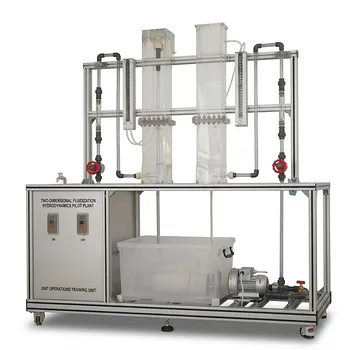
- Two-Dimensional Fluidization Hydrodynamics Educational Pilot Plant for Unit Operations Training
- Multi-Reactor Educational Pilot Plant for Reaction Engineering Unit Operations
- Multi-Modal Distillation Unit Operations Training Pilot Plant
People Also Ask
- What are the key differences in membrane configurations? Choose the Right Unit Operations Pilot Plant
- How Do Pervaporation, Vapor, and Gas Permeation Differ in Pilot Plants? Key Comparison
- What are the advantages of membrane separation pilot plants? Energy-saving process intensification.
- Pervaporation vs. Vapor Permeation: Handling Suspended Solids in Membrane Pilot Plants
- How do PEI, PVDF, and PSU membranes compare in pilot plants? Find the best fit.