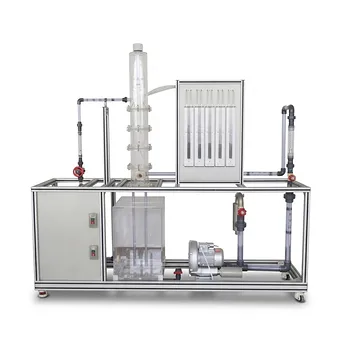
Operating pressure is the single most influential design parameter when you need to shrink a gas–liquid–solid slurry reactor pilot plant from an industrial behemoth into a lab‑scale teaching and research tool. In almost all reaction systems, raising the system pressure from a few atmospheres to around 20 atm collapses the required dispersion volume by 60–70 % – slashing a vessel footprint from over 40 m³ down to roughly 12 m³, with a column diameter of about 1.0 m and a manageable height near 16.7 m.
Every bar of added pressure forces more gaseous reactant into the liquid phase, accelerating the apparent reaction rate. This alone can eliminate the need for a giant column, but the choice of operating pressure also dictates the column’s aspect ratio, the way you measure gas holdup, and the complexity – and therefore the pedagogical value – of your pilot‑plant setup.
How Pressure Shrinks Reactor Volume
More Dissolved Gas, Faster Macroscopic Kinetics
Higher system pressure directly boosts gas solubility in the liquid phase. This increase in dissolved‑reactant concentration feeds the surface reaction, making the overall transformation faster even if the intrinsic mass‑transfer coefficient changes little. The result: the same chemical conversion can be achieved in a far smaller volume of liquid–slurry dispersion.
From 4 atm to 20 atm: A 70 % Volume Reduction
In a representative slurry reactor operating at a superficial gas velocity of 0.5 cm s⁻¹, raising the total pressure at the column top from 4 atm to 20 atm cuts the required contactor volume from 41.27 m³ to just 12.46 m³. Such a dramatic reduction makes the difference between a pilot plant that overwhelms a laboratory floor and one that fits in a standard high‑bay fume‑hood enclosure.
Why Space and Utility Matter in Education and Research
Academic pilot plants must often coexist with other experiments, limited utility grids, and tight safety clearances. A column of 1.0 m diameter and ~17 m total height keeps the setup physically accessible for student observations, sampling, and instrument calibration, while still generating industrially meaningful mass‑transfer data.
Impact on Column Configuration
Diameter, Height, and the Aspect Ratio Decision
High pressure does not simply shrink all dimensions proportionally. Designers typically fix a column diameter that satisfies two competing needs: a cross‑sectional area large enough to handle the gas throughput and a dispersion height that guarantees sufficient residence time. In the 20 atm example, a 1.0 m diameter emerges as the optimum, paired with a 16.69 m dispersion height. Lowering the pressure would force either a much wider column or an impractically tall column, or both, to keep the same conversion.
The Gas‑Holdup Independence Window
For columns larger than 0.15 m in diameter, gas holdup – the volume fraction of gas that drives interfacial area – becomes nearly independent of pressure up to about 1.6 MPa (≈15.8 atm). Staying inside this window lets students apply textbook correlations without worrying about pressure‑induced shifts in bubble dynamics. Above ~16 atm, gas holdup may begin to show a pressure dependence, which can be either a nuisance or a fascinating demonstration of real‑world non‑ideality, depending on your learning objectives.
Slurry Homogeneity and Particle‑Size Boundaries
Even when pressure fixes the column size, the solid catalyst particle size decides whether you have a uniform pseudohomogeneous slurry or an axially segregated bed. Particles smaller than 100 µm generally remain suspended uniformly throughout the column; larger particles settle, altering both reaction engineering and scalability. Because pilot plants often serve as scale‑down tools, maintaining a homogeneous slurry with fine particles is usually preferred, and that constraint must work hand‑in‑hand with the chosen pressure‑driven dimensions.
Understanding the Trade‑offs
High Pressure: Smaller Size, Higher Stakes
While 20 atm operation compresses the reactor into a lab‑friendly package, it introduces thick‑walled vessels, high‑pressure gas supply infrastructure, and rigorous safety interlocks. For an educational pilot plant, these features add capital cost and make routine maintenance more cumbersome. The pedagogical trade‑off is clear: a compact, authentic industrial‑style reactor versus a simpler low‑pressure unit that allows more hands‑on tinkering.
The Gas‑Holdup Trade‑off Above 1.6 MPa
Operating at 20 atm (2.03 MPa) moves you outside the pressure‑independent gas‑holdup regime. Students measuring gas holdup must then account for pressure effects, which complicates the demonstration of mass‑transfer fundamentals. If the primary goal is to teach classical mass‑transfer theory, limiting pressure to ≤1.6 MPa keeps the variable set clean and the data immediately comparable to standard correlations.
Mass Transfer vs. Equipment Cost
The enhanced gas solubility at high pressure more than compensates for the incremental cost of compression. Moreover, the reduced liquid‑phase volume suppresses evaporation losses, shrinking the downstream off‑gas recovery equipment. But these operational savings must be balanced against the initial cost of a high‑pressure column and the training required for safe operation.
When a Low‑Pressure Column Might Actually Be “Better”
For a teaching lab that runs ambient‑pressure air‑water‑solid slurries, the dominant variable is often the superficial gas velocity, not pressure. In such a case, a low‑pressure column with a diameter just above 0.15 m can generate all the essential data on gas holdup, bubble dynamics, and liquid‑phase mixing without the safety burden of 20 atm. The larger volume at low pressure also makes sampling and visual observation easier – a clear advantage when the goal is student comprehension rather than minimum floorspace.
Making the Right Choice for Your Goal
If your primary focus is pure space and utility optimization: Choose a pressure in the 15–25 atm range to shrink the dispersion volume dramatically, targeting a column diameter near 1.0 m and a moderate height to fit inside a standard high‑bay laboratory.
If your primary focus is teaching classical mass‑transfer and gas‑holdup fundamentals: Operate at a pressure no higher than ~16 atm (≤1.6 MPa) and use a column diameter of at least 0.15 m to keep gas holdup pressure‑independent and the underlying theory straightforward.
If your primary focus is safe, hands‑on student interaction: Consider a low‑pressure (≤4 atm) bubble column slurry reactor. The larger volume is offset by greater accessibility, visual clarity, and the ability to explore a wide range of superficial gas velocities without elaborate gas‑boosting equipment.
If your primary focus is research on high‑pressure hydrogenation or similar processes: Accept the complexity of 20 atm+ operation as a necessity. The compact column dimensions then become an incidental benefit, not the driving force, and your pilot plant will directly mimic industrial conditions.
Select the pressure that solves your most important problem – whether that is floorspace, pedagogical clarity, or process authenticity – and the column dimensions will follow naturally, giving you a pilot plant that is not only the right size but the right complexity for your educational or research mission.
Summary Table:
| Operating Pressure | Reactor Volume | Key Design Impact | Primary Use Case |
|---|---|---|---|
| Low (≤4 atm) | Large (~41 m³) | High accessibility, easy visual observation | Hands-on teaching & safety |
| Medium (≤16 atm) | Moderate | Pressure-independent gas holdup regime | Mass-transfer theory education |
| High (20+ atm) | Small (~12 m³) | High gas solubility, complex safety setup | High-pressure industrial research |
Optimize Your Chemical Engineering Lab with LABPARK
Are you designing a unit operations lab or researching advanced reactor systems? LABPARK provides state-of-the-art Educational and Vocational Unit Operations Pilot Plants in chemical engineering, bioprocess & biotech, and environmental & water treatment for universities, research institutes, and enterprises.
Whether you need a compact high-pressure slurry reactor for industrial research or a user-friendly bubble column for student training, we customize solutions tailored to your space, safety, and pedagogical goals.
Ready to elevate your engineering department? Contact LABPARK today to discuss your project requirements with our technical experts.
Related Products
- Fixed Bed Gas Solid Catalytic Reaction Educational Pilot Plant
- Fluidized Bed Gas Solid Catalytic Reaction Educational Pilot Plant
- Fixed-Bed Chemical Reaction and Gas Dust Tar Removal Unit Operations Pilot Plant
- Micro-Scale Gas-Solid Catalytic Reaction Educational Pilot Plant
- Two-Dimensional Fluidization Hydrodynamics Educational Pilot Plant for Unit Operations Training
People Also Ask
- How do reactor pilot plants safely study gas-solid reactions? Master kinetics with thermal & flow control.
- How does the Mears criterion evaluate transport resistance? Key Guide to Intrinsic Kinetics
- Fluidized vs. Fixed Bed Reactors: Comparing Heat & Complexity in Pilot Plants
- Why is a multibed configuration necessary for exothermic reactions? Optimize your pilot plant trajectory.
- What are the differences between pseudohomogeneous and heterogeneous models in pilot plants?