Methane formation directly reduces the gross heating value of syngas obtained from a coal gasifier.
For a fixed oxygen-to‑carbon ratio, the heating value per mole of carbon fed (h) follows the simple relationship h = I – m, where I is an invariant ceiling set by the oxygen input and m is the methane production rate. This means every incremental mole of CH₄ formed subtracts from the maximum possible energy content of the product gas. Although methane itself is a combustible species, its production consumes carbon and hydrogen that would otherwise yield a higher total heating value as CO and H₂ in the syngas. In a unit operations pilot plant, students observe this penalty firsthand and learn to connect thermodynamic limits with real process economics.
The core insight: Methane formation always penalizes the heating value per unit of carbon fed, even though CH₄ is an energetic molecule. The linear penalty equation h = I – m highlights that for any given oxygen supply, every mole of methane produced directly reduces the energy recoverable from the feed carbon. Balancing this cold‑gas efficiency loss against downstream separation costs is a central lesson of pilot‑plant gasification experiments.
The Heating‑Value Penalty Equation
The Invariant Ceiling Set by the Oxygen‑to‑Carbon Ratio
The term I in the relationship h = I – m is fixed solely by the O/C ratio.
It represents the maximum possible gross heating value per mole of carbon fed—attainable only if all carbon is converted to CO and all hydrogen remains as H₂.
Altering the oxygen input changes I, thereby shifting the entire efficiency envelope. In pilot‑plant work, I becomes a tangible knob: students measure how oxygen flow alone defines the ultimate energy potential of the gasifier.
Methane as a Direct Subtractor
The variable m is the molar methane production rate per mole of carbon fed.
Because methane formation occupies carbon atoms that would otherwise exit as CO and consumes hydrogen that would otherwise exit as H₂, it directly reduces the cumulative heating value.
From a stoichiometric perspective, one mole of carbon forming CH₄ delivers less total energy (when combined with the lost hydrogen) than the same carbon forming CO plus the free H₂. The equation h = I – m captures this as a clean linear penalty.
Why Methane’s Own Heating Value Is Deceptive
Per molecule, CH₄ has a higher lower heating value than CO or H₂. However, its formation in a gasifier comes at the expense of two valuable H₂ molecules.
The net energy per carbon atom invested is lower when that carbon ends up in a CH₄ molecule instead of a CO molecule. The pilot plant clarifies this apparent paradox, showing that total system energy—not the heating value of a single species—is the metric that matters.
Why Methane Forms During Coal Gasification
Temperature’s Dominant Role
Methanation (C + 2H₂ ⇌ CH₄) is strongly exothermic, while the steam gasification of char (C + H₂O ⇌ CO + H₂) is endothermic.
As temperature increases, equilibrium shifts away from CH₄ and toward CO and H₂. Consequently, pilot‑plant runs at higher temperatures consistently show lower methane concentrations and higher syngas heating values.
Pressure’s Influence on Equilibrium
The gasification reactions that produce CO and H₂ increase the total number of gas molecules; the reaction forming CH₄ reduces that number.
By Le‑Chatelier’s principle, lower pressures favor CO and H₂, while higher pressures promote methane formation. A pilot plant allows students to manipulate back‑pressure and observe how CH₄ levels—and thus the heating value penalty—respond.
The Intermediate‑Temperature Methane Peak
In many gasifiers, CH₄ concentration exhibits a maximum at intermediate temperatures, not at the lowest temperatures.
At low temperatures, methanation kinetics are sluggish, so CH₄ formation is limited. At very high temperatures, thermodynamics drives CH₄ decomposition into CO and H₂. The intermediate peak is a critical experiential insight: students see that simply lowering temperature does not always raise methane predictably, and they learn to map the operating envelope where the heating‑value penalty is most severe.
Pilot Plant Observations: Connecting Theory to Measurable Outcomes
Data That Bring the Equation to Life
During a typical educational run, students measure the molar flow rate of CH₄ and compute m, then calculate h from product gas composition and flow rates.
Plotting h versus m reveals a clear inverse relationship, with the slope depending on the chosen O/C ratio. This visual confirmation cements the concept that methane production is a direct tax on cold‑gas efficiency.
Tracking I as the Operating Condition Changes
By fixing the oxygen input and varying the temperature, the invariant I remains constant, while m changes.
Students observe that any reduction in methane comes with a corresponding increase in process temperature—often requiring more energy supply (from partial combustion). This reinforces that the heating value ceiling I is an energetic constraint, not a free parameter.
Understanding the Trade‑offs: Thermal Efficiency vs. Process Economics
Cold‑Gas Efficiency vs. Syngas Purity
Minimizing methane maximizes heating value per carbon fed, raising cold‑gas efficiency.
However, in applications that require pure syngas for chemical synthesis (e.g., methanol or Fischer‑Tropsch), even small amounts of CH₄ act as an inert that must be separated downstream. The penalty equation highlights a fundamental trade‑off: running hotter to suppress CH₄ improves thermal efficiency but may demand more oxygen—while leaving some methane in the gas lowers separation costs but hurts the efficiency figure.
The Separation Penalty as a Hidden Cost
Downstream cryogenic or membrane‑based CH₄ removal consumes energy and capital.
The pilot plant experience teaches that the true economic optimum is not simply the highest h value; it balances the heating‑value penalty (m) against the separation burden. This multi‑objective perspective is what transforms a unit operations lab into a realistic process‑design exercise.
Using Methane as a Diagnostic Indicator
In a pilot plant with limited analytical sampling, CH₄ concentration can serve as a quick proxy for process temperature and equilibrium departure.
Because methane formation is a sensitive function of the exit gas temperature, a rising CH₄ reading often signals a temperature drop or a shift in local heat release—valuable feedback for maintaining stable operation.
Making the Right Choice for Your Pilot Plant Goals
The insights from the heating‑value penalty equation guide you toward the operating strategy that matches your experimental or design objective.
- If your primary focus is maximizing cold‑gas efficiency: Operate at high temperature and low pressure to drive CH₄ formation to its thermodynamic minimum. Expect a higher oxygen demand to sustain the endothermic chemistry and accept that the I ceiling will shift slightly as you adjust the O/C ratio.
- If your primary focus is producing syngas for downstream chemical synthesis: Aggressively reduce methane to near‑zero levels, even at the expense of a modest cold‑gas efficiency drop, because the separation penalty for CH₄ often dominates overall economics.
- If your primary focus is teaching fundamental thermodynamic principles: Use the pilot plant to hold the O/C ratio constant and vary temperature; plot h versus measured m to directly visualize the invariant I and the linear penalty. This experiment anchors abstract concepts in tangible data.
By treating methane as both an energy‑content penalty and a process‑economics lever, you transform a simple gasification run into a masterclass on the interplay between thermodynamic limits and practical decision‑making.
Summary Table:
| Parameter | Impact on Syngas / Methane | Pilot Plant Observation |
|---|---|---|
| High Temperature | Decreases CH₄, increases CO & H₂ | Higher syngas heating value |
| High Pressure | Promotes CH₄ formation | Lowers syngas heating value |
| O/C Ratio | Sets the invariant ceiling (I) | Defines maximum potential energy |
| CH₄ Separation | Removes inert, increases purity | Raises cost, lowers overall efficiency |
Bring Advanced Gasification Principles to Your Lab
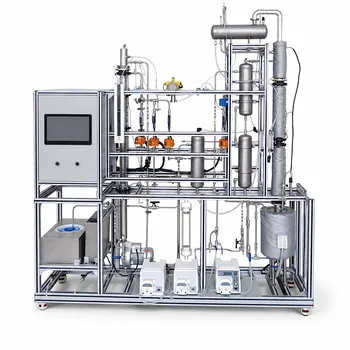
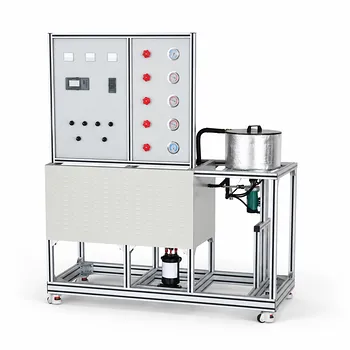
Teaching complex thermodynamic limits and process economics requires hands-on, reliable equipment. LABPARK provides premium Educational and Vocational Unit Operations Pilot Plants in chemical engineering, bioprocess & biotech, and environmental & water treatment for universities, research institutes, and enterprises.
Equip your students and researchers with the tools to master gasification, syngas analysis, and efficiency optimization. Contact LABPARK today to find the perfect pilot plant solution for your institution!
Related Products
- Bench Scale Dual Column Gas Separation and Capture Educational Pilot Plant
- Carbon Dioxide Hydrogenation Methanol Synthesis Educational Unit Operations Pilot Plant
- Comprehensive Heat Transfer Coefficient Determination Educational Unit Operations Pilot Plant
- Methane Cracking Educational Unit Operations Pilot Plant
- Carbon Dioxide Absorption and Desorption Educational Pilot Plant for Carbon Capture Studies
People Also Ask
- What are the key thermodynamic considerations for gas mixture modeling? Expert Guide
- Why Do Flash Calculations Fail for Light-Gas Mixtures? Prevent Pilot Plant Simulation Errors
- What factors should be considered when choosing membrane materials for gas separation pilot plants? A Scale-Up Guide
- Why is Graham's Law critical for gas separation in pilot plants? Master Unit Operations Design
- How does the separation mechanism of gas permeation differ from liquid membrane processes? Pilot Plant Guide