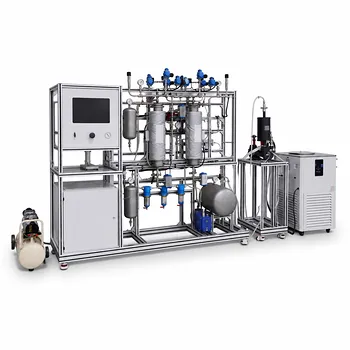
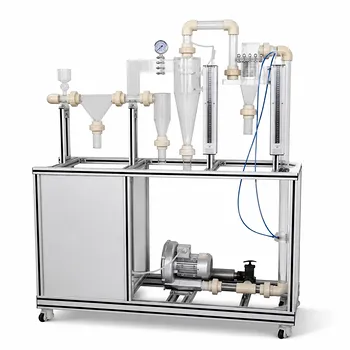
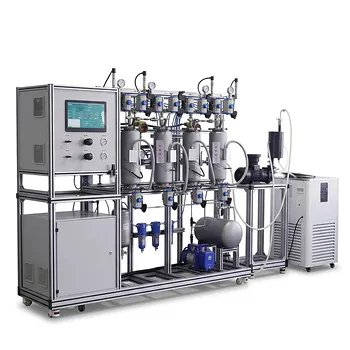
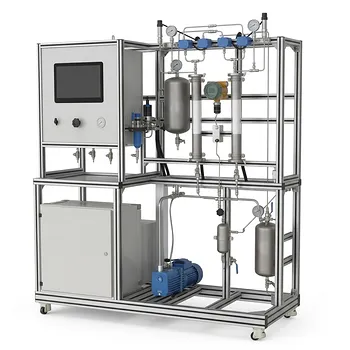
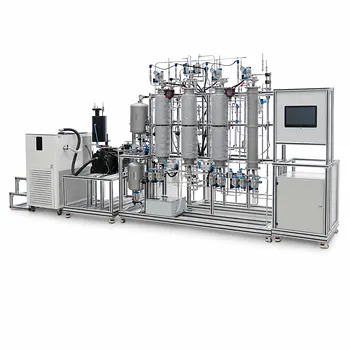
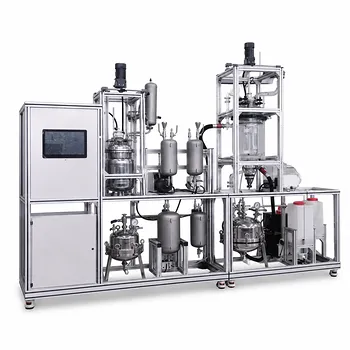
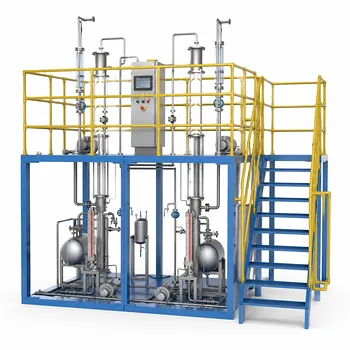
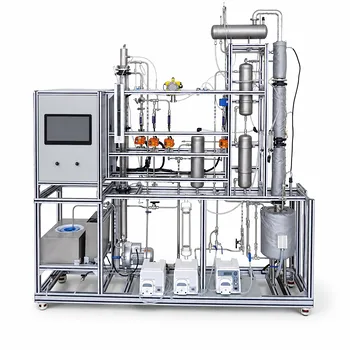
The fundamental difference lies in how molecules move through the membrane. Liquid membrane processes separate components primarily through physical sieving—using pores to block larger molecules and let smaller ones pass. Gas permeation through dense polymer membranes, however, relies on a solution-diffusion mechanism: gas molecules dissolve into the polymer, diffuse through its dense matrix, and then desorb on the low-pressure side. In a gas separation pilot plant, this is characterized by applying Fick’s Law, where the flux is tied to the product of solubility and diffusivity, and by measuring stage cut and selectivity while deliberately varying feed pressures and gas mixtures.
The real insight for an engineer is that gas permeation selectivity is not a simple size filter but a two‑step thermodynamic and kinetic process. Pilot‑scale experiments let you turn that theory into actionable data—plotting flux against partial pressure differences and mapping your membrane’s performance against well‑known limits like Robeson’s upper bound.
The Core Mechanism: Solution-Diffusion vs. Physical Sieving
How Liquid Membrane Processes Rely on Pore Size
Traditional liquid‑phase filtration—ultrafiltration, microfiltration, and even some nanofiltration—uses porous physical media.
The separation is straightforward: molecules smaller than the pores pass through; larger ones are retained. This is a size‑exclusion mechanism. The membrane acts like a molecular sieve, and performance is governed by the pore size distribution and the hydraulic pressure applied.
How Gas Permeation Dissolves and Diffuses Through Dense Polymers
Gas permeation membranes are dense—they have no permanent pores.
Separation happens in three steps: sorption of gas molecules into the high‑pressure side of the polymer, diffusion through the free volume between polymer chains, and desorption at the low‑pressure side. The overall driving force is a partial pressure difference, not a total pressure difference. This means selectivity is defined by the ratio of the products of solubility ($S$) and diffusivity ($D$) for each gas.
Characterizing the Separation in a Pilot Plant
Applying Fick’s Law to Quantify Flux
In a gas separation pilot plant, students and researchers measure the actual gas flux ($J_G$) across the membrane.
The foundational equation is derived from Fick’s Law:
$J_G = \frac{P_M \cdot \Delta p}{\delta_m}$
Here, $P_M$ is the permeability coefficient —the product of the diffusion coefficient ($D$) and the solubility coefficient ($S$). $\Delta p$ is the partial pressure difference between the feed and permeate sides, and $\delta_m$ is the membrane thickness. By holding two variables constant and measuring flux, you can experimentally determine the permeability of a specific gas through the membrane.
Manipulating Pressure to Control Selectivity
The most accessible lever in a pilot plant is the pressure ratio between the high‑pressure feed side and the low‑pressure permeate side.
Increasing the feed pressure directly raises the partial pressure difference, which boosts flux. But selectivity is also affected: the relationship isn’t linear because gas solubility in polymers often follows Henry’s law, while diffusion coefficients can vary with concentration. By systematically varying these pressures and analyzing the composition of both retentate and permeate, students can build a pressure‑selectivity curve that reveals the membrane’s true operating window.
Measuring Stage Cut and Separation Factor
Stage cut is the fraction of the feed that permeates through the membrane. A very low stage cut gives you high purity but sacrifices product recovery.
The separation factor (selectivity) is the ratio of gas compositions in the permeate and retentate. In a pilot plant, you can run experiments with binary gas mixtures—hydrogen and nitrogen, carbon dioxide and methane—and measure these two parameters at different flow rates. This directly simulates industrial tasks like hydrogen recovery from ammonia tail gas or CO₂ removal from natural gas using cellulose acetate membranes.
Plotting Against Robeson’s Upper Bound
A pilot plant offers the perfect data set to teach a critical concept: the trade‑off between permeability (flux) and selectivity.
When you plot your experimentally determined oxygen/nitrogen selectivity against oxygen permeability on a log‑log graph, you’ll find that no polymer exceeds an empirical ceiling known as Robeson’s upper bound. By then testing a modern, tailor‑made polymer membrane and comparing it to an older material, you can visually demonstrate how advances in polymer chemistry have pushed this bound outward—linking material science directly to process efficiency.
Understanding the Trade‑offs
The Flux‑Selectivity Conflict
High permeability usually means low selectivity, and vice versa. In a pilot plant, you can observe this directly: when you modify operating conditions to maximize flux (by increasing pressure or temperature), the separation factor often drops. This is inherent to the solution‑diffusion mechanism. Dense membranes that let gases diffuse more freely also tend to lose their ability to discriminate between similar‑sized molecules.
Temperature Constraints and Material Limits
Polymer‑based gas separation membranes are temperature‑sensitive. Most must operate below 100°C to avoid thermal degradation and structural collapse. While raising the temperature can improve diffusion rates and thus flux, it simultaneously reduces solubility—and may damage the membrane permanently. Your pilot‑plant data must therefore be collected within a safe thermal window, forcing you to balance the desire for higher throughput against material durability and separation accuracy.
Making the Right Choice for Your Research or Teaching Goal
The best way to use a gas separation pilot plant depends on what you need to prove or teach.
- If your primary focus is teaching the fundamental mechanism: Start with a single gas to verify Fick’s Law, then move to a binary mixture and have students plot selectivity against the pressure ratio. This directly links the solution‑diffusion theory to tangible measurements.
- If your primary focus is membrane material screening: Operate at multiple temperatures and pressures, and map each run against Robeson’s upper bound. This clearly shows which polymer offers the best promise for scaling up.
- If your primary focus is simulating an industrial separation: Choose a realistic gas pair like CO₂/CH₄ and precisely measure stage cut and separation factor at varying flow rates. Use these data points to calculate the required membrane area and energy consumption for a scaled‑up unit.
Choosing the right experimental constraints transforms a pilot plant from a simple teaching tool into a true test bed for separation innovation.
Summary Table:
| Feature | Gas Permeation | Liquid Membrane Processes |
|---|---|---|
| Separation Mechanism | Solution-diffusion (sorption, diffusion, desorption) | Physical sieving (size-exclusion) |
| Membrane Structure | Dense (no permanent pores) | Porous (defined pore size distribution) |
| Driving Force | Partial pressure difference | Hydraulic pressure / concentration gradient |
| Characterization Metrics | Permeability, selectivity, stage cut, Robeson's upper bound | Pore size, water flux, rejection rate |
Bring Advanced Membrane Theory to Life with LABPARK
Looking to demonstrate complex separation mechanisms like gas permeation and solution-diffusion in your curriculum or research? LABPARK provides state-of-the-art Educational and Vocational Unit Operations Pilot Plants in chemical engineering, bioprocess & biotech, and environmental & water treatment.
We help universities, research institutes, and enterprises bridge the gap between theory and industrial practice with hands-on, robust pilot systems.
Contact LABPARK today to discover how we can customize the perfect pilot plant for your lab!
Related Products
- Bench Scale Dual Column Gas Separation and Capture Educational Pilot Plant
- Gas-Solid Heterogeneous Separation Demonstration Educational Unit Operations Pilot Plant
- Multi-Component Gas Pressure Swing Adsorption Pilot Plant for Unit Operations Education
- Pressure Swing Adsorption Educational Unit Operations Pilot Plant
- Educational Pressure Swing Adsorption Ethylene Capture Unit Operations Pilot Plant
People Also Ask
- What are the key thermodynamic considerations for gas mixture modeling? Expert Guide
- Which membrane materials are commonly used in gas separation pilot plants, and how is membrane fouling typically managed?
- Why Are Binary Interaction Parameters Critical for Gas Separation Pilot Plants? Avoid Costly Failures
- Why is Graham's Law critical for gas separation in pilot plants? Master Unit Operations Design
- How to study single-stage membrane separation limitations using a pilot plant? Lab Guide