Here’s exactly what you need to know:
By running a gas separation pilot plant with an acid gas mixture like CO₂/CH₄, students can directly observe the thermodynamic dilemma of single-stage membranes—the inability to simultaneously achieve high product purity in both the permeate and retentate streams while maintaining high recovery. This hands-on approach turns an abstract limitation into a measurable reality.
A single membrane stage always forces a trade-off: chasing high methane purity in the retentate sacrifices the CO₂ purity you can collect, and maximizing CO₂ removal slashes recovery. The pilot plant makes this inescapable compromise visible, giving students a concrete foundation for evaluating when and why multi-stage systems or hybrid processes become necessary.
Setting the Stage: The Core Experiment
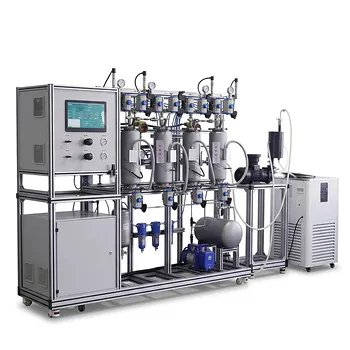
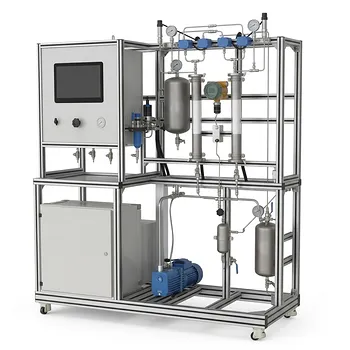
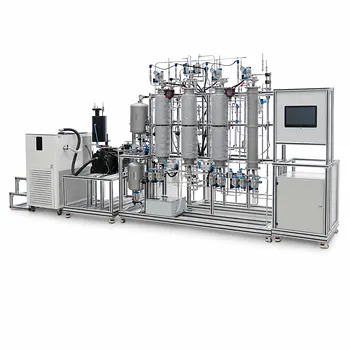
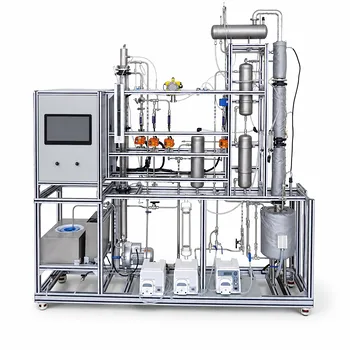
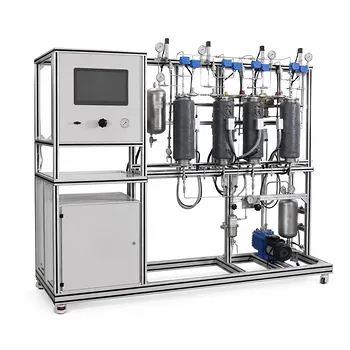
The journey begins by replicating a realistic acid gas separation. Using a gas separation pilot plant equipped with a hollow-fiber membrane module, students feed a mixed stream under controlled pressure and flow. The module splits the feed into a permeate (rich in the faster-permeating acid gas like CO₂) and a retentate (enriched in the slower gas like methane).
Why CO₂/CH₄ is the Ideal Test Case
Natural gas purification mirrors a classic industrial challenge: pipeline specifications demand less than 2% CO₂ in the sales gas. The pilot plant allows students to target that benchmark while simultaneously trying to produce a valuable, high-purity CO₂ permeate. The tension between these goals is where the limitation emerges.
By gradually increasing the recovery rate—often through adjusting the feed flow, permeate pressure, or active membrane area—students watch the retentate purity climb, only to see the permeate’s CO₂ concentration plummet. That direct observation anchors the theory.
How to Surface the Single-Stage Limitation
A well-designed lab protocol turns the pilot plant into an investigative tool. The key is to systematically vary operating parameters and record exactly what happens to purity and recovery.
Manipulating Stage Cut and Driving Force
The stage cut—the fraction of feed that becomes permeate—is the primary lever. By throttling the permeate outlet valve or altering the feed pressure, students can walk the system through a range of stage cuts. A low stage cut yields a high-purity retentate but leaves most of the methane in the permeate, killing recovery. Pushing the stage cut higher recovers more methane, but CO₂ concentration in the retentate starts to climb because the partial pressure driving force for CO₂ dwindles as it gets removed.
Plotting the Trade-off Directly
Using the pilot plant’s integrated sensors and data acquisition, students can build purity vs. recovery curves in real time. They’ll quickly see the inevitable shape: as retentate purity reaches pipeline grade, the recovery number drops off sharply. Plotting this data against the membrane’s selectivity and permeability characteristics—and even against Robeson’s upper bound—shows that no single material can break the constraint; it’s a thermodynamic fact, not a material flaw.
Measuring Permeate Quality Degradation
Students should also sample the permeate composition as they chase higher retentate purity. Initially, the permeate can be highly concentrated in CO₂. But at higher recoveries, methane slip into the permeate becomes unavoidable, diluting the CO₂ product. This dual-stream degradation is the practical face of the limitation.
Bridging Measurement to Understanding
Raw data only tells half the story. The pilot plant’s value is in translating measurements into engineering insight.
Quantifying the Cost of the Limitation
Students can perform simple stage-cut calculations and mass balances to determine how much compression energy would be wasted recycling a low-purity permeate. They can link the limited single-stage performance to process economics—the capital and operating expense of adding a second membrane stage or an amine absorption column. The pilot plant thus turns a theoretical limitation into a design constraint with a price tag.
Comparing Against Selective Absorption
Since acid gases are often removed by chemical absorption, the pilot plant environment can be extended by running parallel experiments on a gas absorption column (also available in many unit ops labs). Students see that while amines can easily reach sub-2% CO₂ in the treated gas, they require substantial energy for solvent regeneration. This direct head-to-head makes the single-stage membrane’s recovery ceiling tangible and justifies hybrid flowsheets.
Understanding the Trade-offs
No experimental study of membrane limitations is complete without looking at the physical phenomena that reinforce them. These are not just numbers; they are dynamic behaviors that erode performance over time.
The Selectivity-Permeability Trade-off
All polymeric membranes exhibit an inverse relationship between selectivity and permeability. A highly selective membrane will deliver excellent purity at an agonizingly slow flux, requiring enormous membrane area. A high-flux membrane floods you with product but offers poor separation. In a single-stage unit, you cannot optimize both; the pilot plant lets students run two different membrane types back-to-back and watch this trade-off flatten any hope of an easy fix.
Fouling and Compaction Amplify the Problem
Industrial gas streams are never perfectly clean. The pilot plant can simulate progressive membrane fouling by introducing trace contaminants or simply operating over extended periods. As fouling builds, effective selectivity drops, and the retentate’s purity ceiling shifts downward. At high feed pressures, physical compaction of the membrane’s composite layers further reduces flux and alters selectivity. Students can measure the decline in separation performance over time, recognizing that the ideal single-stage model is optimistic at best.
The Scale-up Reality Check
Membranes defy traditional economies of scale—their scale-up factor is approximately 1. Doubling capacity means doubling the number of modules in parallel, not building a larger single unit. The pilot plant demonstrates this by showing that pushing a single module to higher feed rates simply raises pressure drop and degrades purity. It forces the conclusion that a single “bigger stage” is not a solution; the real answer lies in staging with interstage compression.
Making the Right Choice for Your Lab or Project
Not every student exercise needs to dig into all these facets at once. Focus on what solves your learning or research goal.
- If your primary focus is revealing the purity-recovery trade-off: Design an experiment where you systematically vary stage cut at constant feed composition and record both retentate and permeate compositions. Plot the curves and calculate the methane loss in the permeate at pipeline-grade retentate conditions.
- If your primary focus is comparing membrane materials: Run two modules with known selectivity differences (e.g., a standard polysulfone vs. a more advanced polymer) under identical pressure and flow. Overlay your results on Robeson’s upper bound and quantify how much closer each gets to the ideal single-stage outcome—neither will reach it.
- If your primary focus is process economics and integration: Use the pilot plant data to size a second membrane stage and estimate the required interstage compression power. Contrast this with the solvent heating and cooling loads needed for an absorption column treating the same feed.
- If your primary focus is real-world operational degradation: Operate the pilot unit for a full day at constant conditions and monitor the drift in selectivity and flux. Introduce a mild impurity to accelerate fouling, then use the declining data to model membrane lifetime and replacement cost.
By making the limitation tangible, your pilot plant transforms a textbook equation into a design philosophy—showing that the only way past a single stage’s ceiling is to stop relying on a single stage.
Summary Table:
| Study Parameter | Physical Phenomenon | Key Educational Insight |
|---|---|---|
| Stage Cut | Purity vs. recovery trade-off | Proves thermodynamic limits of single-stage separation |
| Membrane Type | Selectivity vs. permeability | Teaches material limits relative to Robeson's upper bound |
| Operating Time | Fouling and layer compaction | Demonstrates real-world flux decline and performance degradation |
| Feed Flow Rate | Pressure drop and purity degradation | Highlights why scaling up requires multi-stage configurations |
Bring Real-World Chemical Engineering to Your Lab
Equip your students and researchers with the tools they need to master complex process dynamics. LABPARK provides state-of-the-art Educational and Vocational Unit Operations Pilot Plants in chemical engineering, bioprocess & biotech, and environmental & water treatment designed specifically for universities, research institutes, and enterprises.
Ready to elevate your engineering lab with hands-on learning systems? Contact us today to request a quote!
Related Products
- Bench Scale Dual Column Gas Separation and Capture Educational Pilot Plant
- Gas-Solid Heterogeneous Separation Demonstration Educational Unit Operations Pilot Plant
- Multi-Component Gas Pressure Swing Adsorption Pilot Plant for Unit Operations Education
- Pressure Swing Adsorption Educational Unit Operations Pilot Plant
- Educational Pressure Swing Adsorption Ethylene Capture Unit Operations Pilot Plant
People Also Ask
- What are the key thermodynamic considerations for gas mixture modeling? Expert Guide
- Why is Graham's Law critical for gas separation in pilot plants? Master Unit Operations Design
- Why Are Binary Interaction Parameters Critical for Gas Separation Pilot Plants? Avoid Costly Failures
- Which membrane materials are commonly used in gas separation pilot plants, and how is membrane fouling typically managed?
- How does the separation mechanism of gas permeation differ from liquid membrane processes? Pilot Plant Guide