The accuracy of your pilot plant’s separation performance predictions hinges on a few critical thermodynamic choices. When modeling phase equilibrium for gas mixtures—like methane–carbon dioxide or light hydrocarbons—in distillation and gas separation pilot plants, the essential considerations are selecting a robust equation of state (EOS), calibrating binary interaction parameters against experimental data, and carefully handling computational convergence near the critical region. These elements directly determine whether your model’s phase compositions, column profiles, and energy balances reflect reality.
Successful modeling of gas mixture phase equilibrium in a pilot plant is a three‑legged stool: you need a reliable equation of state (e.g., Peng‑Robinson), fitted binary interaction parameters that correct for molecular asymmetry, and strategies to avoid numerical failure in the critical region. Ignore one, and the entire simulation becomes unreliable.
The Foundation: Choosing the Right Equation of State and Calibration
Why Peng‑Robinson and Modified BWR Dominate Gas Mixture Modeling
For non‑polar and slightly polar gas mixtures common in light‑hydrocarbon and CO₂ separations, cubic equations of state like Peng‑Robinson (PR) or more complex formulations like the modified Benedict‑Webb‑Rubin (BWR) are the workhorses. They provide a mathematically efficient framework to calculate fugacities in both vapor and liquid phases, which is the backbone of any VLE calculation.
In a pilot‑scale distillation column processing methane–ethane–propane, the PR EOS can capture phase envelopes with sufficient accuracy for engineering purposes, especially when tuned with mixture‑specific data.
The Indispensable Role of Binary Interaction Parameters ($k_{ij}$)
No universal EOS can perfectly describe the asymmetric forces between molecules of different size, shape, or polarity. For example, an isobutane–carbon dioxide pair or a methane–hydrogen sulfide system exhibits non‑ideal behavior that the pure EOS framework cannot reproduce without adjustment.
Introducing an adjustable binary interaction parameter ($k_{ij}$) into the mixing rules directly aligns the calculated phase envelope with experimental pilot plant measurements. In practice, you regress these parameters from binary VLE data, and then use them in multicomponent simulations—a critical step that transforms a generic EOS into a tool that mirrors your actual feed.
Navigating the Critical Region and Computational Challenges
Convergence Difficulties at High Pressures
Many gas separation pilot plants operate near the mixture’s critical point, where the distinction between liquid and vapor properties fades and the Jacobian matrices in flash calculations become nearly singular. This leads to frequent convergence failures in standard algorithms.
Engineers and researchers must account for these difficulties by employing pressure‑step damping, switching to more robust root‑finding methods, or using specially formulated cubic EOS implementations that stabilize convergence across the critical locus. Without these precautions, the simulation will stall just when the most valuable data—near the critical region—are being collected.
Ensuring Data Quality and Model Validation
Why Thermodynamic Consistency Tests Are Non‑Negotiable
Pilot plant data always contain random and systematic errors. While random scatter is visible on a y‑x plot, systematic errors from faulty sensors or calibration drifts can go unnoticed and poison your fitted $k_{ij}$ values.
Thermodynamic consistency tests, such as the Herrington area test based on the Gibbs‑Duhem equation, provide a rigorous check on isobaric VLE data. For mixtures with a wide boiling range, ignoring the enthalpy of mixing when applying these tests can lead to false “failure” signals. Performing such checks ensures that only sound data enters your model calibration, protecting the integrity of your pilot plant’s mass‑ and energy‑balance calculations.
Extending the Framework for Complex, Multicomponent Streams
Simplifying Complex Feeds with Pseudocomponents
Real light‑hydrocarbon feeds may contain dozens of isomers that are impractical to model individually. Grouping them into pseudocomponents based on molecular families (paraffins, naphthenes, etc.) and estimating their critical temperature ($T_c$) and pressure ($P_c$) from molar averages dramatically reduces system dimensionality.
This approach introduces an acceptable trade‑off between detail and computational load, making pilot plant simulation tractable without sacrificing the overall phase behavior description.
Handling Supercritical Gases in Absorption and Stripping
If your gas separation pilot plant includes an absorption unit (e.g., removing CO₂ from methane using a physical solvent), you face a situation where CO₂ may exist above its critical temperature in the liquid phase. Extrapolating pure‑liquid fugacities beyond $T_c$ yields gross errors.
The correct approach is to adopt Henry’s constants as the standard‑state fugacity and use unsymmetrically normalized activity coefficients. This framework ensures that gas solubility predictions match experimental observations, enabling reliable mass transfer and efficiency calculations.
Managing Polar and Aqueous Mixtures
Although the primary reference focuses on non‑polar gases, many pilot‑scale separations encounter water, alcohols, or other polar species. In such systems, a simple cubic EOS alone is insufficient.
The vapor phase can still be treated with a modified Redlich‑Kwong EOS (like Soave‑RK), but the liquid phase requires an activity coefficient model (Wilson, NRTL, or UNIQUAC) to capture strong non‑idealities. For example, a polar binary pair like acetaldehyde–ethanol is best described with the Wilson equation. When water is present with hydrocarbons, an additional fitted binary interaction parameter for water must be introduced into the PR EOS to reproduce the highly non‑ideal phase envelopes.
Understanding the Trade‑offs and Avoiding Common Pitfalls
- Predictive power vs. simplicity: Relying on a fully predictive model like UNIFAC avoids the need for experimental binary parameters, but at the cost of lower accuracy for specific, critical separations. Conversely, using many fitted $k_{ij}$ values can lead to overfitting and poor extrapolation outside the calibration range.
- Pseudocomponents reduce resolution: While grouping speeds simulation, it discards precise information about individual isomers that could affect tray efficiency or product purity targets.
- Critical‑region convergence is never “automatic”: Even robust commercial simulators may require custom initialization, limiting the ability of a pilot plant operator to quickly rerun what‑if scenarios without deep thermodynamic knowledge.
- Ignoring systematic errors invalidates everything: Fitting a model to inconsistent data produces a model that may coincidentally match some points but will fail under slightly different conditions—a trap that wastes valuable campaign time.
Making the Right Choices for Your Pilot Plant Operation
The optimal thermodynamic approach depends on the specific goals and constraints of your pilot‑scale work.
- If your primary focus is accurate VLE prediction for a simple gas mixture (e.g., methane‑CO₂): Start with the Peng‑Robinson EOS and regress a single $k_{ij}$ from reliable binary data. Validate using a consistency test.
- If your primary focus is scaling up to a complex, multicomponent natural gas stream: Implement pseudocomponent grouping with molar‑averaged critical properties and fit binary parameters for the key non‑ideal pairs.
- If your primary focus is modeling an absorption column with supercritical solutes (CO₂, H₂S): Transition to a Henry’s law framework for the solute in the liquid phase; never extrapolate pure‑liquid fugacities above $T_c$.
- If your primary focus is handling polar or aqueous contaminants: Combine an EOS vapor model with a Wilson or NRTL liquid model, and for water‑hydrocarbon sub‑systems, secure the necessary binary interaction parameter for water from literature.
- If your primary focus is building a defendable basis for scale‑up: Run a Herrington or similar consistency test on all experimental pilot plant data before using them to calibrate any model.
By weaving these considerations together, you transform your pilot plant from a mere data collector into a rigorous testbed where thermodynamic theory and real‑world operation inform each other, de‑risking the eventual industrial design.
Summary Table:
| Key Consideration | Application Scenario | Best Practice & Solution |
|---|---|---|
| EOS Selection | Non-polar & light hydrocarbons | Use Peng-Robinson (PR) or modified BWR |
| Binary Calibration ($k_{ij}$) | Asymmetric or non-ideal pairs | Regress parameters from experimental VLE data |
| Critical Region Convergence | High-pressure operations | Apply pressure-step damping & robust solvers |
| Polar/Aqueous Mixtures | Water, alcohols, or polar contaminants | Combine EOS (vapor) with NRTL/Wilson (liquid) |
Bring Thermodynamic Theory to Life with LABPARK
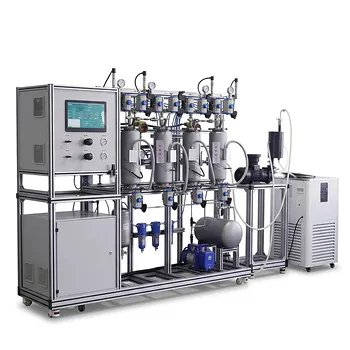
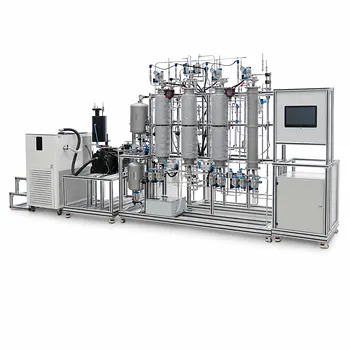
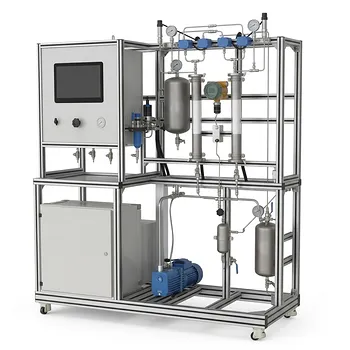
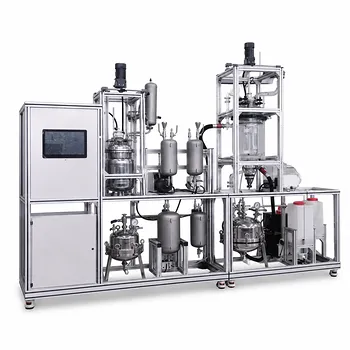
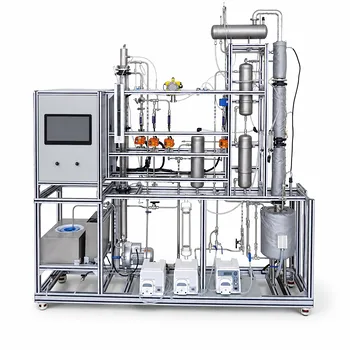
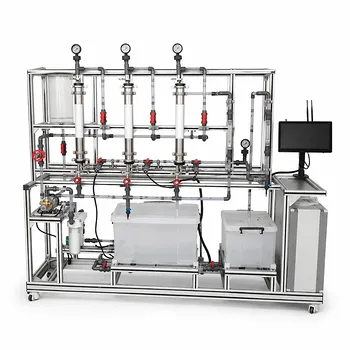
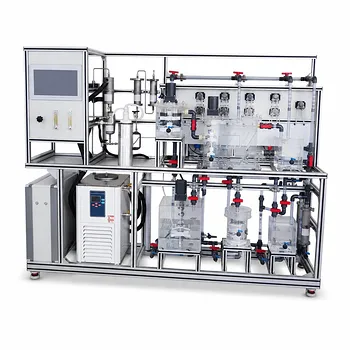
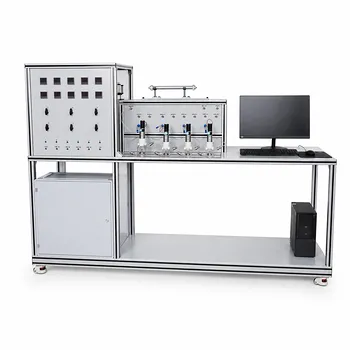
Translating complex phase equilibrium models into physical operations requires reliable, high-precision equipment. LABPARK provides top-tier Educational and Vocational Unit Operations Pilot Plants in chemical engineering, bioprocess & biotech, and environmental & water treatment. Tailored for universities, research institutes, and enterprises, our pilot plants empower you to validate thermodynamic data and run precise separation processes.
Contact LABPARK today to discover how we can support your research and education goals!
Related Products
- Bench Scale Dual Column Gas Separation and Capture Educational Pilot Plant
- Gas-Solid Heterogeneous Separation Demonstration Educational Unit Operations Pilot Plant
- Multi-Component Gas Pressure Swing Adsorption Pilot Plant for Unit Operations Education
- Educational Pressure Swing Adsorption Ethylene Capture Unit Operations Pilot Plant
- Pressure Swing Adsorption Educational Unit Operations Pilot Plant
People Also Ask
- Which membrane materials are commonly used in gas separation pilot plants, and how is membrane fouling typically managed?
- Why is Graham's Law critical for gas separation in pilot plants? Master Unit Operations Design
- How does the separation mechanism of gas permeation differ from liquid membrane processes? Pilot Plant Guide
- Why Are Binary Interaction Parameters Critical for Gas Separation Pilot Plants? Avoid Costly Failures
- How to study single-stage membrane separation limitations using a pilot plant? Lab Guide