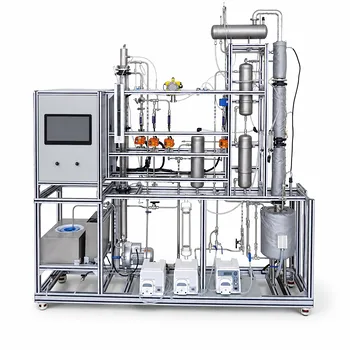
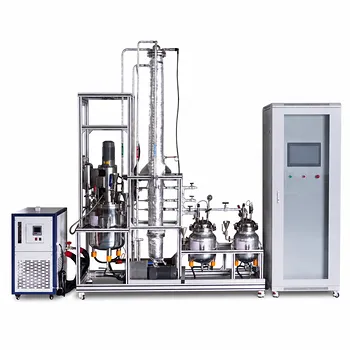
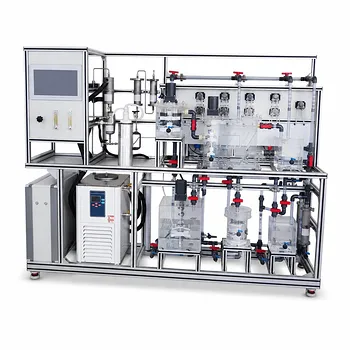
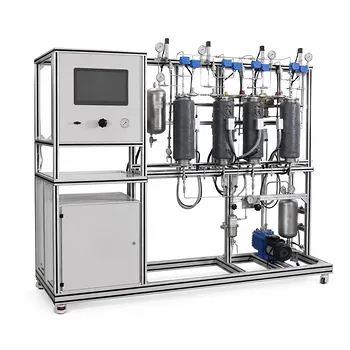
The rate at which a gas moves through a porous barrier isn't random—it's a predictable function of its molar mass. This is the core of Graham's Law, and in chemical engineering pilot plants, it transforms an abstract equation into a tangible demonstration of separation science. The law states that under constant temperature and pressure, the rate of gas effusion is inversely proportional to the square root of its molar mass, meaning lighter molecules travel faster. This simple relationship is the conceptual bedrock for understanding, designing, and optimizing gas separation unit operations—turning a small pilot-scale experiment into a scalable industrial reality.
Graham’s Law is critical not because it’s a perfect predictor, but because it provides the fundamental rationale for diffusion-based separation. It explains why thousands of stages are needed to separate similar-weight molecules, gives students a quantitative tool to evaluate efficiency, and lays the groundwork for mastering more complex mass transfer models.
The Foundational Role of Graham's Law in Gas Separation Education
A Universal Principle for Separation by Molecular Speed
Graham’s Law gives students and researchers a first-principles reason why gas mixtures separate at all. It shows that mixture components inherently move at different speeds through a porous medium or membrane. This is the kinetic energy equalization effect: at a given temperature, lighter molecules possess higher average velocities, so they strike a barrier and pass through it more frequently. In a pilot plant, this isn't just a textbook fact—it’s visible as one gas enriches on the permeate side while the other lags behind.
Quantifying the Theoretical Enrichment Factor
The law’s mathematical form provides an immediate, calculable separation factor ( \alpha \approx \sqrt{M_2 / M_1} ), where M₂ > M₁. This allows students to predict, for example, that hydrogen (M=2) will effuse about four times faster than oxygen (M=32) under identical conditions. Pilot plant experiments then let them confront reality: measured separation efficiency deviates from the ideal due to pressure drops, concentration polarization, or non-ideal flow. That discrepancy is the birthplace of deeper engineering insight.
Why Pilot Plants Use Multi-Stage Configurations
The primary reference’s example of uranium hexafluoride isotopic separation is instructive. UF₆-235 and UF₆-238 have a molar mass ratio so close to 1 that the theoretical separation per stage is minuscule. Graham’s Law makes this limitation explicit: when the square root of the mass ratio approaches unity, a single pass yields negligible enrichment. That is why pilot plants incorporate cascades of hundreds or thousands of diffusion stages. Students learn not only the “why” of staging but also the capital and energy costs that flow directly from this fundamental kinetic limitation.
Bridging the Law to Mass Transfer and Diffusion Coefficients
From Effusion to Real Diffusion in a Pilot Plant
Graham’s Law strictly describes effusion through a pore much smaller than the mean free path. In a pilot-scale membrane or gas absorption column, the transport mechanism is often more complex, involving bulk diffusion through a boundary layer. However, the same square-root mass dependency appears in the molecular diffusion coefficient ( D ). The supplementary reference highlights that diffusion coefficients govern mass transfer in gas absorption, distillation, and liquid-liquid extraction—all core unit operations demonstrated in pilot plants.
Connecting Theory to Measurable Coefficients
Students use empirical correlations like Fuller-Schettler-Giddings to estimate gas-phase diffusion coefficients. These correlations embed Graham’s insight: the diffusion coefficient scales inversely with the square root of the component molar masses and the molecular volume of the mixture. So even when the flow regime moves beyond simple Knudsen diffusion, the underlying mass-motion relationship remains. Pilot plant experiments that measure concentration profiles and separation rates then validate these coefficients, teaching students that Graham’s Law is a limiting case of a broader mass-transfer framework.
Making the Rate-Limiting Step Visible
In many unit operations, diffusion across a stagnant film or within a porous catalyst particle is the bottleneck. By applying Graham’s Law-derived diffusion rates, students can calculate theoretical flux and compare it to actual throughput. This turns the pilot plant into a diagnostic tool: if the measured separation rate deviates significantly from the predicted rate, it flags resistances like liquid film control, pore constriction, or temperature gradients that must be addressed during scale-up.
Understanding the Trade-offs and Limitations
The Ideal Gas Assumption
Graham’s Law assumes ideal gas behavior—negligible molecular volume and no intermolecular forces. At high pressures or low temperatures common in pilot plants, these assumptions break down. Real gas deviations can distort the simple mass-velocity relationship, making the law a starting point rather than a definitive design equation. Students must learn when corrections are needed.
Pore Diameter and Transport Regime Constraints
If the membrane pores are large enough for viscous (Poiseuille) flow, separation by molecular weight differences can be swamped by non-selective bulk flow. Pilot plants demonstrate this pitfall vividly: a slight increase in pore size or pressure differential can collapse the separation efficiency, highlighting the need for tight process control.
Impact of Concentrated Mixtures and Counter-Diffusion
Graham’s Law for effusion describes independent fluxes. In real diffusion processes, the counter-movement of the heavier species can slow the lighter one through collisions. This coupled diffusion effect is absent from the basic law, so students using pilot data will see that separation factors rarely reach the ideal ( \sqrt{M_2/M_1} ) value. This gap is the perfect segue into teaching Fick’s Law and the Maxwell-Stefan equations.
Educational Pitfall: Oversimplification
When used in isolation, Graham’s Law might suggest that any gas pair can be separated simply by weight. A pilot plant quickly corrects this: it demonstrates that a viable industrial process also depends on membrane selectivity, permeance, and mechanical durability, not just diffusion rate ratios. The true lesson is that Graham’s Law provides the thermodynamic driving force, but real-world separation is a race between diffusion and competing transport phenomena.
Making the Right Choice for Your Pilot Plant Learning Goals
After understanding how Graham’s Law anchors gas separation demonstrations, you can tailor your focus to what matters most in your unit operations lab.
- If your primary focus is mastering the fundamentals: Use a single membrane test cell to measure flux ratios for a binary mixture like He/N₂ and directly compare with ( \sqrt{M_{N2}/M_{He}} ). This bridges kinetic theory to a tangible pressure or composition change.
- If your primary focus is scaling up separation processes: Operate a multi-stage cascade and use Graham’s Law to calculate the minimum number of stages for a target purity. Then analyze how pressure drop and back-mixing drive the actual stage count higher.
- If your primary focus is mass transfer coefficient estimation: Run a gas absorption column and compute diffusion coefficients from correlations. Show how the square-root mass dependency in D still shapes the design of tray spacing and column height.
- If your primary focus is troubleshooting equipment performance: Compare on-stream separation data to the theoretical rate predicted by Graham’s Law. A large shortfall often reveals a pore size shift, concentration polarization, or a leak—key skills for an industrial operator.
Graham’s Law may be simple, but within a pilot plant it becomes the thread that connects kinetic theory, staging economics, and mass transfer reality—equipping you with the insight to separate fact from friction.
Summary Table:
| Key Aspect | Role in Pilot Plant Learning | Real-World Limitation / Deviation |
|---|---|---|
| Separation Factor | Predicts enrichment based on molecular weight ratios (e.g., $He/N_2$). | Real gases deviate at high pressures and low temperatures. |
| Multi-Stage Staging | Explains why cascades are needed for gases with close molar masses. | Ideal separation factors are rarely achieved due to back-mixing. |
| Mass Transfer | Connects kinetic molecular speed to diffusion coefficients ($D$). | Simplified effusion models ignore viscous flow in large pores. |
| Flow Regimes | Demonstrates the difference between effusion and bulk transport. | Pressure drops and concentration polarization lower overall efficiency. |
Scale Up Your Chemical Engineering Lab with LABPARK
Translating thermodynamic theory like Graham's Law into practical knowledge requires robust, high-performance equipment. LABPARK provides advanced Educational and Vocational Unit Operations Pilot Plants across chemical engineering, bioprocess & biotech, and environmental & water treatment.
Tailored for universities, research institutes, and enterprises, our modular pilot plants empower students and researchers to analyze mass transfer, optimize gas separation, and master process control.
Ready to elevate your training and research capabilities? Contact LABPARK today to discuss your laboratory specifications and request a customized quote!
Related Products
- Bench Scale Dual Column Gas Separation and Capture Educational Pilot Plant
- Gas-Solid Heterogeneous Separation Demonstration Educational Unit Operations Pilot Plant
- Multi-Component Gas Pressure Swing Adsorption Pilot Plant for Unit Operations Education
- Pressure Swing Adsorption Educational Unit Operations Pilot Plant
- Educational Pressure Swing Adsorption Ethylene Capture Unit Operations Pilot Plant
People Also Ask
- What are the key thermodynamic considerations for gas mixture modeling? Expert Guide
- How does the separation mechanism of gas permeation differ from liquid membrane processes? Pilot Plant Guide
- Which membrane materials are commonly used in gas separation pilot plants, and how is membrane fouling typically managed?
- Why Are Binary Interaction Parameters Critical for Gas Separation Pilot Plants? Avoid Costly Failures
- How to study single-stage membrane separation limitations using a pilot plant? Lab Guide