Knowledge Chemical Engineering Education How does fluid friction affect temperature changes during adiabatic gas expansion? Real vs. Ideal Impacts
Author avatar

Tech Team · LABPARK

Updated 5 days ago

How does fluid friction affect temperature changes during adiabatic gas expansion? Real vs. Ideal Impacts


Fluid friction fundamentally alters the thermal outcome of adiabatic gas expansion in pilot plants.
In an ideal, friction-free expansion, the gas performs work using solely its internal energy, producing a steep temperature drop. In real pilot‑plant piping and valves, however, irreversible fluid friction converts kinetic energy into heat that the gas reabsorbs. This internal heat source offsets much of the adiabatic cooling, resulting in a significantly smaller net temperature decrease than the isentropic case predicts.

In pilot‑scale operations, fluid friction acts as a hidden heat source during gas expansion. The energy dissipated by eddies, shear, and flow obstructions returns to the fluid, partially cancelling the cooling effect. This can slash the temperature drop by 80 % or more, directly influencing downstream processes such as gas‑liquid absorption where temperature control is critical.

The Ideal vs. Real Adiabatic Expansion

Isentropic Expansion as the Reference Point

An ideal adiabatic (isentropic) expansion turns a gas’s internal energy directly into shaft work or kinetic energy. Because no heat crosses the system boundary, the temperature falls in strict accordance with the pressure ratio and the specific‑heat ratio.

Where Friction Changes the Game

Real pilot expansions—through throttling valves, long pipe runs, or sharp bends—experience viscous drag and turbulence. Fluid friction irreversibly degrades mechanical energy into heat. Even in a perfectly insulated system, that heat stays within the gas, so less net work is extracted and the temperature does not drop as far.

A Concrete Pilot‑Scale Example

Consider expanding air from 150 psia to 40 psia. The isentropic calculation anticipates a 189 °F temperature decay. In an actual pilot plant with typical friction, the measured drop was only 41 °F. That means fluid friction reduced the cooling effect by nearly 80 %—a dominant, not a minor, correction.

Why This Matters in Thermodynamic Unit Operations

The Ripple Effect on Gas‑Liquid Absorption

In absorption pilot plants, gas solubility in the liquid solvent drops as temperature rises. If friction upstream reduces the expansion cooling, the gas enters the absorber warmer. This lowers the mass‑transfer driving force, forcing operators to increase column height or solvent flow to meet the same removal target.

Could Friction Ever Be Beneficial?

Rarely, a muted temperature drop prevents undesirable condensation or line freezing. However, for most educational and research pilot plants, minimizing friction is essential to observe the clean thermodynamic behaviour that models predict. The real skill is learning to quantify friction’s thermal impact so that pilot data can be correctly interpreted and scaled.

Understanding the Trade-offs and Common Pitfalls

The Trap of Assuming Perfect Insulation

Many assume an adiabatic, well‑insulated line behaves isentropically. In reality, internal friction heats the gas even with zero heat loss to the environment. Ignoring this leads to large errors in predicted outlet temperature and can misguide students about the nature of real expansions.

Pressure Drop ≠ Temperature Drop

In a frictional expansion the pressure energy dissipates as heat, so the temperature change does not follow the simple isentropic relation. Relying on the ideal pressure‑temperature curve without accounting for Joule‑Thomson effects and irreversibilities yields misleading performance expectations.

Impact on Reaction Kinetics and Instrumentation

A downstream reactor or analyser that assumes the ideal‑expansion temperature can experience shifted reaction rates or sensor damage. Always validate the actual temperature profile by measuring across a known friction element before scaling up to full pilot runs.

Making the Right Choice for Your Pilot Plant

How you manage fluid friction’s thermal effect depends on your core objective.

  • If your primary focus is validating fundamental thermodynamic models: Minimise friction with large‑diameter piping, gradual bends, and low‑loss valves. Strive for near‑isentropic behaviour and use the residual deviation to teach irreversibility concepts.
  • If your primary focus is optimising gas‑liquid absorption or reaction efficiency: Factor friction‑induced warming into your energy balance. Consider downstream pre‑cooling or select a solvent that tolerates the higher gas temperature to keep mass transfer rates on target.
  • If your primary focus is scaling up from pilot data to a full‑scale plant: Quantify the friction‑reduced temperature drop in your bench‑scale rig. Use dimensionless numbers to correct for flow‑regime differences, ensuring your design basis accurately reflects the larger system’s thermal profile.

Understanding and accounting for fluid friction turns a confusing pilot‑plant result into a powerful design tool.

Summary Table:

Parameter Ideal (Isentropic) Expansion Real Expansion (with Friction)
Energy Conversion Internal energy converted purely to work/kinetic energy Kinetic energy is irreversibly degraded into heat
Temperature Drop Steep, maximum predicted cooling (e.g., -189°F) Significantly smaller cooling effect (e.g., -41°F)
Entropy Change Constant (Isentropic, $\Delta S = 0$) Increases due to irreversibilities ($\Delta S > 0$)
Process Impact Predictable downstream cooling Warmer outlet gas; reduces gas-liquid absorption efficiency

Optimize Your Thermodynamic Unit Operations with LABPARK

Bridging the gap between thermodynamic theory and real-world pilot plant performance is critical for successful research and education. LABPARK provides advanced Educational and Vocational Unit Operations Pilot Plants in chemical engineering, bioprocess & biotech, and environmental & water treatment.

Designed specifically for universities, research institutes, and enterprises, our pilot plants allow students and researchers to accurately measure, analyze, and manage real-world phenomena like fluid friction, heat transfer, and mass-transfer kinetics.

Ready to elevate your laboratory capabilities and prepare the next generation of engineers? Contact our experts today to find the perfect pilot plant solution for your institution.

Related Products

People Also Ask

Related Products

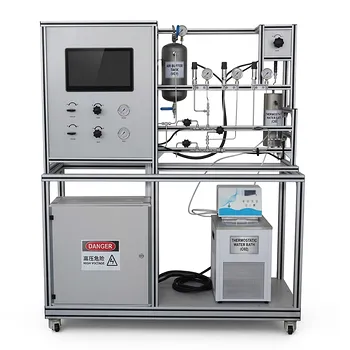
Throttling Effect Determination Educational Unit Operations Pilot Plant

Throttling Effect Determination Educational Unit Operations Pilot Plant

Investigate the Joule-Thomson throttling effect with this educational unit operations pilot plant. Designed for engineering students, it enables hands-on comparative analysis of adiabatic gas expansion using precise process control, interactive digital interface, and eco-friendly operation, ensuring safe repeatable thermodynamic experiments.

Dual Mode Heat Transfer Pilot Plant for Unit Operations Training

Dual Mode Heat Transfer Pilot Plant for Unit Operations Training

Engineering-scale dual-mode heat transfer pilot plant for hands-on unit operations training in chemical engineering. Features real and simulated modes, multiple heat exchanger types, comprehensive coefficient determination, and advanced process control with data acquisition for engineering students and researchers.

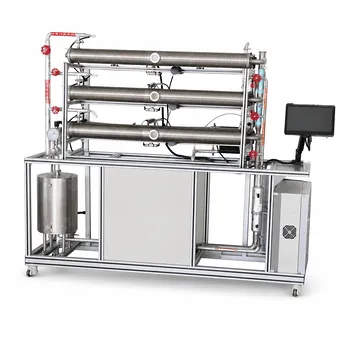
Three-Tube Heat Transfer Educational Pilot Plant for Unit Operations Training

Three-Tube Heat Transfer Educational Pilot Plant for Unit Operations Training

Three-tube heat transfer pilot plant for studying convective heat transfer enhancement and condensation. Allows comparison of smooth, corrugated, turbulent tubes, verifying empirical correlations. Ideal for chemical engineering education with safety and closed-loop steam recovery.

Comprehensive Multi-Modal Heat Transfer Unit Operations Pilot Plant for Engineering Training

Comprehensive Multi-Modal Heat Transfer Unit Operations Pilot Plant for Engineering Training

Comprehensive multi-modal heat transfer unit operations pilot plant for engineering training. Features four heat exchanger types, multi-media switching, and three operating modes. Hands-on experience in safety, optimization, and process control. Industrial-grade design with real-time data acquisition for chemical engineering labs.

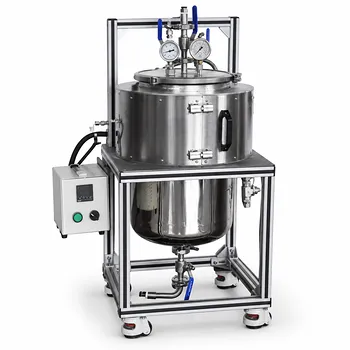
Hot Filtration Educational Unit Operations Pilot Plant Laboratory System

Hot Filtration Educational Unit Operations Pilot Plant Laboratory System

This integrated laboratory bench-scale hot filtration pilot plant enables students to study solid-liquid separation under thermal conditions, featuring a stainless steel vessel, removable heating jacket, and multi-layer filter plates for unit operations education, ideal for chemical engineering laboratory curriculum.

Multimodal Absorption and Desorption Pilot Plant for Unit Operations Training

Multimodal Absorption and Desorption Pilot Plant for Unit Operations Training

Multimodal absorption and desorption pilot plant for higher education labs. Bridges theory and industrial practice with transparent packed columns, three operational modes (real-material, simulated, semi-physical), and SCADA control. Students explore mass transfer, column hydraulics, and process control. Customizable.

Multi-Reactor Educational Pilot Plant for Reaction Engineering Unit Operations

Multi-Reactor Educational Pilot Plant for Reaction Engineering Unit Operations

Integrated bench-scale educational pilot plant for chemical engineering teaching featuring fixed bed fluidized bed and stirred tank reactors with web-based digital twin controls and safety interlocks for hands-on unit operations and reaction engineering comparative studies in one compact system.

Comprehensive Heat Transfer Coefficient Determination Educational Unit Operations Pilot Plant

Comprehensive Heat Transfer Coefficient Determination Educational Unit Operations Pilot Plant

Advanced industrial-grade educational pilot plant for comprehensive heat transfer coefficient determination. Enables quantitative convective heat transfer analysis, evaluates double-pipe and shell-and-tube exchanger configurations, and includes digital data acquisition. Customizable for engineering curriculum. Ideal for engineering unit operations labs.

Multi Pump Fluid Transport Process Piping Unit Operations Training Pilot Plant

Multi Pump Fluid Transport Process Piping Unit Operations Training Pilot Plant

Industrial-scale multi-pump pilot plant for unit operations training in fluid transport and process piping, featuring real-material and semi-physical simulation modes, comprehensive pump and flowmeter calibration, and safety-enhanced two-tier platform, bridging academic theory and industrial practice for chemical engineering education.

Educational Unit Operations Pilot Plant for Intraparticle Diffusion Effective Factor Measurement

Educational Unit Operations Pilot Plant for Intraparticle Diffusion Effective Factor Measurement

Designed for chemical engineering university labs, this pilot plant allows hands-on determination of catalyst particle intraparticle diffusion effective factors and gas-solid reaction kinetics using a fixed-bed tubular reactor with industrial touchscreen control, bridging theory and practical reactor design.

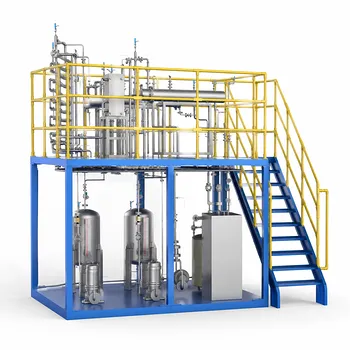
Dual-Mode Rectification Pilot Plant for Practical Training Unit Operations

Dual-Mode Rectification Pilot Plant for Practical Training Unit Operations

Industrial-scale dual-mode rectification pilot plant for chemical engineering practical training. Features real-material and simulated-material operation modes, sieve-plate column with sight glasses for visual observation of hydrodynamics, and customizable SCADA control for safe, hands-on learning of unit operations and mass transfer.

Multi-Modal Distillation Unit Operations Training Pilot Plant

Multi-Modal Distillation Unit Operations Training Pilot Plant

Multi-modal distillation pilot plant for practical unit operations training in chemical engineering education. Features real, analog, and semi-physical simulation modes, industrial construction, customizable for university labs. Hands-on fractionation columns, SCADA control, safety systems. Includes sight glasses, sampling ports, closed-loop recycling.

Fixed-Bed Chemical Reaction and Gas Dust Tar Removal Unit Operations Pilot Plant

Fixed-Bed Chemical Reaction and Gas Dust Tar Removal Unit Operations Pilot Plant

Integrated educational pilot plant for studying catalytic gas-solid reactions and downstream gas purification. Features dual fixed-bed reactor, three-stage heating, and touchscreen control for hands-on engineering training. Ideal for chemical and environmental engineering curricula.

Multi-Functional Drying Educational Unit Operations Pilot Plant

Multi-Functional Drying Educational Unit Operations Pilot Plant

Versatile multi-functional drying educational unit operations pilot plant integrating tunnel, fluidized bed, and spray drying. Enables hands-on study of drying curves, psychrometry, and gas-solid separation for chemical engineering curriculum in higher education labs.

Rising and Falling Film Evaporation Educational Unit Operations Pilot Plant

Rising and Falling Film Evaporation Educational Unit Operations Pilot Plant

Hands-on educational pilot plant for studying rising and falling film evaporation, flow regimes, and heat transfer. Customizable for university labs with industrial instrumentation and data acquisition. Enables comparative evaluation of evaporation modes and energy efficiency.

Methanol Synthesis and Catalyst Performance Evaluation Educational Unit Operations Pilot Plant

Methanol Synthesis and Catalyst Performance Evaluation Educational Unit Operations Pilot Plant

Bench-scale methanol synthesis and catalyst evaluation educational pilot plant for chemical engineering labs to study catalytic kinetics, high-pressure operations, process control, and unit operations under realistic conditions with industrial safety features, precision gas delivery, data acquisition, and intelligent monitoring.

Methane Cracking Educational Unit Operations Pilot Plant

Methane Cracking Educational Unit Operations Pilot Plant

This bench-scale methane cracking educational pilot plant provides hands-on catalytic conversion training with a 1000°C furnace, seven mass flow controllers, and real-time automation for safe, curriculum-aligned experiments. Designed for university teaching of unit operations and reaction engineering.

100L Continuous Loop Hydrogenation Educational Unit Operations Pilot Plant

100L Continuous Loop Hydrogenation Educational Unit Operations Pilot Plant

This 100L continuous loop hydrogenation pilot plant is designed for chemical engineering education, featuring 316 stainless steel construction, advanced gas-liquid mass transfer components, explosion-proof safety systems, and a 15.6-inch touchscreen with 5G connectivity, cloud data logging, bridging theory and industry.

Multi Functional Catalytic Reaction and Reactor Evaluation Educational Unit Operations Pilot Plant

Multi Functional Catalytic Reaction and Reactor Evaluation Educational Unit Operations Pilot Plant

Bench-scale educational pilot plant for catalytic reaction and reactor evaluation, integrating fixed bed, fluidized bed, and stirred tank reactors. Students compare reactor designs, evaluate catalysts, and study reaction kinetics and hydrodynamics. Perfect for unit operations labs in chemical engineering curricula.

Tubular Reactor Flow Characteristics Determination Educational Unit Operations Pilot Plant

Tubular Reactor Flow Characteristics Determination Educational Unit Operations Pilot Plant

Educational pilot plant for investigating tubular reactor flow characteristics and residence time distribution Features adjustable recycle for plug flow and backmixing studies industrial touchscreen interface and real-time data acquisition Ideal for chemical engineering unit operations laboratory training and education


Leave Your Message