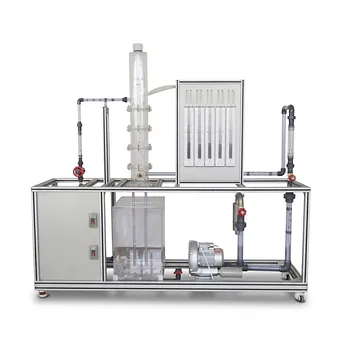
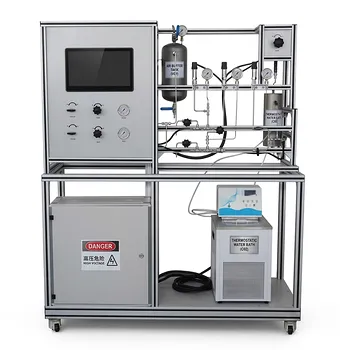
Students should evaluate four critical operational criteria on educational chemical process units: product quality, process economics, operational safety, and environmental impact. These criteria reveal how each unit operation affects purity, throughput, energy and material use, hazard control, emissions, and overall process performance. Students should also connect these outcomes to process control, equipment constraints, utilities, and the unit’s role within the complete process flow.
A pilot-plant unit should be judged as part of an operating process, not as isolated equipment. The strongest analysis balances product specifications, cost efficiency, safe operating limits, and environmental performance.
Evaluate Product Quality and Process Performance
Product Purity and Consistency
Students should determine whether the unit produces material within the required purity, composition, and quality specifications. They should examine how changes in temperature, pressure, residence time, flowrate, or feed composition affect the result.
Quality analysis should include both the final product and intermediate streams. A unit that achieves high conversion but creates difficult-to-remove impurities may reduce the performance of downstream separation or recovery steps.
Conversion and Recovery
The analysis should measure how effectively the unit converts raw materials and recovers valuable products or unreacted reactants. Important indicators include conversion, yield, selectivity, recovery rate, and material balance closure.
These measurements help students understand the relationship between individual equipment performance and overall process efficiency. They also show why raw material preparation, reaction, separation, recovery, and waste treatment must be considered together.
Process Stability
Students should assess whether the unit maintains stable operation when feed conditions or operating variables change. Real-time trends can reveal disturbances, oscillations, fouling, poor control tuning, or gradual drift in product quality.
Pilot plants are particularly useful because students can compare theoretical models with measured data. Mathematical modeling, graphical analysis, and dimensional analysis help explain why observed performance differs from ideal predictions.
Analyze Process Economics
Material and Energy Efficiency
Students should quantify raw material consumption, energy use, utility demand, product output, and waste generation. The key question is whether the unit delivers the required performance with reasonable resource use.
Utility analysis should include heating and cooling requirements, pumping costs, maximum available flowrates, supply and return conditions, and the potential value of recovered or returned utilities.
Operating and Capacity Constraints
A unit may perform well at one scale or flowrate but become inefficient when another step limits capacity. Students should evaluate bottlenecks, residence time, equipment utilization, and the balance of capacity across connected operations.
The analysis should also consider labor, downtime, maintenance, and the effect of operating flexibility on productivity. A flexible unit that can demonstrate batch and continuous operation may provide greater training value, provided the additional complexity is justified.
Reactor and Separation Choices
For reactor systems, students should evaluate whether batch, continuous stirred-tank, or tubular operation best suits the reaction kinetics and thermodynamics. They should connect reactor type and dimensions to heat transfer, mass transfer, fluid flow, residence time, and economic performance.
For separation systems, the analysis should consider recovery, purity, energy demand, throughput, and susceptibility to flooding, fouling, or other operating restrictions.
Establish Operational Safety
Safe Operating Boundaries
Students should identify the acceptable ranges for temperature, pressure, flowrate, concentration, composition, and inventory. These boundaries define where the unit can operate without creating unacceptable risk or damaging equipment.
The analysis should address hazards such as explosive vapor mixtures, rapid thermal decomposition, runaway reactions, excessive pressure, and loss of cooling capacity.
Safeguards and Interlocks
Students should verify how sensors, alarms, control loops, shutdown systems, and safety interlocks respond when conditions approach or exceed operating limits. The objective is to understand how automated control maintains safe and stable operation.
Pilot plants should allow students to observe the relationship between measurement quality and control performance. Analyzer requirements should be matched to the material and process conditions, including physical state, temperature, pressure, corrosiveness, viscosity, toxicity, accuracy, precision, and response speed.
Equipment Integrity
Operational safety includes respecting mechanical and process limits. Students should look for risks such as pump cavitation, column flooding, heat-exchanger fouling, corrosion, catalyst thermal degradation, and inadequate utility reliability.
They should also assess whether the equipment can tolerate feed impurities, transient conditions, and interruptions in heating, cooling, power, or instrument air.
Assess Environmental Impact
Effluent and Emissions
Students should evaluate the temperature, composition, flowrate, and contaminant levels of liquid, gas, and solid waste streams. The unit should be assessed against applicable environmental requirements rather than only against production targets.
Environmental performance may be improved through higher conversion, recovery of unreacted reactants, reduced solvent or utility consumption, and effective waste treatment.
Resource Consumption
Water, energy, raw materials, and other utilities are environmental as well as economic considerations. Students should examine whether the unit minimizes resource use while maintaining product quality and safe operation.
Utility selection should include supply reliability, return-stream purity, corrosion characteristics, and the environmental consequences of disposal or reuse.
Control of Disturbances
Environmental performance can deteriorate when a process becomes unstable. Continuous monitoring and control help maintain effluent temperature and contaminant levels within acceptable limits during feed changes or other disturbances.
This connects environmental analysis directly to process control. A unit that cannot maintain stable operation may create intermittent releases even when its average performance appears acceptable.
Understand the Trade-offs
Quality Versus Cost
Improving purity may require additional separation stages, higher reflux, longer residence time, or greater energy consumption. Students should identify whether the quality improvement is necessary for the product specification and whether its cost is justified.
A technically superior result is not automatically the best process result if it uses disproportionate energy or creates additional waste.
Throughput Versus Safety Margin
Operating at higher capacity can improve productivity but may reduce residence time, increase heat-release rates, or push equipment toward flooding, cavitation, or thermal limits. Students should distinguish the maximum possible rate from the highest rate that can be operated reliably and safely.
The appropriate operating point is usually a controlled region within the equipment limits, not the boundary itself.
Automation Versus Complexity
Comprehensive control systems provide valuable training in disturbance rejection, constraint management, and real-time optimization. However, excessive instrumentation or poorly specified analyzers can make experiments difficult to interpret and may obscure the underlying process behavior.
Students should separate essential measurements from optional features. Instrumentation should be selected according to the control objective and required accuracy, precision, and response time.
Pilot-Plant Realism Versus Educational Scope
A pilot plant should represent important industrial stages, including preparation, reaction, separation, recovery, and waste treatment. It should also provide enough flexibility for students to investigate alternative operating conditions and process configurations.
At the same time, the system must remain understandable and manageable for the intended course level. A unit is educationally valuable when its complexity supports meaningful analysis rather than simply reproducing industrial complexity.
Making the Right Choice for Your Analysis
A useful evaluation should combine measurements, operating observations, models, and control-system behavior.
- If your primary focus is product quality: Measure purity, conversion, yield, recovery, consistency, and the effect of operating changes on product specifications.
- If your primary focus is process economics: Quantify raw material, energy, utility, pumping, labor, capacity, and maintenance requirements relative to useful output.
- If your primary focus is operational safety: Map safe operating boundaries and evaluate alarms, interlocks, controls, equipment limits, and responses to disturbances.
- If your primary focus is environmental performance: Track waste streams, effluent temperature, contaminant levels, emissions, resource consumption, and recovery opportunities.
- If your primary focus is process understanding: Compare pilot-plant data with mass and energy balances, transport models, graphical methods, and dimensional analysis.
- If your primary focus is industrial readiness: Evaluate process flexibility, capacity balance, automation, utility reliability, and the unit’s connection to upstream and downstream operations.
Students develop sound process-engineering judgment when they evaluate every unit through the combined lenses of quality, economics, safety, and environmental responsibility.
Summary Table:
| Evaluation criterion | What students should assess | Key indicators |
|---|---|---|
| Product quality and performance | Purity, consistency, conversion, yield, recovery, and process stability | Product specifications, material balance closure, flowrate, temperature, pressure, residence time |
| Process economics | Material use, energy demand, utility consumption, capacity, bottlenecks, labor, and maintenance | Throughput, utility demand, operating cost, equipment utilization, downtime |
| Operational safety | Safe operating limits, hazards, safeguards, interlocks, control performance, and equipment integrity | Temperature, pressure, flowrate, concentration, alarms, shutdowns, cavitation, flooding, corrosion |
| Environmental impact | Liquid, gas, and solid waste streams, emissions, resource consumption, and disturbance control | Effluent temperature, contaminant levels, emissions, water use, energy use, recovery rate |
| Process integration | Connections between preparation, reaction, separation, recovery, waste treatment, and utilities | Capacity balance, upstream and downstream effects, utility reliability, process flexibility |
| Trade-offs and educational value | Balance among quality, cost, safety, environmental performance, automation, and system complexity | Safe operating region, control requirements, model-to-data agreement, experimental flexibility |
Evaluate Pilot-Plant Performance with LABPARK
Give students and researchers practical experience analyzing complete chemical processes, not isolated equipment. Contact LABPARK to discuss Educational and Vocational Unit Operations Pilot Plants for chemical engineering, bioprocess and biotech, and environmental and water treatment applications.
LABPARK can help universities, research institutes, and enterprises select training systems that demonstrate product quality, process economics, operational safety, environmental performance, process control, and equipment integration. Our pilot plants support hands-on investigation of reaction, separation, recovery, utility use, waste treatment, and upstream and downstream process behavior, helping learners connect theory with reliable operating data and industrial practice.
Related Products
- Multi-Reactor Educational Pilot Plant for Reaction Engineering Unit Operations
- Multi-Functional Special Distillation Educational Pilot Plant
- Multi-Functional Membrane Separation Educational Pilot Plant for Unit Operations Lab
- Micro-Scale Gas-Solid Catalytic Reaction Educational Pilot Plant
- High-Gravity Emulsification and Mass Transfer Educational Pilot Plant
People Also Ask
- How do reactor pilot plants define QbD design space? Master chemical process scale-up.
- When configuring a reactor unit operations pilot plant for highly exothermic reactions, how to prevent thermal runaway?
- How do metal ion-catalyzed reaction mechanisms inform chemical engineering pilot plant design? From kinetics to scale-up
- What are the barriers to process intensification & how do pilot plants help?
- What role do educational pilot plants play in scaling green chemistry? Bridging the Lab-to-Industry Gap