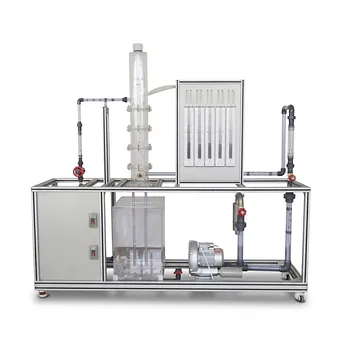
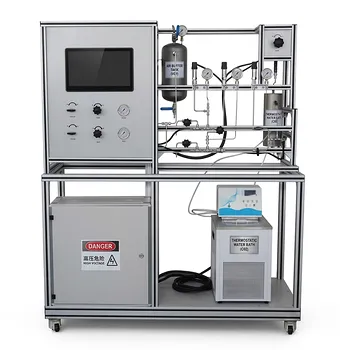
An open system allows mass to cross its boundary, while a closed system does not during the defined analysis period. For pilot-plant material balances, draw the boundary around the equipment or process section being studied, then count only material streams that cross it. Continuous equipment such as absorption towers, heat exchangers, and continuous reactors is normally treated as open; batch mixers and sealed batch reactors are normally treated as closed.
The system boundary determines which streams appear in the material balance. Open-system balances use inlet and outlet flow rates, while closed-system balances track the total mass initially present, any accumulation, and any reaction or transformation over a specified time interval.
What a System Boundary Means
The Boundary Defines the Control Volume
A system boundary is an imaginary surface drawn around the equipment, process unit, or complete plant being analyzed.
The material balance includes every material stream that crosses that surface. Streams remaining entirely inside the boundary—such as internal reflux, circulation, or tray-to-tray flow—are not external inputs or outputs for that boundary.
The Boundary Is an Analytical Choice
The same pilot plant can be analyzed using different boundaries. A boundary around a complete distillation assembly produces an overall balance, while a boundary around only the reboiler or condenser produces a local balance.
The correct boundary is the one that matches the question being asked and the measurements available.
Heat and Work Are Not Material Streams
Heat and work may cross either an open or closed system boundary, but they are not included as mass flows.
They become relevant to an energy balance, not to the material balance, unless a utility stream physically mixes with the process material.
How Open-System Boundaries Are Defined
Mass Crosses Through Inlets and Outlets
An open system, also called a flow system or control volume, permits material to enter and leave during operation.
Typical crossing streams include feed, product, purge, vent, drain, and recycle streams when they cross the selected boundary.
Continuous Pilot Equipment Is Usually Open
Gas absorption towers, heat exchangers, continuous stirred-tank reactors, distillation columns, pumps, and compressors are commonly treated as open systems.
For these units, the balance is usually written in terms of mass flow rates:
[ \text{Accumulation} = \text{Mass in} - \text{Mass out} + \text{Generation} - \text{Consumption} ]
For a nonreactive process at steady state, accumulation is zero, so:
[ \text{Total mass flow in} = \text{Total mass flow out} ]
Component Balances May Be More Useful
A total mass balance may show that mass is conserved without showing how components are distributed.
For example, an ethanol distillation unit requires component balances for ethanol and water, not only a total flow balance. At steady state:
[ \dot{m}{\text{feed}} = \dot{m}{\text{distillate}}+ \dot{m}_{\text{bottoms}} ]
The corresponding ethanol balance tracks the ethanol fraction in each stream.
Internal Streams Are Excluded from an Overall Boundary
If the boundary encloses the column, condenser, and reboiler together, internal vapor, liquid, and reflux streams do not cross the boundary.
They are therefore excluded from the overall material balance, even though they are essential to the separation mechanism.
How Closed-System Boundaries Are Defined
No Process Mass Crosses the Boundary
A closed system contains a fixed quantity of material during the selected operating period.
A sealed batch reactor or a batch mixing tank is treated as closed when there are no feeds, product withdrawals, vents, leaks, or drains crossing the boundary.
Batch Equipment Requires a Time Interval
Because there are no inlet or outlet flow rates, the balance compares the material inside the system at two times.
For a nonreactive closed system:
[ m_{\text{initial}} = m_{\text{final}} ]
If material accumulates, is consumed, or is generated through reaction, the appropriate component balance must include those effects.
Closed Does Not Mean Nothing Changes
A closed system can experience temperature changes, pressure changes, mixing, phase changes, heat transfer, or shaft work.
It remains closed with respect to mass as long as no material crosses the defined boundary.
Batch Equipment Is Not Automatically Closed
A batch reactor with a feed addition, gas vent, sampling line, or product withdrawal is not fully closed during that period.
In that case, either include those streams in a material balance or redefine the operating interval so the claimed closed-system assumption is valid.
Choosing Boundaries for Multi-Unit Pilot Plants
Use an Overall Boundary for Plant-Wide Results
A boundary around the entire pilot plant includes only streams entering from outside and streams leaving to the external environment.
Interconnecting streams between the mixer, reactor, separator, and storage tank are internal and cancel from the overall balance.
This approach is useful for checking total recovery, overall yield, and plant-wide material losses.
Use Subsystem Boundaries for Unit Performance
A boundary around one piece of equipment isolates its local behavior.
For example, a boundary around a distillation column may include feed, distillate, bottoms, reflux, and boil-up streams, depending on whether the condenser and reboiler are inside or outside the boundary.
The selected boundary determines which of these streams must be measured and included.
Use Junction Boundaries for Mixing and Splitting
A small boundary around a mixing point allows the combined outlet to be related to multiple inlet streams.
A boundary around a splitter relates one inlet to multiple outlets. These local balances are often simpler than balancing the entire flowsheet at once.
Perform a Degree-of-Freedom Check
Before solving a subsystem, count the unknown stream flow rates and compositions and compare them with the independent equations available.
A well-posed calculation generally has zero degrees of freedom after specifications, measurements, and material-balance equations are included.
Applying the Definition to Educational Equipment
Batch Mixing Tank
For a sealed batch mixing tank, draw the boundary around the tank and its contents for the mixing period.
If no feed, drain, sampling, or vent crosses the boundary, use a closed-system balance and compare the total or component masses before and after mixing.
Continuous Absorption Tower
For a gas absorption tower, draw the boundary around the tower and identify the gas inlet, gas outlet, liquid solvent inlet, and liquid outlet.
These crossing streams form the basis of the open-system total and component balances.
Continuous Distillation Unit
For overall separation performance, draw the boundary around the column, overhead condenser, and reboiler as one unit.
The external material streams are typically the feed, distillate, and bottoms. Internal reflux and boil-up are omitted from this overall balance because they do not cross the boundary.
Heat Exchanger
A heat exchanger is an open system when process fluid enters and leaves continuously.
The hot-side and cold-side material streams each cross the boundary, while heat transfer between the streams is handled in the energy balance rather than treated as a material flow.
Understanding the Trade-offs
A Larger Boundary Simplifies the Overall Balance
Enclosing several connected units removes internal streams from the overall balance.
The disadvantage is that it hides individual-unit performance, making it harder to identify where a loss, leak, or separation inefficiency occurs.
A Smaller Boundary Provides More Detail
Unit-level boundaries reveal local compositions, conversion, recovery, and accumulation.
They also create more unknown streams and require more instrumentation, measurements, and equations.
Steady State Can Be Misidentified
A continuous unit is not automatically at steady state. Start-up, shutdown, tank filling, concentration changes, and fluctuating feed conditions create accumulation.
When accumulation is nonzero, inlet and outlet flow rates are not necessarily equal.
Utilities Must Be Classified Correctly
Cooling water, heating steam, and refrigerant generally belong to the energy balance when they do not mix with the process material.
If a utility enters the process—for example, steam that condenses into the product—then it crosses the material boundary as a process mass stream and must be included.
Leaks and Samples Can Invalidate Assumptions
A supposedly sealed batch unit may lose mass through a leak, vent, or sample port.
Educational experiments should document these paths explicitly rather than forcing the equipment into an idealized closed-system model.
How to Apply This to Your Pilot Plant
The following procedure provides a reliable starting point for educational material-balance work:
- If your primary focus is a continuous unit’s throughput: Draw the boundary around the equipment, list every inlet and outlet, and use steady-state flow-rate balances only after confirming that accumulation is negligible.
- If your primary focus is a sealed batch operation: Define the starting and ending times, verify that no process mass crosses the boundary, and compare initial and final total or component quantities.
- If your primary focus is overall plant recovery: Enclose all connected units in one boundary and include only external feed, product, waste, purge, and vent streams.
- If your primary focus is individual equipment performance: Isolate the selected unit and include every stream that crosses its local boundary, including relevant recycle or bypass streams.
- If your primary focus is separation efficiency: Use component balances for species such as ethanol and water rather than relying only on total mass flow.
- If your primary focus is a defensible calculation: Complete a degree-of-freedom check before solving for unknown flows or compositions.
A clearly drawn boundary turns a complex pilot plant into a manageable, measurable material-balance problem.
Summary Table:
| System or boundary type | Material crossing boundary | Typical pilot plant examples | Balance focus |
|---|---|---|---|
| Open system | Inlets, outlets, vents, drains, purges, and other process streams | Absorption towers, heat exchangers, continuous reactors, distillation units | Flow rates, accumulation, generation, and consumption |
| Closed system | No process mass during the defined time interval | Sealed batch mixers and batch reactors | Initial and final mass, accumulation, and reaction effects |
| Overall plant boundary | External feeds, products, waste, purge, and vent streams | Complete interconnected pilot plant | Overall recovery, yield, and material losses |
| Unit-level boundary | Every stream entering or leaving one selected unit | Distillation column, reactor, separator, or mixer | Equipment performance, conversion, and separation efficiency |
| Component balance | Species-specific flows and compositions | Ethanol-water distillation or reactive systems | Component distribution, generation, and consumption |
| Utility stream | Usually energy only unless the utility mixes with process material | Cooling water, heating steam, refrigerant | Include in material balance only when it becomes process material |
Need reliable material-balance results from your pilot plant? Contact LABPARK to discuss your requirements. LABPARK provides Educational and Vocational Unit Operations Pilot Plants for chemical engineering, bioprocess and biotechnology, and environmental and water treatment applications. Our systems help universities, research institutes, and enterprises teach and verify open- and closed-system balances, evaluate unit performance, and conduct practical process training with configurable equipment and measurable process streams.
Related Products
- Multi-Reactor Educational Pilot Plant for Reaction Engineering Unit Operations
- Multi-Functional Special Distillation Educational Pilot Plant
- Multi-Functional Membrane Separation Educational Pilot Plant for Unit Operations Lab
- Micro-Scale Gas-Solid Catalytic Reaction Educational Pilot Plant
- High-Gravity Emulsification and Mass Transfer Educational Pilot Plant
People Also Ask
- How do reactor pilot plants define QbD design space? Master chemical process scale-up.
- When configuring a reactor unit operations pilot plant for highly exothermic reactions, how to prevent thermal runaway?
- How do metal ion-catalyzed reaction mechanisms inform chemical engineering pilot plant design? From kinetics to scale-up
- What are the barriers to process intensification & how do pilot plants help?
- What role do educational pilot plants play in scaling green chemistry? Bridging the Lab-to-Industry Gap