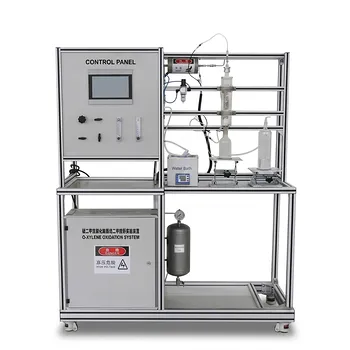
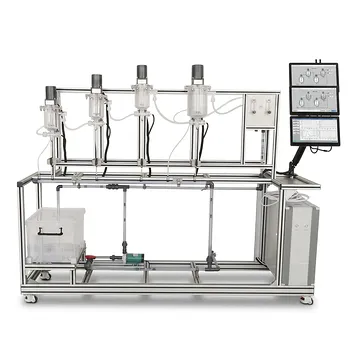
Axial mixing is the fundamental prerequisite for steady-state multiplicity in a pilot-scale fixed-bed reactor. Without it, an ideal plug-flow reactor (PFR) can only achieve a single, unique steady state. Axial dispersion, or back-mixing, allows the non-linear feedback loop between reaction rate and temperature to sustain multiple stable operating profiles, where a low-conversion (extinguished) and a high-conversion (ignited) state can exist for the exact same inlet temperature.
The key insight is that axial mixing transforms the reactor from a purely one-way, initial-value problem into a system with boundary-value characteristics. This creates the mathematical possibility for three steady states—a stable low-temperature state, an unstable intermediate state, and a stable high-temperature state—leading to dramatic phenomena like sudden ignition (runaway) and hysteresis.
The Mechanism: How Axial Mixing Creates Multiplicity
The core of the issue lies in the nature of heat feedback. In an exothermic reaction, heat generated at one point in the reactor must be able to influence the reaction rate upstream for multiple states to exist.
Understanding the Péclet Number: The Switch for Multiplicity
The Péclet number (Pe) is the critical parameter governing this behavior. It defines the ratio of convective transport to dispersive transport.
- As Pe → Infinity (Ideal PFR): Zero axial mixing exists. The reactor profile is defined by an initial-value problem where the state at any point depends only on what happened before it. Heat cannot travel upstream. A single, smooth temperature profile is the only mathematical solution for a given inlet condition.
- As Pe → 0 (Ideal CSTR): Infinite mixing exists. The entire reactor has a uniform temperature and concentration. This perfectly stirred state allows the non-linear reaction kinetics to interact globally with the cooling system, famously supporting multiple steady states.
- Finite Pe (Pilot Plant Reality): A pilot plant operates in this intermediate regime. Some axial dispersion is always present. This small but finite back-mixing of heat acts as a feedback mechanism, allowing the reaction rate at the reactor's end to influence the temperature at its beginning.
From Mathematical Conditions to Physical Ignition
The transition between states is not smooth. It is a discontinuous jump, or bifurcation.
- The Ignition Point: As you slowly increase the feed temperature, the reactor may move along the lower, stable steady-state curve. The exit temperature rises only modestly. A critical bifurcation point is reached where the low-conversion state vanishes mathematically. The reactor has no choice but to jump violently to the only remaining stable solution: the high-temperature, ignited state. This is the classic thermal runaway.
- The Extinction Point: Once in the high-temperature state, simply reversing the action doesn't bring it back immediately. You must lower the feed temperature significantly below the ignition point to reach the extinction bifurcation point, where the ignited state vanishes and the reaction catastrophically "blows out" back to the low-conversion state.
- The Unstable Middle State: The third steady-state solution is physically unattainable in a stable manner. It’s a mathematical saddle point; any infinitesimal perturbation will cause the reactor to diverge and transition to one of the two stable states.
Implications for Reactor Safety
Understanding this multiplicity is not an academic exercise; it is a fundamental requirement for safe operation, especially when translating data from a pilot plant to a full-scale industrial reactor.
Parametric Sensitivity and Runaway
The sudden jump at the ignition point reveals extreme parametric sensitivity. Near the bifurcation, an almost imperceptible change in feed temperature, concentration, or coolant flow can trigger a massive and rapid temperature excursion.
- Catalyst and Material Damage: A runaway event can instantly exceed the maximum operating temperature of the catalyst, causing irreversible sintering and deactivation. It can also compromise the reactor's metallurgical integrity.
- Predicting the "Blow-Out": The hysteresis effect shows that shutting down an ignited reactor requires a much larger cooling action than what triggered the runaway. This is a critical lesson for startup and shutdown procedures to avoid both runaway during heating and thermal shock during cooling.
Dispersion Disguised as Kinetics
A significant pilot-plant pitfall is misinterpreting data. If you assume your pilot reactor behaves as an ideal PFR, you will fit your kinetic model to data shaped by the reactor's inherent axial dispersion. When scaling up to a large industrial reactor, which may have a very different effective Pe, your safety predictions for runaway will be dangerously wrong. The pilot plant's multiplicity-driven behavior must be deconvoluted from the intrinsic kinetics to create a reliable scale-up model.
Using the Hysteresis Loop for Operator Training
The controlled environment of a pilot plant is an irreplaceable tool for building operator intuition. By safely and deliberately mapping the hysteresis loop, students and operators can physically experience:
- The precise location of ignition and extinction points.
- The non-intuitive path-dependence of the reactor's state.
- The real-world meaning of stability criteria like Inoue's criterion, which help define a safe operating envelope away from these catastrophic bifurcation boundaries.
Understanding the Trade-offs
Pilot plants are critical for revealing these non-linear phenomena, but their value comes with specific limitations.
- Map is Not the Territory: A hysteresis loop mapped in an adiabatic pilot plant provides qualitative insight into multiplicity but cannot be directly overlaid onto a production reactor with complex radial heat transfer, multi-dimensional flow, and different boundary conditions.
- The Danger of the "Perfect" Experiment: Student experiments are often designed to find the multiplicity region by carefully sweeping parameters. In a real industrial process, you design the process to operate as far away from this region as possible. The pilot plant teaches what to avoid, not what to target.
- Adiabatic vs. Non-Adiabatic: The pronounced runaway and hysteresis in an adiabatic pilot plant will be dampened in an industrial reactor with active heating/cooling systems. The physical feedback loop created by axial mixing is directly competing against the heat removal system, altering the bifurcation landscape.
Making the Right Choice for Your Goal
- If your primary focus is process safety and runaway prevention: Use the pilot plant to physically demonstrate the concept of bifurcation under safe conditions. The key lesson is that safe operating parameters must keep the reactor away from the inflection point where a small input change leads to a massive output jump.
- If your primary focus is kinetic model development for scale-up: You must critically determine the Péclet number of your pilot reactor. If it is not high enough to approximate an ideal PFR, the axial dispersion model must be part of your parameter estimation to avoid building a kinetic model that perfectly describes your pilot plant's runaway behavior but fails for the production unit.
- If your primary focus is teaching reactor engineering: This is the definitive demonstration. It transforms abstract concepts like steady-state multiplicity and hysteresis from differential equations into tangible, observable events, creating an unforgettable lesson in the non-linear and counter-intuitive nature of chemical reacting systems.
By mastering the direct link between axial mixing and the emergent, often dangerous, behavior of steady-state multiplicity, you move from simply operating a reactor to truly understanding its fundamental limits.
Summary Table:
| Péclet Number (Pe) | Mixing Regime | Steady States | Safety Impact & Thermal Behavior |
|---|---|---|---|
| Pe -> Infinity | Ideal PFR (No mixing) | Single (Unique) | Stable, predictable, no upstream feedback. |
| Finite Pe | Real Pilot Plant (Back-mixing) | Multiple (Up to 3) | High parametric sensitivity, thermal runaway, and hysteresis. |
| Pe -> 0 | Ideal CSTR (Infinite mixing) | Multiple | Uniform temperature/concentration, high global feedback. |
Bridge the gap between reactor theory and safe industrial scale-up. LABPARK provides high-quality Educational and Vocational Unit Operations Pilot Plants in chemical engineering, bioprocess & biotech, and environmental & water treatment. We help universities, research institutes, and enterprises safely demonstrate complex kinetics, heat transfer, and steady-state multiplicity in the lab. Contact us today to enhance your research and training programs!
Related Products
- Fixed Bed Gas Solid Catalytic Reaction Educational Pilot Plant
- Fixed-Bed Chemical Reaction and Gas Dust Tar Removal Unit Operations Pilot Plant
- Multi Functional Catalytic Reaction and Reactor Evaluation Educational Unit Operations Pilot Plant
- Ethylbenzene Dehydrogenation Educational Unit Operations Pilot Plant
- Educational Unit Operations Pilot Plant for Intraparticle Diffusion Effective Factor Measurement
People Also Ask
- How do reactor pilot plants safely study gas-solid reactions? Master kinetics with thermal & flow control.
- How does the Mears criterion evaluate transport resistance? Key Guide to Intrinsic Kinetics
- Fluidized vs. Fixed Bed Reactors: Comparing Heat & Complexity in Pilot Plants
- Why is a multibed configuration necessary for exothermic reactions? Optimize your pilot plant trajectory.
- What are the differences between pseudohomogeneous and heterogeneous models in pilot plants?