The answer lies in the deviation from a simple, spherical energy well. For a simple fluid like argon, molecular interaction is solely a function of separation distance, creating a single, deep potential well. In contrast, complex molecules like carbon dioxide or hydrocarbons have angularly dependent intermolecular forces. Their energy "landscape" is not a simple well but a more complex, often narrower, and orientation-specific profile. This fundamental molecular difference means these fluids store and exchange energy in ways that deviate sharply from simple fluid patterns, directly impacting the thermal and phase-change behavior engineers must model in pilot-plant heat exchangers and separation columns.
The core operational challenge is that complex molecular shapes make fluids behave in ways that break the rules of simple, "textbook" thermodynamics. The seemingly abstract concept of an acentric factor is the practical bridge that connects a molecule's non-spherical potential to the tangible design of a pilot plant, ensuring that enthalpy and vapor-liquid equilibrium calculations don't lead to dangerously undersized heat exchangers or inefficient distillation columns.
From Molecular Potential to Macroscopic Behavior
The non-ideal potential of a complex molecule isn't just a theoretical curiosity; it's the direct cause of measurable, non-ideal macroscopic properties that affect every pump, pipe, and heat transfer surface in a pilot plant.
How Molecular Shape Distorts the Energy Landscape
Simple fluids are modeled as spherical particles. Their intermolecular potential, the force they "feel" from their neighbors, depends only on distance.
Complex molecules like elongated hydrocarbons break this symmetry. Their interaction energy depends on both distance and relative orientation. This creates a narrower, more directional potential well. Disrupting this ordered, orientation-dependent structure requires less energy than escaping the uniform, symmetric well of a simple fluid.
This molecular "eccentricity" has a direct thermodynamic penalty: it leads to greater deviations from the ideal gas law and corresponding states principle, especially at the saturated vapor curve. A fluid’s acentric factor is the numerical value that quantifies this deviation.
Linking Molecular Eccentricity to Measurable Properties
The microscopic, angular forces cascade into macroscopic problems. When molecules pack together in a liquid, their non-spherical shapes cause non-ideal mixing behaviors, including viscosity peaks and unexpected volume contraction, as seen in mixtures like alcohols and aldehydes.
In a pilot plant, these molecular interactions directly translate to altered fluid dynamics. A higher-than-ideal viscosity will increase pressure drop across a packed column or a heat exchanger's tube-side circuit. This changes the power required by the feed pump and the convective heat transfer coefficient, invalidating any design based on ideal, simple-fluid assumptions.
How These Deviations Reshape Pilot Plant Operations
Ignoring the non-spherical nature of a molecule when designing or analyzing a pilot-scale heat exchanger or separation unit isn't an academic shortcut—it's a direct path to incorrect equipment sizing and failure to meet performance targets.
Rethinking Enthalpy and Thermal Loads in Heat Exchangers
The design of a heat exchanger hinges on an accurate energy balance. The change in a fluid's enthalpy between two states dictates the thermal load, and this calculation is highly sensitive to the equation of state used.
For a complex fluid, using a simple cubic equation of state requires the acentric factor as a critical input. Neglecting it leads to an incorrect estimation of enthalpy and entropy. In a pilot plant, this miscalculation would produce a heat exchanger that is either too small to handle the required duty or wastefully oversized. This error is compounded by the need to select an optimal fluid velocity—a balance between maximizing heat transfer and minimizing fouling, all while staying within safe pressure drop limits.
Navigating Vapor-Liquid Equilibria (VLE) in Separation Columns
Distillation columns are fundamentally governed by vapor-liquid equilibria. The relative volatility, which determines how efficiently components separate on each tray, is a powerful function of non-ideal intermolecular forces.
Modeling the separation of a complex organic mixture with simple-fluid assumptions will predict an incorrect equilibrium curve. This translates directly to pilot-plant operation as an incorrect number of theoretical stages, wrong reflux ratio, and an off-spec product. The fluid dynamics experienced in a pilot plant, such as the channeling or loading in a packed bed, are themselves influenced by the liquid’s non-ideal density and viscosity, which trace their roots right back to the molecular potential well.
Understanding the Trade-offs and Complexities
The move from simple to complex fluid modeling is an exercise in managing accuracy against complexity, especially in an educational or R&D pilot-plant setting where the goal is deeper understanding.
The Limitation of Simple Models and the "Acentric Factor" Fix
The acentric factor is a wonderfully practical correction, but it's a single number. It corrects for the vapor pressure curve's shape but does not capture all the nuances of a molecule's asymmetric force field.
This is why multi-parameter equations of state exist. They provide higher accuracy by incorporating more molecular physics. The trade-off in a pilot plant is clear: these models require more computational power and, more critically, pure-component parameters that may not be available for novel or proprietary chemicals being tested.
The Diagnostic Value of Non-Ideal Behavior
For students and researchers, the "problem" of complex fluid behavior is actually the educational point. A pilot plant where an alcohol-aldehyde mixture doesn't obey ideal mixing rules isn't broken; it's teaching a fundamental truth.
When a distillation column fails to reach its design separation or a heat exchanger shows a mysteriously low heat transfer coefficient, the diagnosis should always circle back to fluid properties. Directly measuring the real mixture's density, viscosity, and phase envelope in the pilot plant becomes more valuable than any textbook prediction, highlighting the gap between an idealized spherical molecule and a real, angular one.
Making the Right Choice for Your Pilot Plant Study
Your approach must be defined by your primary objective—whether you are validating a design, studying a new chemical, or learning fundamental principles.
- If your primary focus is designing or scaling up a unit: You must default to a multi-parameter equation of state and measure or precisely estimate the acentric factor for every component. The cost of a computational error is a missized piece of capital equipment.
- If your primary focus is research on a new or poorly characterized fluid mixture: Begin with a simple cubic equation of state and the acentric factor, but treat the predictions as a starting hypothesis only. Rapidly conduct physical property measurements in your pilot plant to validate and calibrate your model against real-world VLE and density data.
- If your primary focus is fundamental education and vocational training: Deliberately compare the results from an ideal-state assumption against a model using the acentric factor. Use the pilot plant to literally see the deviation in pressure drop, product purity, and heat duty, cementing the tangible reality of molecular "shape" on unit operations.
This rigorous, property-first approach ensures your pilot plant is not just a smaller version of a factory, but a precise instrument for translating the hidden world of molecular forces into sound engineering design.
Summary Table:
| Parameter | Simple Fluids | Complex Fluids | Pilot Plant Impact |
|---|---|---|---|
| Potential Well | Symmetric (distance only) | Angular & orientation-dependent | Deviates from ideal thermodynamic models |
| Acentric Factor | Close to 0 | High (non-zero) | Essential parameter for accurate Equation of State (EOS) |
| Fluid Dynamics | Predictable viscosity | Viscosity peaks & non-ideal mixing | Affects pressure drop, pump power, & velocity |
| VLE Behavior | Standard equilibrium | Non-ideal volatility curves | Dictates reflux ratio & number of column stages |
Optimize Your Chemical Engineering Lab with LABPARK
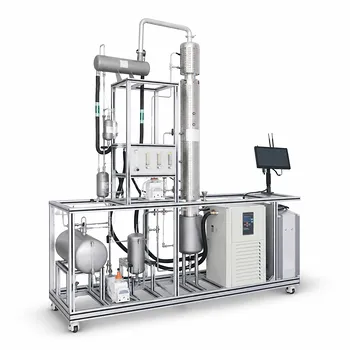
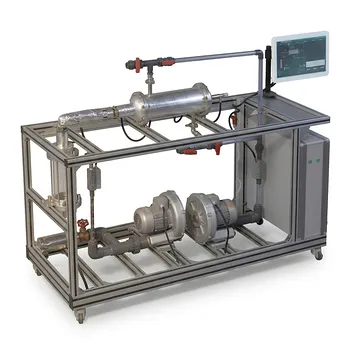
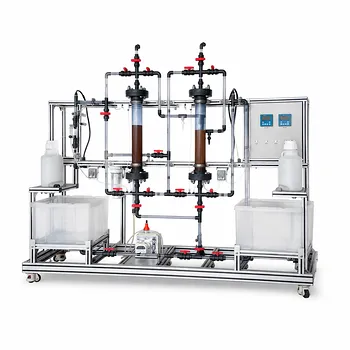
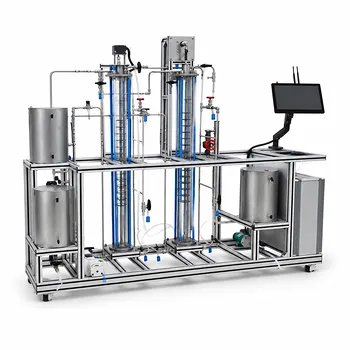
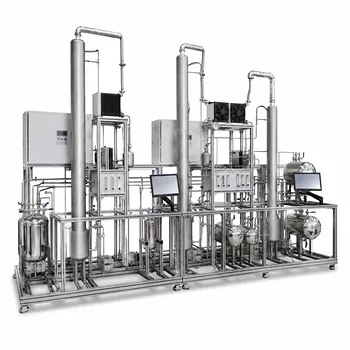
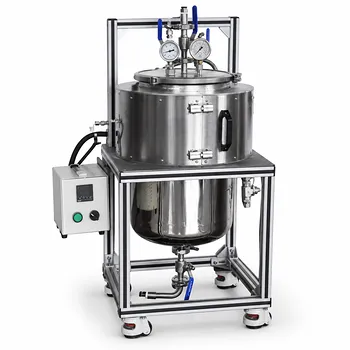
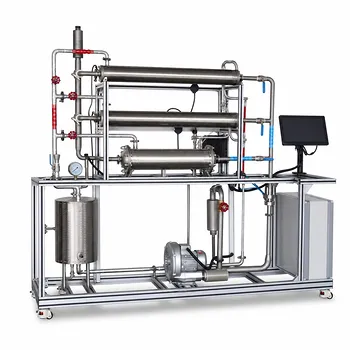
Are you looking to bridge the gap between thermodynamic theory and practical pilot plant operations? LABPARK provides state-of-the-art Educational and Vocational Unit Operations Pilot Plants in chemical engineering, bioprocess & biotech, and environmental & water treatment. Designed specifically for universities, research institutes, and enterprises, our systems enable students and researchers to analyze real-world fluid dynamics, heat transfer, and VLE deviations firsthand.
Contact our engineering experts today to find the perfect pilot plant solution for your institution!
Related Products
- Continuous Sieve-Plate Distillation Pilot Plant for Unit Operations Laboratory Education
- Multi-Functional Special Distillation Educational Pilot Plant
- Multi-Modal Distillation Unit Operations Training Pilot Plant
- Continuous Batch Extractive Distillation Educational Pilot Plant
- Dual-Mode Rectification Pilot Plant for Practical Training Unit Operations
People Also Ask
- Why is vacuum operation capability an essential feature for a distillation unit operations pilot plant? Unlock Efficiency
- What are the primary reflux ratio control strategies? Master Distillation Unit Operations
- How does catalyst water concentration affect distillation pilot plant design? Key separation train choices.
- How to select the right activity coefficient model (Wilson, NRTL, UNIQUAC) for distillation pilot plants?
- How can real-time carbon number prediction improve distillation pilot plants? Optimize control.