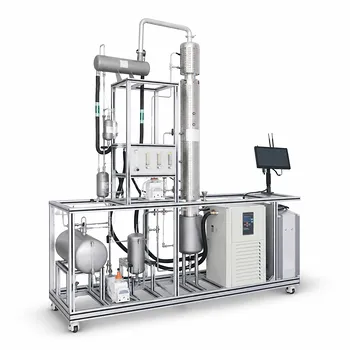
The water concentration demanded by your catalyst is the single most decisive factor in your distillation pilot plant's architecture. A rhodium catalyst system requires a high water environment (10–15 wt%) to stay active, which forces you into a more complex, three-column separation train. In contrast, an iridium catalyst operates below 8 wt% water, allowing you to simplify the design by combining the light ends and drying columns into a single unit.
The catalyst’s stability chemistry directly dictates separation complexity. A high water requirement to prevent rhodium precipitation cascades into a heavier separation load, demanding separate light ends, drying, and product columns. A more tolerant catalyst collapses that into a leaner, two-column train.
How Catalyst Water Requirements Dictate Separation Design
The connection between the reactor and the distillation columns is forged by catalyst stability. Understanding this link reveals why your choice of catalyst system can completely reshape the downstream equipment list.
The Stability Problem: Why Water Is Needed in the Reactor
Rhodium catalysts rely on a delicate chemical equilibrium. When the reaction mixture leaves the reactor and enters the flash vessel, carbon monoxide pressure drops sharply. Under these low-CO conditions, the rhodium complex can shed its protective CO ligands and precipitate as insoluble species like RhI₃. This catalyst loss is catastrophic for both cost and continuity.
To keep the rhodium in solution, a high water concentration of 10–15 wt% must be maintained throughout the reactor and flash system. The water molecules serve as stabilizing ligands, filling the coordination sites vacated by CO and preventing precipitation. Additionally, this excess water suppresses unwanted side reactions that form methyl acetate and dimethyl ether.
An iridium catalyst is inherently more stable under the same conditions. It retains its active structure at a much lower water concentration, typically below 8 wt%, eliminating the need for a large aqueous buffer.
The Separation Burden: How Water Load Drives Complexity
Every unit of water you add to the reactor must eventually be removed from the product stream. A high water concentration introduces two major separation challenges. First, you must strip out large volumes of water to meet product purity specifications for acetic acid. Second, the water promotes the water-gas shift reaction, which consumes carbon monoxide and generates carbon dioxide and hydrogen, creating additional off-gas and separation loads.
This is where the design of the separation train forks. For a rhodium-based process, the high water load overloads a single distillation column. You are forced into a three-column configuration:
- A light ends column to remove volatile components like methyl iodide and acetaldehyde.
- A dedicated drying column to handle the substantial water removal.
- A final product column to purify the acetic acid.
Each column adds capital cost, requires more floor space, increases utility consumption, and introduces additional control loops that your pilot plant team must manage.
The Simplified Alternative: Iridium’s Effect on Design
When you switch to an iridium catalyst with its sub-8% water requirement, the separation mathematics change fundamentally. The water removal duty shrinks enough that the light ends and drying functions can be combined into a single distillation column.
Your pilot plant now operates with just two main columns instead of three. This consolidated design directly reduces the plant footprint, lowers both steam and cooling water consumption, and simplifies operator training and process control. For a pilot plant where flexibility and ease of modification are paramount, that reduction in physical equipment is a significant advantage.
Understanding the Trade-offs
The choice between catalyst systems is not a simple one-for-one substitution. It involves navigating a set of interconnected performance and cost variables.
Catalyst Cost Versus Separation Capital
Rhodium catalysts are expensive and require more elaborate separation equipment to handle the water. However, the process knowledge around rhodium-based carbonylation is extensive, and the reaction kinetics are well characterized. The higher upfront capital for a three-column train may be acceptable if your organization has deep operational familiarity with this chemistry.
Iridium catalysts often cost more on a per-kilogram basis, but they dramatically reduce the downstream equipment count. The total installed cost of the pilot plant can drop significantly when you eliminate an entire column, its associated condensers, reboilers, pumps, and instrumentation. You swap higher catalyst cost for lower capital and operating expenses.
By-product Formation and Waste Streams
High water concentration promotes the water-gas shift reaction, converting carbon monoxide to CO₂ and hydrogen. This wastes a key reactant and generates a gaseous purge stream that must be handled safely. In a pilot plant, where material efficiency and waste reduction are often secondary learning objectives, this can skew material balances and complicate data analysis.
The lower water level in an iridium system minimizes this side reaction, giving you a cleaner separation task and more straightforward modeling of the core reaction kinetics.
Operational Complexity and Pilot Plant Learning Goals
A three-column train provides more unit operations for students and researchers to study. If your pilot plant’s purpose is educational—demonstrating azeotropic distillation, reflux ratio optimization, and multi-column heat integration—then the rhodium-driven complexity might be an asset, not a liability.
If the goal is process intensification or demonstrating a commercially lean flowsheet, the iridium route’s simplified train aligns better with that objective. The design of your separation equipment must match not just the chemistry but the learning or demonstration purpose of the facility.
Making the Right Choice for Your Project’s Goals
Your catalyst’s water requirement is a non-negotiable design input that reverberates through the entire separation train. Deciding on a path requires clarity on what you are optimizing for.
- If your primary focus is pilot plant throughput and capital efficiency: Choose an iridium catalyst and its corresponding two-column separation train. You will minimize equipment count, footprint, and utility costs.
- If your primary focus is educational depth or legacy process familiarity: A rhodium catalyst with a three-column train (light ends, drying, product) may be the right choice. It provides rich learning opportunities on multi-column operation at the expense of higher complexity.
- If your primary focus is clean kinetic data and minimal side reactions: The lower water concentration of an iridium system will suppress the water-gas shift reaction, yielding more accurate carbon monoxide mass balances and simpler stream analysis.
Ultimately, the water concentration demanded by your chosen catalyst system is not an isolated variable; it is a design lever that sets the entire complexity of your distillation unit operations pilot plant.
Summary Table:
| Catalyst System | Water Req. (wt%) | Columns | Design Complexity | Key Trade-off |
|---|---|---|---|---|
| Rhodium | 10–15% | 3 columns | High (Separate drying & product) | Higher CAPEX, proven kinetics, high educational depth |
| Iridium | < 8% | 2 columns | Low (Combined light ends/drying) | Lower CAPEX, fewer side-reactions, higher catalyst cost |
Are you designing a chemical engineering lab or scaling up your process? LABPARK provides premium Educational and Vocational Unit Operations Pilot Plants in chemical engineering, bioprocess & biotech, and environmental & water treatment. Whether you need a flexible multi-column distillation setup for university teaching or a simplified process demonstration for research, we customize solutions for universities, research institutes, and enterprises. Contact LABPARK today to consult with our experts and get a tailored pilot plant design!
Related Products
- Continuous Sieve-Plate Distillation Pilot Plant for Unit Operations Laboratory Education
- Multi-Modal Distillation Unit Operations Training Pilot Plant
- Green Anhydrous Ethanol Purification Extractive Distillation Unit Operations Training Pilot Plant
- Dual-Mode Rectification Pilot Plant for Practical Training Unit Operations
- Ethyl Acetate Synthesis Unit Operations Pilot Plant for Practical Training
People Also Ask
- Why is vacuum operation capability an essential feature for a distillation unit operations pilot plant? Unlock Efficiency
- What are the primary reflux ratio control strategies? Master Distillation Unit Operations
- How to select the right activity coefficient model (Wilson, NRTL, UNIQUAC) for distillation pilot plants?
- How can real-time carbon number prediction improve distillation pilot plants? Optimize control.
- Why run shortcut fractionation before rigorous distillation calculations? Optimize your pilot plant.