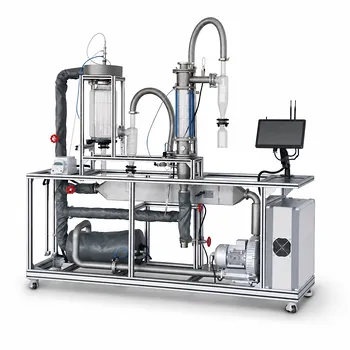
Choosing the right activity coefficient model—Wilson, NRTL, or UNIQUAC—for a distillation pilot plant demonstration hinges on one non‑negotiable criterion: the mixture’s ability to split into two liquid phases. If the system is completely miscible and you are only dealing with vapor‑liquid equilibrium (VLE), the Wilson equation is often the most pragmatic, accurate choice. If there is any chance of liquid‑liquid immiscibility (LLE)—as in heteroazeotropic distillation or decanting steps—you must switch to NRTL or UNIQUAC, because Wilson cannot predict a phase split in the liquid.
The core rule is simple: match the model’s thermodynamic capability to the phase behavior of your pilot‑plant mixture. Wilson dominates in purely miscible, polar‑to‑non‑polar VLE; NRTL and UNIQUAC are essential when liquid‑liquid equilibrium appears alongside vapor‑liquid equilibrium. Teaching students this explicit mapping transforms a selection exercise into a lesson in practical thermodynamics.
The Three Workhorses of Activity Coefficient Modeling
Understanding the strengths and boundaries of each model is the first step toward a pedagogically sound selection.
Wilson: The Specialist for Completely Miscible Systems
The Wilson equation is exceptionally versatile for miscible polar and non‑polar mixtures—alcohols, ketones, ethers, and hydrocarbon blends that do not separate into two liquid phases. Its major advantage is predictive accuracy in such systems, often outperforming older correlations like Margules or Van Laar.
However, the fatal limitation is its inability to describe liquid‑liquid phase splitting. Wilson’s mathematical structure contains a logarithmic composition dependence that cannot generate a miscibility gap. In any pilot plant where a second liquid phase forms (a common occurrence in butanol‑water separation or heteroazeotropic distillation), using Wilson will yield physically impossible results, silently eroding the credibility of the simulation.
NRTL: The Workhorse for Highly Non‑Ideal and Partially Miscible Mixtures
The NRTL (Non‑Random Two‑Liquid) equation is the go‑to choice when both VLE and LLE must be captured. It performs remarkably well with highly non‑ideal, partially miscible systems—exactly the sort of challenging separations instructors often want to demonstrate.
NRTL introduces three adjustable binary interaction parameters per pair. While this extra parameter improves flexibility, it also creates a non‑uniqueness problem. When parameters are regressed from mutual solubility data alone, multiple parameter sets can mathematically fit the same LLE data, yet produce dramatically different VLE predictions. This means students might see excellent liquid‑liquid agreement but grossly mispredicted column temperature profiles—an invaluable teaching point about parameter reliability.
UNIQUAC: The Versatile Universal Solution
The UNIQUAC (Universal Quasi‑Chemical) model addresses NRTL’s ambiguity by separating the excess Gibbs energy into a combinatorial term (accounting for molecular size and shape differences) and a residual term (accounting for molecular interactions). With only two adjustable binary parameters, it can be uniquely determined from mutual solubility data, giving it a significant advantage in reliability for both VLE and LLE.
UNIQUAC is particularly powerful for multi‑component systems where components differ markedly in molecular size. The combinatorial term ensures that even mixtures of small molecules like water and large alcohols or polymers are modeled realistically. Its mathematical complexity is higher, but modern process simulators absorb that burden automatically. For instructors, the pedagogical value lies in showing that a model with fewer, more robust parameters often gives more trustworthy results than a higher‑parameter alternative.
Bridging the Data Gap with UNIFAC
When experimental binary interaction parameters are scarce, the UNIFAC group‑contribution method can be integrated with UNIQUAC. UNIFAC predicts liquid‑phase activity coefficients from the functional‑group composition of each molecule, allowing instructors to run simulations and compare against pilot‑plant measurements even before full experimental parameter regression is completed. This closes the loop between theory and experiment, emphasizing that a model is only as good as the data that feeds it.
A Pedagogical Decision Framework for Pilot Plant Demonstrations
Selecting the model should be a guided, repeatable exercise that students can apply to any new system.
Step 1: Classify the Mixture’s Phase Behavior
Ask one question first: “Is there any chance of liquid‑liquid phase separation under the operating conditions?” If the answer is yes—even for just one tray or a decanter—eliminate the Wilson equation immediately. For simple azeotropic ethanol‑water (fully miscible) distillation, Wilson is perfectly valid. For a butanol‑water mixture that splits into two liquid phases, you must use NRTL or UNIQUAC.
Step 2: Assess Parameter Availability and Reliability
Check the process simulator’s databank. Well‑regressed NRTL or UNIQUAC parameters for classic systems like ethanol‑water are abundant. However, for uncommon educational mixtures, ask yourself: “Are the parameters unique and validated against both VLE and LLE data?” If NRTL parameters were fitted only from LLE, be cautious—introduce the non‑uniqueness caveat as a discussion point. UNIQUAC parameters, being uniquely determined from mutual solubility data, typically provide a safer starting point for dual‑phase systems.
Step 3: Align with Learning Objectives
Choose the model that best supports your pedagogical goal, not merely the one that gives the “correct” answer.
- Teaching fundamental VLE and azeotropy? Wilson for miscible, well‑behaved systems keeps the focus on relative volatility and column profiles.
- Demonstrating real‑world pitfalls of thermodynamic assumptions? Run a side‑by‑side simulation with NRTL parameters from different sources to show how minor differences cascade into off‑spec product.
- Highlighting the role of molecular structure? UNIQUAC’s combinatorial term makes size effects explicit, providing a rich discussion of activity coefficient origins.
Understanding the Trade‑offs
Each model carries implicit pedagogical and practical trade‑offs that instructors must manage.
Wilson’s simplicity can become a trap. Students may incorrectly assume all activity coefficient models are interchangeable. A pilot‑plant experiment where a second liquid phase suddenly appears (due to a slightly different feed composition) will produce data that Wilson cannot digest. This is a prime moment to introduce model limitations, but only if you’re prepared to pivot quickly.
NRTL’s three‑parameter structure can mask bad data. If students regress parameters from noisy pilot‑plant measurements, the extra degree of freedom may fit the noise rather than the physics. The resulting parameter set might pass internal validation yet fail spectacularly when predicting a different phase region. Emphasize that more fit parameters do not equal more truth.
UNIQUAC’s mathematical complexity can distract from core separation principles. While modern simulators handle the calculations, the theory behind the combinatorial and residual terms can overwhelm undergraduates who are still mastering K‑values. Reserve deep‑dive discussions of UNIQUAC’s structure for advanced courses where the goal is thermodynamic modeling, not just process operation.
Parameter scarcity is a hidden showstopper. The most theoretically appropriate model is worthless without accurate binary interaction parameters. Instructors must be prepared to use the pilot plant itself to generate VLE data (temperature, pressure, concentration) and then fit parameters—a two‑step process that teaches students how industrial models are built and validated.
Making the Right Choice for Your Educational Goal
Match the model selection directly to the core learning outcome you want students to take away.
- If your primary focus is demonstrating robust VLE fundamentals (K‑values, relative volatility, tray‑to‑tray profiles): Choose the Wilson equation for fully miscible systems like ethanol‑water. Its accuracy keeps the spotlight on separation fundamentals without LLE complications.
- If your primary focus is exploring heteroazeotropic distillation or liquid‑liquid phase‑split phenomena: Use the NRTL or UNIQUAC equation. NRTL is more common in industrial practice for these cases, while UNIQUAC offers a more reliable parameter structure—discuss both to illustrate the trade‑off between flexibility and uniqueness.
- If your primary focus is teaching parameter regression and model validation from pilot‑plant data: Begin with UNIQUAC’s two‑parameter framework to ensure uniqueness, then challenge students to compare against NRTL results from literature parameters, explicitly discussing non‑uniqueness.
- If your primary focus is minimal data availability (a new or unusual mixture): Use the UNIFAC group‑contribution method as a predictive starting point, then guide students through refining parameters with pilot‑plant measurements to build a custom UNIQUAC model.
Every time you select a model, you’re not just running a simulation—you’re modeling the decision‑making process that separates a novice from a skilled process engineer. Ground that choice in the mixture’s phase behavior, and you transform a routine selection into one of the most enduring lessons of the unit operations lab.
Summary Table:
| Model | Best Used For | Key Advantage | Major Limitation |
|---|---|---|---|
| Wilson | Completely miscible systems (VLE only) | High predictive accuracy for polar/non-polar mixtures | Cannot predict liquid-liquid phase splitting (LLE) |
| NRTL | Highly non-ideal & partially miscible mixtures (VLE + LLE) | High flexibility with 3 parameters per binary pair | Parameter non-uniqueness can lead to poor VLE predictions |
| UNIQUAC | Multicomponent mixtures with size variations (VLE + LLE) | Robust with 2 parameters; accounts for molecular size/shape | Higher mathematical complexity |
| UNIFAC | Systems with scarce experimental parameters | Predicts activity coefficients from functional groups | Less accurate than regressed experimental data |
Elevate Your Engineering Lab with LABPARK
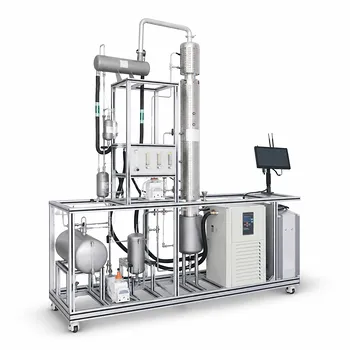
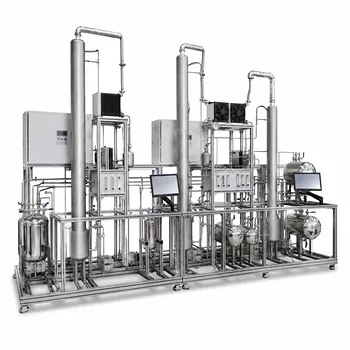
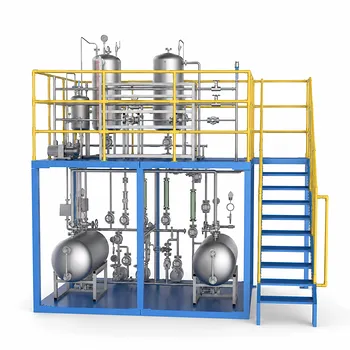
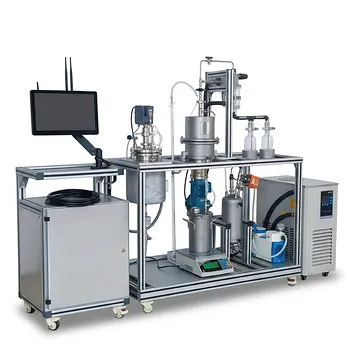
Bridge the gap between complex thermodynamic theory and hands-on unit operations. LABPARK provides premium Educational and Vocational Unit Operations Pilot Plants in chemical engineering, bioprocess & biotech, and environmental & water treatment, tailormade for universities, research institutes, and enterprises.
Our systems empower students to apply models like Wilson, NRTL, and UNIQUAC to real-world separations. Contact LABPARK today to find the perfect pilot plant setup for your curriculum!
Related Products
- Continuous Sieve-Plate Distillation Pilot Plant for Unit Operations Laboratory Education
- Multi-Modal Distillation Unit Operations Training Pilot Plant
- Green Anhydrous Ethanol Purification Extractive Distillation Unit Operations Training Pilot Plant
- Dual-Mode Rectification Pilot Plant for Practical Training Unit Operations
- Ethyl Acetate Synthesis Unit Operations Pilot Plant for Practical Training
People Also Ask
- What are the primary reflux ratio control strategies? Master Distillation Unit Operations
- How can real-time carbon number prediction improve distillation pilot plants? Optimize control.
- Why is vacuum operation capability an essential feature for a distillation unit operations pilot plant? Unlock Efficiency
- How does catalyst water concentration affect distillation pilot plant design? Key separation train choices.
- Why run shortcut fractionation before rigorous distillation calculations? Optimize your pilot plant.